through R68). Adding and subtracting logarithms is equivalent to multiplying and dividing the
original values, so the collector current of IC18-D is proportional to the product of product of the
two multiplication inputs, divided by the division input. IC24-B converts this current to a voltage
across R82 to create the PROD output. The transmission gates route the analogue signals to the
appropriate resistors to produce the mathematical function needed for each mode. A calibration
value is always applied to the third input.
VR23 adjusts the input offset of the voltage channel; VR35 adjusts the output to exactly zero
when either multiplication input is zero. These adjustments are critical for accurate operation of
the unit at low voltages or high resistance respectively.
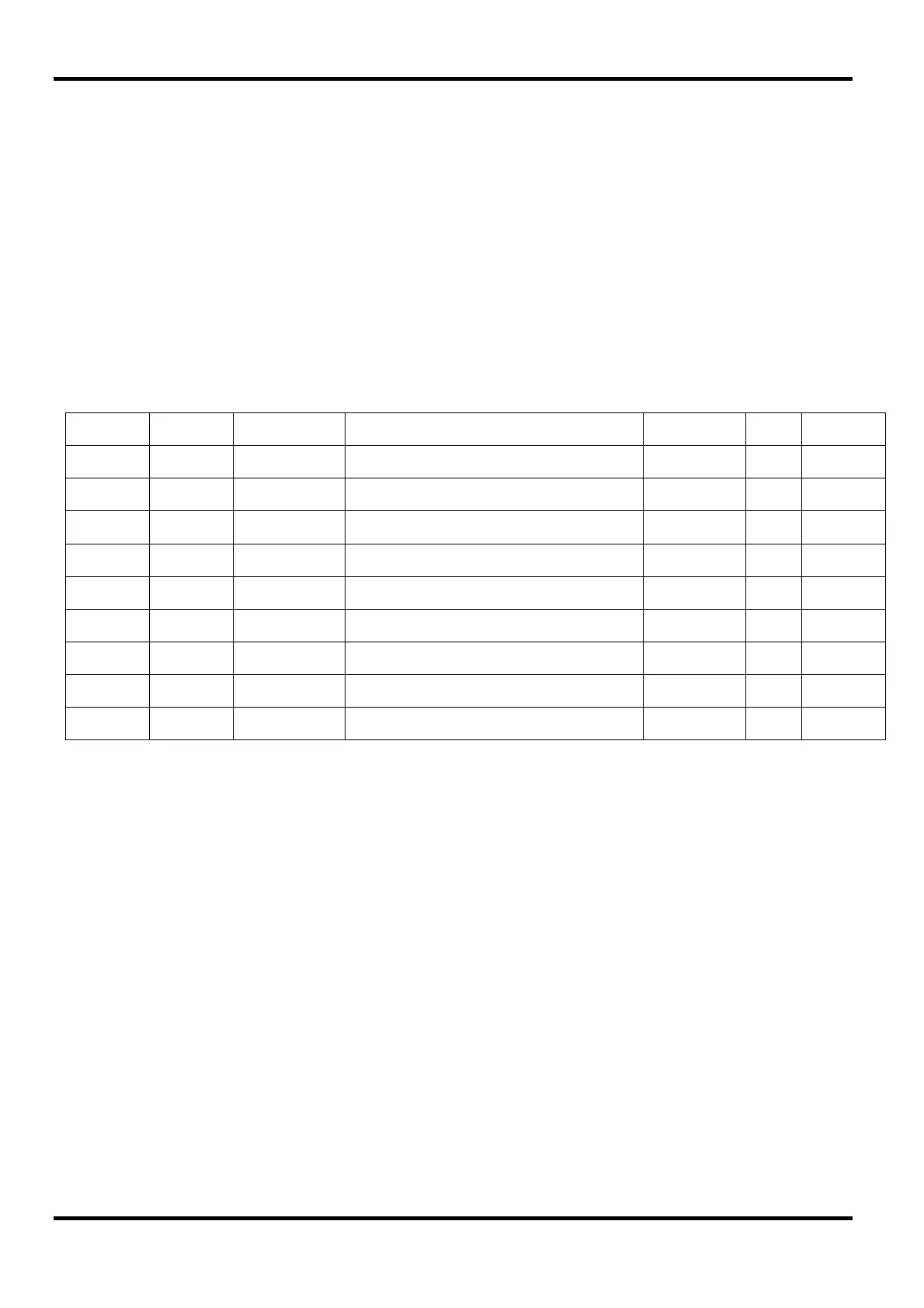
This following table lists the state of the various routing signals which are derived from the
operating mode code (from the control PCB), the function implemented in the multiplier (if it is
used), and the relevant calibration adjustment. Note that LM0 selects the range within each
mode, and determines (together with the two signals AR2 and AR1) the routes through IC42 and
44 to the inputs of the comparison amplifier. AR2 is low in Power and Voltage modes, AR1 is
low in Power and Current modes; the table lists the selected input of IC42 and 44.
Mode LM[3...0] Asserted Function Adjustment AR IC42&44
8 Amps LHH H VR34 HL Y5
80 Amps LHH L VR25 HL Y4
320 Watts HHH L W, GandW PROD = DMD * VR27 VFB VR27 LL Y0
8 Volts HHL H VR32 LH Y3
80 Volts HHL L VR38 LH Y2
10 Ohms HLH H R10, R PROD = VR16 * (VFB+VXO) DMD VR16 HH Y7
400 Ohms HLH L R400, R PROD = VR17 * (VFB+VXO) DMD VR17 HH Y6
1 A/V HLL H G1, GandW PROD = VFB * DMD VR14 VR14 HH Y7
40 A/V HLL L G40, GandW PROD = VFB * DMD VR15 VR15 HH Y6
Comparison Amplifier
IC43 is the point in the system where the main feedback action occurs. Depending on the
selected operating mode, one of its inputs is connected to the required demand signal and its
other input is connected to the corresponding measured feedback signal. Its output passes to the
gate drivers and defines the current that is required to be conducted by the FET power stages.
R124:123 and R137:136 scale its output from about 2·37 volts at 80 Amps to the 200mV required
by the gate drivers (which is determined by the 5mΩ shunts).
Q6 and Q7 are clamps which protect the gate drivers from gross overdrive: Q6 prevents the
output of IC43 going more negative than one diode drop below ground; while Q7 prevents it rising
more positive than about 3 Volts.
IC26-B switches in the bandwidth limiting network C165 & R259 on the slowest slew rate range.
C51 & R164 are a stabilisation network which operates in conjunction with the source impedance
set by the resistors at the inputs to IC42, which depends on the operating mode.
In all modes except voltage mode, IC43 acts as a normal non-inverting feedback amplifier: IC44
passes the required current value from DMD (via current mode calibration adjustments) or PROD
to the positive input, while IC42 routes the current feedback signal IFB to the negative input. By
normal feedback loop action, IC43 produces whatever output is needed into the gate drivers to
cause IFB to match the demanded value. Overall accuracy depends on the current sense
amplifier IC22, not on the local feedback in each FET stage.
18


 To Next Page
 Loading...