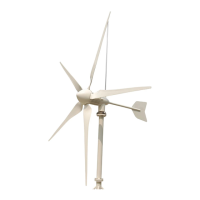
This document serves as a user manual for the Tumo-Int 3000W 5Blades Small Wind Turbine, providing essential information for its assembly, installation, operation, and maintenance.
Function Description
The Tumo-Int 3000W 5Blades Small Wind Turbine is designed to generate electricity from wind energy. It is suitable for both off-grid and grid-tied systems, converting wind power into electrical energy for various applications. The turbine features a three-phase Permanent Magnet Alternator (PMA) generator and utilizes both electromagnetic and aerodynamic braking for strong wind protection. Its primary function is to provide a dependable source of renewable energy.
Important Technical Specifications
The Tumo-Int 3000W 5Blades wind turbine has the following key specifications:
- Model: 3000W 5 Blades
- Rated Power: 3000W
- Max. Power: 3500W
- Rated Voltage Options: 48Vdc, 110Vdc, 220Vdc
- Rated Rotation Speed: 700rpm
- Start-up Wind Speed: 2.0m/s
- Cut-in Wind Speed: 2.5m/s
- Rated Wind Speed: 12m/s
- Survival Wind Speed: 50m/s (calculated as 48.82m/s based on Class III wind turbine standards)
- Rotor Diameter: 3m
- Blades Quantity: 5
- Swept Area: 7.3m²
- Noise Level: <30 dB (5m behind turbine @5m/s gusting)
- Generator Type: Three phase PMA
- Wind Turbine Type: Upwind
- Tower Connection: Flange connection
- Operating Temperature: -40°C to 60°C
- Strong Wind Protection Mode: Electromagnetic brake, blades aerodynamic brake
- Service Life: 15 years
- Net Weight: 70kg
- Gross Weight: 84kg
- Package Size: 153.5×64.5×32.5CM, 60.5×65.5×30CM
The manual also includes a "Wind Turbine Power Curve" chart, illustrating the power output (in watts) across various wind speeds (in m/s), ranging from 2.5 m/s to 18 m/s, with the maximum output around 12-13 m/s.
Usage Features
The manual emphasizes safe and proper usage through detailed instructions for assembly, installation, and operation.
Safety Precautions:
- Do not install on windy days (wind speed > 8m/s) or dusty days.
- Avoid wearing wet gloves or clothes during installation.
- Installation and maintenance must be performed under professional guidance or by contacting distributors.
- Use cables as specified in the manual (Section 4, Wire Size Selection) to prevent leakage, fires, and line losses.
- Non-professionals should not open the controller and inverter enclosures to avoid voiding the warranty.
- Ensure proper grounding device installation according to standards.
- Prevent inflammables near the work environment during battery wiring due to potential sparks.
- Avoid placing the controller, inverter, and battery in damp, rainy, vibrating, corrosive, strong electromagnetic interference, direct sunlight, or near heat sources.
- During installation, especially in less windy locations, the three-phase wires must be short-circuited to prevent the turbine from turning.
- Never check the wind turbine while the blades are spinning or on a windy day.
Installation Process:
The installation involves several steps:
- Mounting Blades on the Hub:
- Check all components.
- Pass hex bolts through the back of the hub.
- Place blades, flat washers, and locknuts, then tighten nuts to 30N.m.
- Connecting Lead Wires to Wind Generator:
- Unscrew the cable cover and pass wires through.
- Connect three-phase lead wires to terminals, ensuring no short circuits.
- Screw up the cable cover and waterproof cover.
- Generator and Tail Vane Assembly:
- Insert the tail vane into the groove at the back of the generator, aligning the flange bore position with the hole at the back of the generator.
- Use bolts and washers, then tighten bolts to 35N.m.
- Install the decoration cover, screws, and locknuts.
- Mounting Turbines on the Pole:
- Snap the cover to the back of the generator and tighten with screws to 5N.m.
- Pass the cable through the pole.
- Connect the turbine to the pole using bolts.
- Place flat washer, spring washer, and nut, then tighten the nut to 60N.m.
- Hub/Blades and Generator Assembly:
- Place the hub with blades onto the rotor shaft.
- Fully tighten the nut to 500N.m and "spin" it completely onto the turbine alternator shaft.
- Place flat washer, spring washer, and nut in sequence.
- Snap the nosecone into position over the blade hub edges and tighten with screws to 7N.m.
- After installation, tug on the nosecone to ensure security and turn blades to check for rubbing against the generator's front cover.
Siting Requirements:
- An ideal location has stable wind speed and direction.
- Higher towers generally lead to greater wind speed and power production.
- Minimum recommended tower height: 20 ft (6 m) on open ground or 20 ft (6 m) above nearby obstructions.
- Locate the turbine in "cleanest" turbulent-free air to maximize efficiency and reduce wear.
- Avoid obstacles within 200m of the installation center.
- Installation distance between two turbines should be 8-10 times the rotor diameter.
- Comply with local regulations for installation sites.
Controller and Inverter Requirements:
- Controller specifications must match the voltage, power, and current of the battery, solar panel array, wind turbine, and load.
- Install the controller and battery in the same distribution box, in a drafty room, out of reach of children.
- Installation must comply with electrical equipment installation specifications and manufacturer's operation specifications.
- Sealed lead-acid batteries are recommended for distribution boxes in inhabited rooms.
Wiring Requirements:
- Hardwired connections between system components must be fixed and reliable; avoid plugs or sockets.
- Connections between the system output terminal and external circuit should be fixed or use a socket.
- Do not use two-way plug adapters for system output terminal connections.
- Cables or wires exposed outdoors should be sheathed with conduit for protection.
- Wire size selection charts are provided for 3000W/48V, 3000W/110V, and 3000W/220V systems, detailing appropriate AWG/Metric wire sizes based on distance from the wind generator to the controller (e.g., 0-10m, 11-20m, etc.) to minimize energy losses.
Troubleshooting:
The manual provides guidance for common issues:
- Wind Turbine Vibration: Check for loose blade mounting bolts, frozen blades, distorted/defective blades, weak tower, or loose guy ropes. Also, check for unbalanced three-phase output voltage.
- Insensitive to Adjust Rotor Direction: May be due to damaged alternator shaft, out-of-plumb tower, mismatched tower flange, loose turbine flange, or natural wind turbulence. If caused by buildings, relocate the turbine.
- Rotation Speed Dramatically Decreases: Normal deceleration is due to over-speed protection (dump load, electromagnetic/aerodynamic braking). Abnormal deceleration can be caused by friction between rotor/stator, damaged bearings, burned generator, deformed blades, or tower shake.
- Generator Abnormal AC Output: Check for long connecting wires, small wire size, unbalanced three-phase output voltage (should not exceed 10%), or short-circuit mode.
- Abnormal Noise: May indicate friction between rotor/stator, damaged bearings, or self-vibration.
- Solar Output Voltage Too Low or No Output (Off-grid system): Check for short circuits, circuit breaks, open circuits in solar panel leads, or damaged/dusty solar panels.
- Abnormal Charging (Off-grid system): Could be due to low wind speed, wind turbine DC output voltage lower than battery voltage, incorrect system wiring, controller issues, mismatched battery/controller type, or battery saturation (leading to braking mode).
- Abnormal Output (Off-grid system): Incorrect controller control mode settings or damaged controller, or battery in over-discharge state.
- No Power Feed into Grid (Grid-tied system): Low wind speed (below cut-in), high wind speed (triggering over-voltage protection), manually switched on short-circuit brake, disconnected/damaged on-grid inverter, controller issues, incorrect wiring, mismatched wind turbine/inverter characteristics, or loose wiring/unstable grid.
- Low Charging Power (Grid-tied system): Low wind turbine output voltage (due to low wind speed or turbine issues) or mismatched wind turbine/inverter characteristics.
Maintenance Features
The Tumo-Int wind turbine is designed for 15 years of operation without maintenance, but periodic inspection enhances reliability and performance.
- Pre-storm Precaution: It is suggested to lower the pole and short-circuit the wind turbine before extremely bad weather (e.g., typhoon) to prevent accidents.
- Regular Maintenance Schedule:
- After Storm: Check blades for chips or nicks, check blade bolts and hub nut for tightness, check nosecone for cracks and proper fit, wash off dirt/debris from blades, check all electrical connections for tightness and corrosion.
- Every Six Months: Check blade bolts and hub nut for tightness, check nosecone for cracks and proper fit, wash off dirt/debris from blades, check all electrical connections for tightness and corrosion.
- Every One Year: Check blades for chips or nicks, check blade bolts and hub nut for tightness, check nosecone for cracks and proper fit, wash off dirt/debris from blades, check all electrical connections for tightness and corrosion.
- Every Two Years: (No specific checks listed beyond the annual ones, implying the same checks as "Every One Year").
- Every Five Years: Replace blades, replace battery.
The manual includes a table summarizing these maintenance items and their recommended frequencies.


 To Next Page
 General