

EasyManua.ls Logo

Tunstall Keypad - User Manual

Tunstall Keypad
2 pages
Print Icon
To Next Page IconTo Next Page
Loading...
Installer’s Keypad Quick Reference Card
Introduction
The keypad is designed to enable a trained installer
to congure a home unit prior to use. It must not be
left connected to an operational unit.
If unused for 5 minutes the keypad will enter a
sleep” condition, and if left connected to a home
unit warning tones will be sounded until it is
disconnected.
Attachment points are provided to enable the
keypad to be carried on a neck cord/belt clip
The slot on the rear of the Keypad can be used to
hold an ID card or this quick reference card.
Compatibility
The keypad can congure the following models:
Vi, Vi+
All keypad functions available
Connect/Connect+ Sub-set of keypad functions
Caresse, 400, 4000 Sub-set of keypad functions
Connection
Connect to keypad Connect to home unit
AUX socket
Note that the keypad has no internal power source
and is only operational when connected to a home
unit running on mains power.
Key Guide & Display Symbols
Key Use
Cursor right, volume up
Cursor left, volume down
Delete/back-space
(press & hold to clear display)
Value entry
Programming/commands
Response Centre functions & dataA
Unit ID functions & data “B
Personal Recipient functions & data C”
Time functions & data “D
Information functions, enquiry & data “E
Trigger/sensor functions & data “F
Battery test and test calls
Programming/command entry
Programming
Refer to home unit documentation for details of
parameters, codes etc. Key entries can be edited
using .
Indexed Parameter Data Entry (all compatible models)
parameter number data (max 16 digits)
eg to set ID to 995
Quickcodes (all models produced after June 2007)
4 digit quickcode
eg to reset to default settings
Enquiry (all compatible models)
parameter number
Displays current value of specied parameter
eg might show *2*995EEEEEEEEEEEEE
Content can be edited using and then re-
programmed by entering at the end of the
sequence.
Note thatE” denotes an “emptydigit. This is shown
when reading a parameter but will be added
automatically when programming new values.
Question and Answer IconNeed help?

Do you have a question about the Tunstall Keypad and is the answer not in the manual?

Summary

Key Guide & Display Symbols

Programming

Indexed Parameter Data Entry

Entry of parameter number and data for compatible models.

Quickcodes

Entry of 4-digit quickcodes for models after June 2007.

Enquiry

Displays current value of specified parameter for compatible models.

Advanced Operations (Vi;Vi+ only)

Unit Configuration Templates

Store up to four customised settings templates for subsequent programming.

Save Template into Keypad Memory

Save current settings to a template in keypad memory.

Write Template to Home Unit

Apply a stored template from keypad to home unit.

List Stored Templates

List home unit software version associated with stored templates.

Delete Template from Keypad

Delete a stored template from the keypad memory.

Battery Test (Vi;Vi+ only)

Resetting Configuration Defaults

Selecting STMF or DTMF

Personal Trigger Test Reminder (Vi;Vi+ only)

Overview

This document describes an Installer's Keypad Quick Reference Card, a tool designed for trained installers to configure Tunstall home units. The keypad is not intended for continuous connection to an operational unit and will sound warning tones if left connected for more than 5 minutes, entering a "sleep" condition after 5 minutes of inactivity. It operates only when connected to a home unit running on mains power, as it lacks an internal power source. The keypad features attachment points for a neck cord or belt clip and a rear slot for holding an ID card or this quick reference card.

Keypad Compatibility:

The keypad can configure various Tunstall models:

  • Vi, Vi+: All keypad functions are available.
  • Connect/Connect+: A subset of keypad functions is available.
  • Caresse, 400, 4000: A subset of keypad functions is available.

Connection:

The keypad connects to the home unit's AUX socket.

Key Guide & Display Symbols:

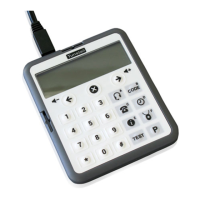
The keypad features several keys with specific functions:

  • Right Arrow: Cursor right, volume up.
  • Left Arrow: Cursor left, volume down.
  • X: Delete/back-space (press & hold to clear display).
  • 0-9: Value entry.
  • *: Programming/commands.
  • #: Response Centre functions & data "A".
  • CODE: Unit ID functions & data "B".
  • Person Icon: Personal Recipient functions & data "C".
  • Clock Icon: Time functions & data "D".
  • Information Icon: Information functions, enquiry & data "E".
  • Trigger Icon: Trigger/sensor functions & data "F".
  • TEST: Battery test and test calls.
  • P: Programming/command entry.

Programming:

Installers should refer to the home unit documentation for detailed information on parameters, codes, etc. Key entries can be edited using the left and right arrow keys and the 'X' key.

Indexed Parameter Data Entry (All Compatible Models):

To set a parameter, use the sequence: * parameter number * data (max 16 digits) *. For example, to set an ID to 995, enter * 2 * 995 *.

Quickcodes (All Models Produced After June 2007):

Quickcodes are 4-digit sequences followed by 'P'. For example, to reset to default settings, enter 2050P.

Enquiry (All Compatible Models):

To display the current value of a specified parameter, use the sequence: * parameter number Information Icon. For example, * 2 Information Icon might show *2*995EEEEEEEEEEEEE. The 'E' denotes an "empty" digit, which is shown when reading a parameter but is automatically added when programming new values. Content can be edited using the left and right arrow keys and the 'X' key, and then re-programmed by entering 'P' at the end of the sequence.

Advanced Operations (Vi/Vi+ Only):

Unit Configuration Templates:

The keypad can store up to four configuration "templates" of customised settings for subsequent programming to other home units. This feature requires careful use, as specific settings like unit ID, radio trigger assignments, personal recipient, and auto-answer numbers must be individually configured after applying a template. Only settings configurable by service providers and changed from their default values are stored/overwritten; radio peripheral and unit identities remain unaffected. A stored template should only be applied to home units of the same model and release level as the unit from which it was read; otherwise, a warning will be given, and the process halted.

  • Save Template into Keypad Memory from Home Unit: Press CODE followed by the destination template number (1-4) held for 3 seconds, then P.
  • Write Template from Keypad to Home Unit: Press CODE followed by the source template number (1-4) held for 3 seconds, then P.
  • List Stored Templates: Pressing CODE Information Icon lists the home unit software version associated with each stored template.
  • Delete Template from Keypad: Press CODE followed by the source template number (1-4) held for 3 seconds, then X.

Frequently Used Codes:

Refer to home unit programming documentation for full details.

ID (Vi/Vi+ Only):

  • To Add: P CODE 1-4 CODE Unit ID (max 12 digits) P.
  • Delete Specific: P CODE 1-4 CODE P.
  • Delete All: P CODE P.

Monitoring Centre Numbers (Vi/Vi+ Only):

  • To Add: P \# 1-4 \# Tel. No. (max 16 digits) P. (The * within the number represents a dialling pause).
  • To Make Test Call: P \# 1-4 TEST P.

Time/Date (Vi/Vi+ Only):

  • Set Time: P Clock Icon HHMM (24hr format) P.
  • Set Date: P Clock Icon 0 DDMMYYYY P.
  • Speak Time/Date: 3020P (Vi+ only).

Volume Setting (Vi/Vi+ Only):

Clear the display using the X key. Press the left or right arrow key to select the desired volume. Press P within 10 seconds to store the new level.

Battery Test (Vi/Vi+ Only):

Clear the display using the X key. Press the TEST key.

  • Good Battery: Three ascending tones.
  • Bad Battery: Single low-pitched tone.

Resetting Configuration Defaults:

  • All Except Radio Triggers, Time/Date: 2040P.
  • All Except Time/Date: 2050P.

Selecting STMF or DTMF:

  • Auto-select STMF/DTMF: 9000P (default).
  • Only Use DTMF: 9001P.
  • Only Use STMF: 9002P.
  • Note: Before using STMF, the PNC monitoring centre and back-up centre must be configured to receive STMF.

Personal Trigger Test Reminder (Vi/Vi+ Only):

  • Demo Test Reminder Messages: 3300P.

Part Number: D5107226B

For a larger version of this document, visit www.tunstall.com. Designed and Manufactured in the United Kingdom by Tunstall Healthcare (UK) Ltd, Whitley Bridge, Yorkshire.
Tunstall Keypad Specifications

General IconGeneral
BrandTunstall
ModelKeypad
CategoryKeypad
LanguageEnglish