Need help?
Do you have a question about the Tunze Osmolator nano 3152 and is the answer not in the manual?
Overview of the Osmolator® nano, its function, and suitability for small aquariums.
Guidelines for safe use by individuals with limited abilities, emphasizing supervision.
Ensure device is used indoors and away from heat sources; maintain dry, ventilated conditions.
Avoid bending cables and placing magnets near the sensor to prevent malfunction.
Do not run pump dry; disconnect power for maintenance; repair damaged cables via service center.
Avoid external connections and switch off during water changes; store manual safely.
Handle strong magnets with care, keep away from children, avoid pinching fingers between parts.
Keep sensitive items and metal away from magnets; avoid exceeding 50°C to preserve magnetic strength.
Power supplies are not for outdoor use; place them away from the aquarium to prevent water damage.
Operate only with RCD (max 30mA); do not repair cables; no connection to third-party devices.
Position in dry, ventilated areas, away from heat sources; observe operating temperature and humidity limits.
Mount the sensor into its housing and then into the magnet holder, ensuring a secure fit.
Attach self-adhesive elastic buffers to the magnet holder halves, using 4 per part.
Mount sensor on aquarium rim (up to 10mm glass), ensuring glass is clean and dry.
Install in the last filter chamber with return pump in cabinet filter systems; avoid water inlet/outlet areas.
For seawater, route Kalkwasser intake directly into the aquarium, not the filter box.
Secure the feed hose to the mounting clamp using hose clamp, screw, and nut; ensure a tight fit.
Attach hose above water level to prevent backflow; direct filter tank entry is allowed if storage level is lower.
Connect the dosing pump and controller cables to the terminal; wire polarity does not matter.
Insert hose into pump, place pump vertically in tank, and route hose without kinks for good flow.
Connect power supply to controller, check functionality; do not replace pump with a switched socket outlet.
Mount sensor with black ring down and cord up; clean every 6 months for heavily stocked tanks.
Use vinegar for cleaning; check function by lifting float, pump should cycle and then stop.
The device stops the pump after 2 minutes of continuous operation to prevent aquarium overflow.
Reset by power cycle; pulses indicate empty reservoir and need for refill.
Details refilled volumes based on conveying height (0.80m to 1.30m).
Values are for original 2m hose; shorter hoses yield higher metering amounts.
Storage tank water level must be below aquarium/filter tank level to prevent siphoning.
Aquarium must have enough capacity for refilled water; examples show water level increase based on surface area.
The sensor's switching variance (up to 1mm) can affect the water level increase.
For larger aquariums (>200L), the maximum dosing time may be insufficient for safe refilling.
Detach the sensor housing from the magnet by pulling firmly.
Unscrew sensor nut, slide sensor out, unplug connector from controller, and replace with new sensor.
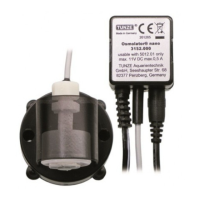
Visual representation of all supplied components and accessories.
Detailed list of all parts with corresponding part numbers and names in multiple languages.
Limited 24-month warranty covers material and manufacturing defects from purchase date.
Excludes consequential damage; ship defective units with sales slip in original packaging.
Do not dispose of in household waste; follow local community guidelines for proper disposal.
 General
| Brand | Tunze |
|---|---|
| Model | Osmolator nano 3152 |
| Category | Pet Care Product |
| Language | English |

 To Next Page