4.2 Installation requirements
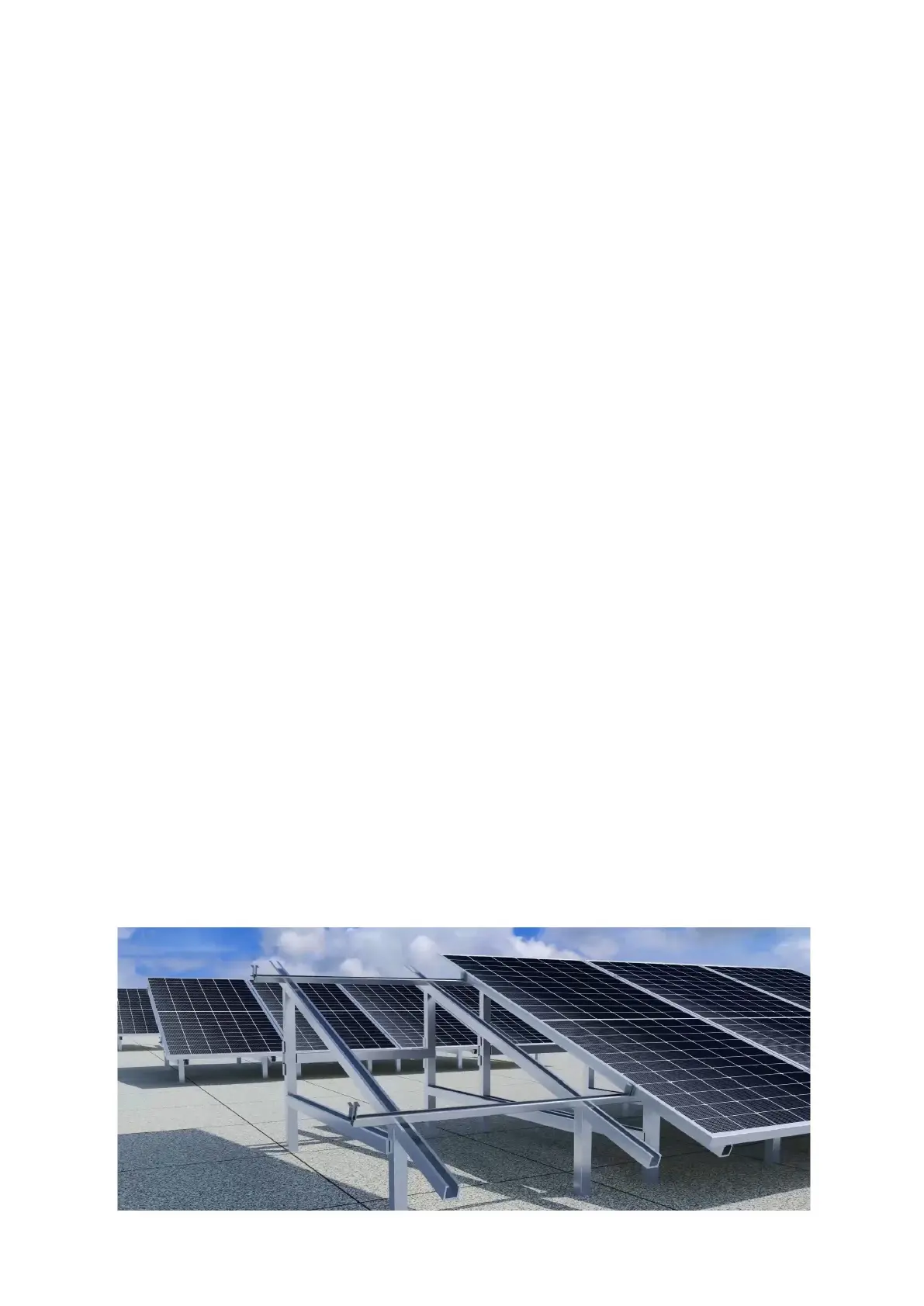
● Ensure the module installation method and support system sufficiently robust, so that the
Modules can undertake the preset loading conditions, the support installer or supplier shall
provide necessary guarantee and other related certifications. The installation support
system shall pass the inspection and test by the third-party test institution with the static
mechanic analysis capability, and use the local national or international standards, such as
DIN1055 or equivalent.
● The support structure shall be made of the durable, corrosion resistant and ultraviolet
resistant materials.
● The module shall be firmly mounted on the support.
● Choose proper installation height of the photovoltaic support system, and ensure the lowest
part of the module is high enough, to avoid being shaded by plant or being damaged by the
flying sand. Or being covered by snow for a long time in winter.
● When the module is installed on the roof or the building, it is necessary to ensure that the
roof structure is fixed firmly and will not be damaged by heavy wind or heavy snow, and
the back of the module shall be well-ventilated to facilitate the cooling of the module.
● Due to the thermal expansion of physical properties of materials, the Modules are
asymmetric structure, which will produce a certain degree of warping deformation at
different temperatures, which does not affect the installation, use and reliability of the
Modules. The minimum distance between two Modules should not be less than 10 mm.
● Ensure that the module backside will not contact the support or architectural structure even
if there is the module surface is under the external pressure.
● It is required to observe the instruction guide and safety rules attached on the support.
● It is not allowed to drill the hole in the glass surface or frame of the module. Otherwise ,the
guarantee will be invalidated.
● When to install the Modules on the roof, it is necessary to guarantee the roof structure is
suitable for the module installation. And the installed modules should not be beyond the
roof zone. Additionally, the roof area where it is penetrated by module installation shall be
properly sealed to prevent the roof from water leakage.
● When the module is installed on the supporting column, it is necessary to ensure the
supporting column and module installation structure is capable of withstanding the
expected local wind.


 To Next Page
 Loading...