Need help?
Do you have a question about the U-Turn BACKUP X100 and is the answer not in the manual?
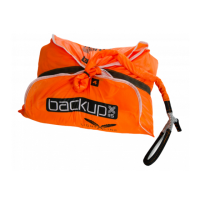
The U-Turn BACKUP X100 is a manually released rescue parachute designed for paragliding pilots, offering a safe landing in emergency situations. This rescue system is part of the BACKUP series, representing an innovative line of next-generation reserve parachutes from U-Turn. It incorporates the latest development findings and provides all the constructional advantages of a square reserve parachute, notably with a sensational lightweight design.
The primary function of the BACKUP X100 is to enable a safe and controlled descent in the event of an emergency during paragliding. It is engineered to open reliably fast and achieve a low sink rate, minimizing the risk of injury upon landing. The cross canopy design, combined with optimized air outlets and a deeply downwards pulled construction, contributes to a flight behavior that is almost completely free of pendulum movements, enhancing stability during deployment and descent. The Rapid Inflation System (RIS) is a key feature that optimizes opening time by efficiently managing air inlets and pre-tensioning at the base edge.
The BACKUP X100 is available in different sizes, with the X100 model having a weight of 0.98 kg and a surface area of 28.5 m². It supports a maximum payload of 100 kg. The packing volume for the X100 is 2380 cm³, and it features 12 panels with a total length of 5.8 meters. The X115 model, for comparison, weighs 1.2 kg, has a surface area of 36.2 m², a maximum payload of 115 kg, a packing volume of 3850 cm³, 20 panels, and a total length of 6.2 meters. Both models are LTF (Lufttüchtigkeitsforderungen) and EN/LTF certified, with certification numbers EP 187.2017 for the X100 and EP 153.2016 for the X115. The minimal sink rate is stated as 6 m/s. The maximum permitted speed at which it may be released is 100 km/h (32 m/s). The operational time limit for the BACKUP X100 is 10 years, provided check-over intervals are complied with and packing is recorded.
The BACKUP X100 is designed for ease of use and reliability. Its lightweight material (Paratex SX 20 canopy material with high resistance and low elongation, and an antistatic coating to prevent layers from sticking) makes it an ideal choice for alpine pilots and those using convertible and lightweight harnesses. The rescue system is equipped with the "Easy Connect" system, an innovation that simplifies mounting of the reserve. This integrated soft-link allows the main bridle to be connected to any junction neatly and easily. Color-coded packing loops and numbered widths aid in simplified packing. The container itself is a four-leaf design in a signal color, optimized for opening.
Pre-flight Check: Before every flight, pilots must ensure the rescue release handle is correctly mounted on the harness and the rescue container is properly closed and secured. Release in Emergency: To deploy, the pilot grasps the release handle with one hand, pulls it, and allows the BACKUP to fall into free space diagonally behind them with a sideways movement. It is crucial to let go of the handle for the system to open. A regularly packed parachute will open immediately once the lines are stretched. Opening and Landing: After deployment, the paraglider will become unable to fly, stopping any rotations. The BACKUP will open and rise above the pilot, while the paraglider dives down. The pilot should immediately deform or pull in the paraglider (e.g., via B-stall or winding a riser) to prevent it from dangerously influencing the rescue system. The high swing resistance of the BACKUP is active only under full load. During landing, the pilot should stand up in the harness, bend knees slightly, and keep legs hip-width apart. Upon ground contact, rolling to soften the landing is recommended. The paraglider should remain deformed until landing to avoid being pulled in one direction. After Landing: After landing, the rescue parachute should be deformed in a controlled manner by pulling the middle of the canopy inward at the middle line to prevent strong winds from blowing it up and dragging the pilot. A complete check-over and re-packing are mandatory after every landing, and any possible damage to the rescue system requires a thorough inspection before re-packing.
The rescue system can be built into a harness using its original container, into a harness with an integrated rescue container, or into an external rescue container. U-Turn recommends having the rescue system built in by authorized packers only. A compatibility verification is mandatory to ensure correct installation and must be recorded in the service record. The connection between the release handle and the inner container must never be under tension after installation, as this could impair or inhibit opening.
Packing should be done on a clean, anti-static surface, preferably a packing table. The parachute must be stretched to its overall length. Lines are pulled through color-coded packing loops and mounted at the top of the table, ensuring no loops are forgotten. The main suspension is fixed at the bottom, and the parachute is tightened. Lines are checked for straight and parallel course, and any tangles are removed. The canopy is laid out with four corners, with the first facing downwards, one left, one right, and the last on top. Panels are then laid to the right, preferably without wrinkles, with corner panels pulled out as depicted. The canopy is adjusted to the container width using s-flaps. Lines are placed in 3-4 bundles, fixed with packing rubber bands, and placed on the canopy. The container is then closed by pulling the line loop through the elastic band. The opening is checked through self-weight, and any packing cord is removed. The packing must be recorded in the service record.
Maintenance and Care: Canopies and containers should be cleaned with clear tap water and a soft sponge or cloth. Harsh chemicals, brushes, hard sponges, or similar cleaners should not be used. Mechanical rubbing should be avoided. Frequent washing/cleaning accelerates the aging process. The system should be stored in a dry, cool place, away from paints, solvents, acid, or other harmful substances. It should be stored loosely rolled in an air-permeable bag. Packing Intervals: The BACKUP needs to be opened, aired out, and newly packed every 12 months. This must be recorded in the service record. A periodic check-over of the rescue system is required every 24 months, also recorded in the service record. Extreme environmental influences (moisture, sand, water, salt) can shorten the packing interval. Check-over and packing must only be handled by the manufacturer or authorized competence centers. Failure to maintain check intervals invalidates certification. Trial Release: A trial release must be performed after every re-packing, with the opening force between 4 and 8 daN. Damage and Repairs: In case of damage or if the parachute has been opened for a rescue, a complete check-over is required. Repairs should only be carried out by the manufacturer or an authorized competence center. Smaller damages that could eventually influence airworthiness should also be sent for checking. Disposal: After the designated life of the rescue system (10 years), it should be disposed of environmentally appropriately. U-Turn GmbH offers a return work-out program. The rescue system will be disassembled and disposed of appropriately. It is recommended to replace the system after 10 years from the purchase date, even if it hasn't been activated.
 General
| Brand | U-Turn |
|---|---|
| Model | BACKUP X100 |
| Category | Safety Equipment |
| Language | English |


 To Next Page