The Udo Roesner Da Capo 75 is a two-channel combo amplifier designed for acoustic instruments and vocals, prioritizing natural sound reproduction. It aims to deliver an open, real, and undistorted sound, making it suitable for music lovers, private users, and professionals who value authentic tone.
Function Description:
The Da Capo 75 features two independent channels, each with a combi-socket input (TRS 6.3mm jack or XLR-connector) for instruments or microphones. Channel 1 includes an additional "tone" switch that brightens the sound by reducing mids and emphasizing higher frequencies, beneficial for certain instruments or playing styles. Channel 2 is equipped with a high-pass filter (HPF) or bass-cut filter, adjustable from 40 Hz to 350 Hz, to attenuate lower frequencies.
Both channels offer active, high-quality three-band tone controls (bass, middle, treble) designed as shelving filters, allowing for intuitive and musical operation. The "pan" control distributes the signal between channels 1 and 2 for both internal and external effects.
The amplifier incorporates six digital effect presets (reverb short, reverb long, chorus, custom delay/reverb, "my delay" (Udo Roesner's delay preset), and "tap n' delay"). An external effect loop (send/return) allows for the integration of additional effect devices. The "efx pan" control blends internal and external effects between channels, while the "efx level" controls the output level of the internal effect.
For monitoring, the device includes a stereo headphone output that mutes the internal speaker when connected. Two line outputs (Line 1 and Line 2) are provided: Line 2 delivers a standard line level for mixing consoles, while Line 1 offers a lower output suitable for direct connection to soundcards. Two electronically balanced XLR direct outputs (DI ch 1 and DI ch 2) make individual channel preamp signals available, ensuring interference-free signal processing. These DI outs are dry, without effects.
An auxiliary input (3.5mm TRS stereo jack) allows for connecting playback devices, with its left and right channels mixed and forwarded directly to the power amp.
The Da Capo 75 supports a standard, latching double-footswitch (2 x on-/off) for controlling internal effects (on/off) and the "tap n' delay" time. Phantom power (48V) is provided for condenser microphones connected to the XLR sockets, which can be deactivated internally if needed.
Important Technical Specifications:
- Power Amp: 75 W / 4 ohm, DMOS, monolithic I.C. dynamic range, A-weighted: 92 dB.
- Analog Signal Processing: Dedicated equalizer, subsonic filter, adaptive peak limiter.
- Limiter Threshold: 60 W.
- Speaker System: 8” (200 mm) twin cone full-range speaker, bass reflex enclosure.
- Mains Power: 100, 120, 230, or 240 V AC, 50–60 Hz (depending on model).
- Power Consumption: Max. 200 W.
- Mains Fuse: 5 x 20 mm T 1A L /250 V for 230 and 240 V; 5 x 20 mm T 2A L /250 V for 100 and 120 V.
- Cabinet: 12 mm (0.47") plywood.
- Finish: Polyester black spatter finish.
- Dimensions: 265 mm (10.43“) height, 325 mm (12.8") width, 245 mm (9.65") depth.
- Weight (net): 7.5 kg (16.5 lbs).
- Channel 1 and 2 (Combi-socket): Min. dynamic headroom: 8 dB.
- Line Mode: High impedance jack input for instruments (pick-ups directly), unbalanced and line-level sources.
- Impedance: 2.2 Meg.
- Sensitivity: 22 mV (–33 dBV) (high/low attenuator: –10 dB via jumper).
- Equivalent Input Noise (A-weighted): 1 uV (–120 dBV).
- Mic Mode: XLR-, balanced and stereo jack socket, unbalanced.
- Impedance (XLR, balanced): 1.2 kOhm.
- Impedance (jack, unbalanced): 2.7 kOhm.
- Sensitivity: 3.3 mV (–50 dBV).
- Voice Filter: -10 dB at 270 Hz (referred to 10 kHz).
- Equivalent Input Noise (A-weighted): 0.8 uV (–122 dBV).
- Phantom Power (XLR only): 48 V, max. 10 mA, short-circuit protected.
- Return: Unbalanced jack input, 1¼” (6.35 mm), pre-master.
- Sensitivity: 320 mV (-10 dBV).
- Impedance: 19.7 kOhm (changes to 4.7 kOhm when external effect is switched OFF).
- Aux In: TRS stereo input, 3.5mm.
Output Specifications:
- Phones: Headphones, jack socket, stereo, L/R connected, 1/4" (6.35 mm).
- Input Impedance: 470 Ohm (common for L and R).
- Send: Jack socket, unbalanced, ¼” (6.35 mm), pre master.
- Output Voltage: 1.4 V (+3dBV).
- Line Out 1 and 2: Jack socket, unbalanced, preamp out, 14” (6.35 mm), post effect, post EQ and master.
- Output Voltage 2: 1.74 V (+3 dBV).
- Output Voltage 1: 0.33 V (-4.6 dBV).
- DI-Out 1 and 2: Balanced XLR socket, pre/post EQ (switchable by jumper), post effect and master.
- 1 = ground, 2 = positive, 3 = negative.
- Differential Output Voltage: 140 mV (–17 dBV).
EQ - Tone Controls:
- Channel 1:
- Tone: -3 dB at 700 Hz, +7 dB at 8 kHz.
- Bass: 8 dB at 100 Hz (shelf type).
- Middle: 6 dB at 800 Hz.
- Treble: 8 dB at 10 kHz (shelf type).
- Channel 2:
- HPF Filter: 40Hz to 350 Hz.
- Bass: 8 dB at 100 Hz (shelf type).
- Middle: 6 dB at 800 Hz.
- Treble: 8 dB at 10 kHz (shelf type).
Usage Features:
- Gain Structure and Level Adjustment: Users are advised to carefully set signal levels to ensure optimal performance and avoid distortion. The master level control should be at zero (left stop) when setting the sound level (gain). The clip indicator flashes momentarily with strong attacks, and temporary clipping is not recommended but indicates saturation. Reducing gain slightly thereafter provides additional dynamic headroom.
- Tone Control: The tone controls are designed for intuitive musical operation. Setting them to the mid position (no function) provides a pleasant, warm, and realistic sound.
- Footswitch Functionality: A standard latching double-footswitch can control the internal effect on/off (switch 1) and the delay-time of "tap n' delay" (switch 2, factory setting). Switch 2 can be reconfigured via an internal jumper to on/off the external effect.
- Headphone Use: Only stereo jack plugs (TRS) should be used for headphones. Plugging in headphones mutes the internal speaker.
- Mains Voltage Module: The mains power cable connector, fuse holder with a spare fuse, and an illuminated mains switch are integrated into one module for convenience.
Maintenance Features:
- Safety Instructions: The manual emphasizes reading and understanding safety notes, including warnings about electric shock, high sound pressure levels, and hot surfaces.
- Cable Management: Proper cabling from reputable manufacturers is recommended to improve sound quality and simplify troubleshooting.
- Fuse Replacement: Only correct fuses with the same current rating and trigger characteristics should be used as replacements. The mains plug must be pulled before replacing a fuse. If a fuse blows again shortly after replacement, the device needs to be checked by qualified staff.
- Cleaning: Always pull the mains plug before cleaning. Use only a dry cloth and avoid detergents or liquids seeping into the unit.
- No User-Serviceable Components: The unit should not be opened by unauthorized personnel to avoid electric shock and voiding the 2-year warranty. All maintenance, adjustment, and repair work must be carried out by qualified staff.
- Jumper Settings: Internal jumper settings (e.g., for attenuation, voice filter, phantom power, DI out pre/post EQ, footswitch functionality) can only be changed by qualified service personnel when the unit is disconnected from the mains power supply.
- EMV Regulations: Cables with shielding and correctly fitted connectors must be used for all signal connections to comply with EMV regulations.
- Disposal: The product is marked with a crossed garbage can, indicating it should not be disposed of with household waste.

 Need help?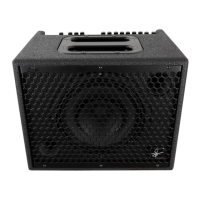

 To Next Page
 General