
 Need help?
Do you have a question about the UMAGE EOS and is the answer not in the manual?
Guide on allowing Eos lamp feathers to regain their original shape, potentially taking up to two weeks.
Details of items included in the Eos lamp box and access to assembly video resources.
Step-by-step instructions for attaching the cord set, expanding the Eos, and inserting the frame.
How to clean the Eos lamp using a hairdryer and damp cloth, and essential fire safety precautions.
Critical safety instructions and notes for the Tripod floor stand, including product specifications.
Comprehensive safety guidelines for assembling, operating, and maintaining the Tripod floor stand.
Key dimensions, electrical parameters, and crucial warnings for the Tripod floor stand, including cable damage.
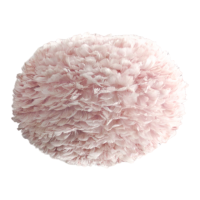
The Eos lamp is a unique and elegant lighting solution designed to bring a soft, natural aesthetic to any indoor space. Its primary function is to provide ambient light, creating a warm and inviting atmosphere. The lamp's distinctive design, resembling a cloud or a fluffy sphere, is achieved through the use of genuine feathers, which are the core element of its visual appeal and light diffusion properties.
The Eos lamp is designed for straightforward assembly and integration into various interior settings. It can be used as a pendant lamp, a floor lamp, or a table lamp, depending on the chosen frame or stand (sold separately).
For use as a pendant lamp, the assembly process involves attaching a cord set and a light bulb to a specific frame. The frame is designed to hold the light source securely within the feather shade. The lamp shade itself, when initially unboxed, may appear compressed. A key usage feature is the need to gently expand the Eos lamp by pulling from its top and bottom holes, allowing the feathers to naturally unfurl and take on their intended voluminous shape. This expansion process is crucial for achieving the lamp's full aesthetic potential and optimal light diffusion. Once expanded, the frame is inserted into the Eos lamp, with hooks on the frame attaching to rings within the feather shade, ensuring the structure is stable and the light source is properly centered.
For larger versions of the Eos lamp, specifically the Eos XX-Large, a different frame assembly is required. This frame, also designed to hold the light source, is integrated into the expanded feather shade in a slightly different manner, accommodating the larger size and ensuring structural integrity. The general principle of expanding the feathers and securing the light source remains consistent across all sizes.
The lamp is designed to be used with an LED bulb, with a maximum wattage of 15W for the pendant setup, ensuring energy efficiency and preventing excessive heat buildup that could potentially damage the feathers.
When used with a tripod floor stand (sold separately), the Eos lamp transforms into a versatile floor lighting fixture. The tripod floor stand itself is designed for easy assembly, typically involving screwing together tubes to form the legs and then attaching the socket for the light bulb. The lampshade (Eos) is then assembled onto the socket, secured by a ring. This modularity allows users to adapt the Eos lamp to different lighting needs and room configurations.
A critical aspect of using the Eos lamp, especially after unpacking, is allowing the feathers time to readjust to their original shape. This process can take up to two weeks. Users can gently assist this by carefully running their fingers through the feathers, helping them to fluff up and achieve their full, soft appearance. This gentle handling ensures the longevity and aesthetic quality of the lamp.
Maintaining the Eos lamp primarily involves keeping its feather shade clean and ensuring the electrical components are in good working order.
For routine cleaning of the feather shade, a hair dryer is recommended. By setting the hair dryer to its coolest setting and holding it approximately 25 cm (10 inches) away from the lamp, users can gently blow away loose dust from the feathers. This method is effective for light dust accumulation and helps maintain the lamp's pristine appearance without damaging the delicate feathers.
For more stubborn dust or dirt that cannot be removed with a hair dryer, a damp cloth can be used. This method should be applied carefully and sparingly to avoid saturating the feathers. The goal is to gently wipe away the dirt without causing the feathers to clump or lose their natural texture.
A crucial safety and maintenance instruction is to always keep the lamp away from fire. Given that the lamp is made of feathers, it is inherently flammable, and adherence to this warning is paramount for safety.
Regarding the electrical components, particularly when used with a tripod floor stand, several maintenance and safety procedures are outlined. Before cleaning the stand, changing the light bulb, or performing any repairs, the power supply must always be disconnected. This prevents electrical shock and ensures user safety. The light bulb should be allowed to cool sufficiently before being changed to prevent burns.
If the external flexible cable or cord of the luminaire becomes damaged, it must be exclusively replaced by the manufacturer or a similarly qualified person. This is a critical safety measure to prevent potential hazards and ensure the lamp's continued safe operation. Users are explicitly warned against attempting to repair the tripod or any electrical components themselves if they are broken or not functioning as expected; such tasks are strictly for qualified electricians.
The Eos lamp, when paired with the tripod floor stand, has specific requirements for light bulbs: an E26 light bulb with a maximum wattage of 60W. Users are advised not to insert their fingers into the socket. The stand should always be placed on a level surface, not exceeding an 8° angle, to ensure stability. It is designed for indoor use only.
In case of any malfunction with the tripod floor stand, users should contact the UMAGE Service Center or a qualified electrician. This ensures that any issues are addressed safely and correctly, preventing accidents or mishandling. The instruction sheet also covers a variety of stands, emphasizing that while colors may differ, the assembly and safety applications remain the same. Users are advised not to plug in the stand to a power source until all stand and lamp assembly and bulb installation are complete.
Finally, the Eos lamp and its associated stands are not children's toys and should not be used in any manner other than described. The minimum open area diameter (top & bottom) for the lampshade should not be less than 100mm (4 inches), lamp-to-shade spacing must be over 63.5mm (3-1/4 inches), and lamp centerline length must be over 82.5mm (2-1/2 inches). The weight of the lampshade should not exceed 1.1 KGS (2-1/2LBS) to ensure stability and safety when mounted on a stand. These detailed instructions ensure both the aesthetic longevity and safe operation of the Eos lamp system.
 General
| Color | White |
|---|---|
| Max wattage | 15W LED |
| Category | Pendant Lamp |
| Voltage | 220-240V |
| IP Rating | IP20 |
| Light source | E27/E26 |
| Cord Length | 300 cm |
| Dimmable | Yes |
| Design | Søren Ravn Christensen |

 To Next Page