
 Need help?
Do you have a question about the Unifire Saw and is the answer not in the manual?
General safety precautions and warnings for saw operation, including modifications and chemical exposure.
Detailed steps for starting the saw engine when cold, including chain brake, ignition, choke, and decompression valve.
Procedure for starting the saw engine when warm, similar to cold start but without choke.
Instructions for gripping and pulling the starter cord, including choke release and throttle latch.
Method for stopping the saw engine by switching off the ignition.
Specifications for unleaded gasoline, including octane rating and quality recommendations.
Guidelines for using two-stroke oil, recommended types, and mixing ratios for the saw.
Requirements for chain lubrication oil, viscosity, and temperature considerations.
Instructions for cleaning around the fuel cap, filling fuel and oil tanks, and fuel filter maintenance.
Step-by-step guide for assembling the guide bar and chain, including tensioning.
Instructions for assembling the starter device, ensuring pulley engagement with pawls.
Procedure for adjusting the oil pump flow using a screwdriver or spanner.
Instructions for cleaning and maintaining the air filter to prevent carburetor malfunctions and power loss.
Guidance on checking and cleaning the spark plug, including electrode gap adjustment.
Steps for replacing a broken starter cord, including pulley zero-setting and knot tying.
Procedure for tensioning the recoil spring after starter cord replacement.
Instructions for disassembling and reassembling the recoil spring assembly.
Explanation of carburetor function, air/fuel mixture, and adaptation to local conditions.
Steps for finely adjusting the carburetor jets and idling screw after engine break-in.
Procedure for adjusting the low speed needle for optimal acceleration and idling.
Method for adjusting the idling speed using the T screw for smooth engine operation.
Guidance on adjusting the high speed needle for power and to prevent engine damage.
Criteria for a correctly adjusted carburetor, including acceleration and chain rotation at idle.
Verify smooth throttle operation and lockout function.
Check chain brake function and chain catcher for damage.
Clean or replace air filter as needed, checking for damage.
Turn bar for even wear, check lubrication hole, and clean bar groove.
Ensure the oiler is functioning correctly to lubricate the bar and chain.
Sharpen chain, check tension, condition, and drive sprocket wear.
Inspect starter cord for wear and clean intake slots on starter housing.
Check for and retighten any loose nuts and screws.
Inspect anti-vibration elements for softness or tears.
Lubricate the bearing in the clutch drum.
File off any burrs on the side of the bar.
Clean the spark plug and verify the electrode gap.
Check the starter and recoil spring, clean flywheel fins.
Clean the cooling fins on the engine cylinder.
Clean or replace the screen in the muffler.
Clean the exterior of the carburetor and the air box.
Inspect the brake band on the chain brake for wear.
Check the clutch center, clutch drum, and clutch spring for wear.
Clean the outside of the carburetor.
Replace the fuel filter.
Clean the inside of the fuel tank.
Clean the inside of the oil tank.
Inspect all cables and electrical connections.
Replace the spark plug.
Replace the air filter.
List of tools and materials needed for depth gauge installation.
Instruction to remove the saw bar and clean it before installation.
Procedure for marking and drilling holes on the bar using a template.
Reinstall the bar and chain, adjusting chain tension properly.
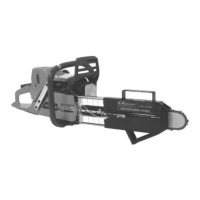
Slide the depth gauge over the bar and chain, aligning studs with holes.
Apply Loctite 272 to depth gauge studs for secure fastening.
Install stud nuts and tighten them, avoiding over-tightening.
Explanation of how the spring-loaded depth gauge functions during cuts.
Procedure for using the depth gauge for standard cuts, setting depth and angle.
Specific instructions for using the depth gauge on corrugated roofs, maintaining angle.
Identifies the cylinder cover component of the saw.
Identifies the front handle component of the saw.
Identifies the starter cover component of the saw.
Identifies the chain oil tank component of the saw.
Identifies the starter handle component of the saw.
Identifies the adjuster screw for the carburetor.
Identifies the choke control and start throttle lock.
Identifies the rear handle component of the saw.
Identifies the stop switch and ignition control.
Identifies the fuel tank component of the saw.
Identifies the muffler component of the saw.
Identifies the sprocket located at the tip of the saw bar.
Identifies the saw chain component.
Identifies the saw bar component.
Identifies the bumper component of the saw.
Identifies the chain catcher, which stops chain jumps or breaks.
Identifies the clutch cover component of the saw.
Identifies the right hand guard component of the saw.
Identifies the throttle control mechanism.
Identifies the throttle lock mechanism.
Identifies the decompression valve for easier starting.
Identifies the combination spanner tool.
Identifies the screw used for adjusting chain tension.
Refers to the operator's manual for further information.
Identifies the protective bar guard.
Identifies the switch for heated handles.

 To Next Page
 General