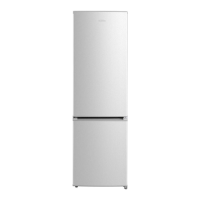
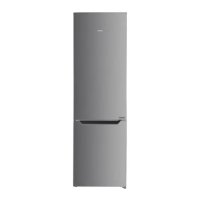
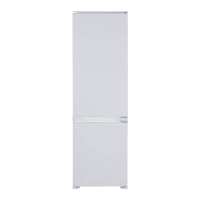
This document describes the VALBERG CNF 270 F W625C CE-BCD276WE-ST refrigerator-freezer, a household appliance designed for the storage of fresh food and short-term storage of frozen products.
Function Description
The VALBERG CNF 270 F W625C CE-BCD276WE-ST is a combined refrigerator and freezer unit. It features a thermostat for temperature control, allowing users to adjust the internal temperature of both compartments. The appliance is equipped with LED lighting for internal illumination and includes various storage components such as shelves, drawers, and door balconies. A fast chilling function is available to rapidly cool the refrigerator compartment, and a fast freezing function is provided for the freezer to quickly freeze fresh produce. The appliance is designed to operate under a single-phase voltage of 230 volts.
Important Technical Specifications
- Model: CNF 270 F W625C CE-BCD276WE-ST
- Energy Efficiency Class: F (as per the erratum)
- Voltage: 230 volts, single-phase
- Temperature Range (Ambient):
- SN: Between 10 and 32°C
- N: Between 16 and 32°C
- ST: Between 16 and 38°C
- T: Between 16 and 43°C
- The appliance is a multi-class appliance, capable of operating across all covered temperature classes.
- Temperature Indicator: An "OK" symbol is displayed to indicate correct temperature regulation. If "OK" does not appear, the average temperature is too high, and the temperature regulation should be reset.
- Lighting: LED light source.
- Dimensions (approximate):
- Width: 75 cm
- Depth: 84 cm
- Height: 180 cm (based on diagrams showing 100cm for the lower part and 637mm for the upper part, plus 135° for the door swing, and 1135mm for the total height, these are indicative and may require precise measurement from the product itself).
- Storage Capacity: The quantity of food to be frozen must not exceed the quantity indicated on the rating plate.
- Defrosting: No-Frost refrigerators and freezers do not produce the formation of frost or ice.
Usage Features
Installation:
The appliance must be installed so that the plug is always accessible and not resting on the power cable. It should be placed away from heat sources (heating, cooking, sunlight) and in a well-ventilated area. A minimum distance of 10 cm from the back wall and 5 cm from the sides is recommended for proper air circulation. The appliance is fitted with adjustable legs to ensure stability and proper leveling. The door opening direction can be reversed, but this must be done by a qualified technician or the store where the appliance was purchased.
Temperature Control:
The electronic thermostat allows for temperature adjustment. The "SET" button is used to change the mode or temperature. The display shows temperature settings (e.g., 2°C, 3°C, 4°C, 6°C, 8°C).
- Fast Chilling: This function rapidly cools the refrigerator compartment to 2°C within 2 hours and 30 minutes. It automatically stops after 150 minutes or can be stopped manually by pressing the "SET" button again.
- Freezer Compartment Temperature Control:
- NORMAL: Generally used. Freezing temperature is relatively low.
- COOLER: Freezing temperature is relatively high.
- COOL: When ambient temperature is high (summer), the temperature will be in the NORMAL to COOL range. If ambient temperature is below 35°C, then the COOL position will be the most appropriate.
- When ambient temperature is low (winter), the temperature will be in the NORMAL and COOLER range. If ambient temperature is less than 10°C, then the COOLER position will be the most appropriate.
Food Storage:
- Refrigerator Compartment: The coldest part is at the bottom, above the vegetable drawer. Cooked foods, desserts, and all foodstuffs that must be consumed quickly should be stored here.
- Vegetable Drawer: For meat, poultry, fish (storage time 1 to 2 days), and fruit and vegetables.
- Door Balconies: For low volume products (cream, yogurt, etc.), butter, and eggs.
- Freezer Compartment: Designed for short-term storage of frozen products.
- Only freeze top quality products after cleaning and preparing them.
- Allow cooked dishes to cool to room temperature before placing them in the freezer.
- Pack all products in polyethylene bags or aluminum trays/plastic boxes.
- Each pack must be proportioned according to the importance of family consumption.
- Do not freeze in one go a quantity of product greater than the freezing capacity indicated on the rating plate.
- Thawed products should never be refrozen.
- Do not place liquids in glass packaging, soft drink bottles, or cans in the freezer, as they may burst.
- Do not eat popsicles straight out of the freezer to avoid cold burns.
- To freeze fresh produce: Adjust the thermostat to obtain the lowest possible temperature without causing it to reach a value below 0°C in the refrigerator. Do not open the freezer door during a freezing operation. Leave the appliance in freezing mode for 24 hours, then return the thermostat button to the medium position.
- Storage of frozen products: Frozen products can be grouped together to leave free spaces for freezing. When buying frozen products, ensure the packaging is intact.
Thawing:
- Do not exceed the storage period indicated by the food manufacturer.
- Do not open the door frequently or leave it open longer than absolutely necessary.
- Meat, poultry, and fish must be thawed in the refrigerator to prevent the growth of bacteria. Other products can be thawed in ambient air.
- Small portions can be cooked right out of the freezer.
- Bread and pastries can be defrosted in a hot oven. Microwaves can be used to thaw most foods.
Maintenance Features
Cleaning:
- Before cleaning, unplug the appliance.
- Use non-abrasive products or a sponge with soapy water.
- Remove all accessories (shelves, door shelves, vegetable bins) and wash them in lukewarm water with a mild, odourless detergent.
- Wash the interior walls in the same way.
- Wash the door seal and reassemble it.
- Reconnect the appliance.
- Clean the freezer each time you defrost it.
- From time to time, dust off the condenser at the back of the appliance.
Defrosting:
No-Frost refrigerators and freezers do not produce the formation of frost or ice, so it is not necessary to remove them.
Replacing the Light Bulb:
This appliance contains light emitting diodes (LEDs). This type of diode cannot be changed by the user. If the LEDs are defective, contact after-sales service.
Troubleshooting (Common Issues):
- Appliance not working properly: Check power cable, fuse, and ambient temperature (should not be too low).
- Smells in drawers: Interior may need cleaning, or food containers/packaging may cause odors.
- Noises: Normal noises include working compressor, clicking noise before compressor starts, and other unusual noises due to intervention.
- Motor runs constantly: Normal if ambient temperature is high, or if a large amount of hot food has been stored.
- Ice formation in compartment: Ensure food is placed to allow sufficient ventilation, and the door is closed properly.
- Interior temperature too high/low: Doors may have been left open too long or too frequently.
- Doors not closing properly: Check if the top of the refrigerator is tilted backwards, and if there are objects inside preventing the doors from closing.
- Water running on the ground: Check the water tank (located at the back of the refrigerator) and drain trap for blockages.
- Light not working: The light can be damaged; refer to the chapter on cleaning and maintenance to replace the lights.
This appliance is designed to provide reliable and efficient food preservation, with user-friendly controls and features for easy maintenance.

 Need help?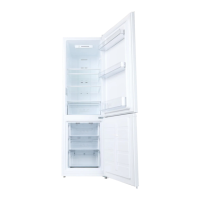

 To Next Page
 General