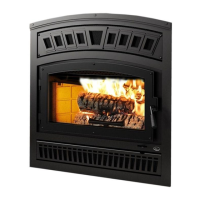
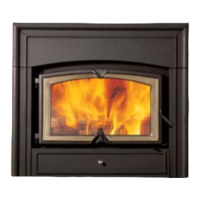
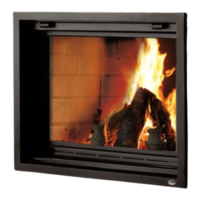
This document is an installation and operation manual for the Valcourt FP10 Lafayette II wood fireplace (FP10R model). It provides comprehensive information on the fireplace's function, technical specifications, usage, and maintenance.
The Valcourt FP10 Lafayette II is a non-catalytic, factory-built wood fireplace designed for residential use. It is safety tested according to ULC S610 and UL 127 standards by an accredited laboratory, and is a US Environmental Protection Agency (EPA) phase II certified wood fireplace compliant with the 2020 cord wood standard, with an emission rate of ≤2.5 g/h. The fireplace is intended as a supplementary heat source, providing zone heating for homes.
Important Technical Specifications:
- Model: FP10 Lafayette II (FP10R)
- Fuel Type: Dry Cordwood
- Combustion Technology: Non-Catalytic
- Recommended Heating Area: 750 to 2,200 ft² (70 to 204 m²)
- Overall Firebox Volume: 2.5 ft³ (0.071 m³)
- EPA Loading Volume: 1.94 ft³ (0.055 m³)
- Maximum Burn Time: 8 hours
- Maximum Heat Output (dry cordwood): 80,000 BTU/h (23.4 kW)
- Overall Heat Output Rate (min. to max.): 12,700 BTU/h to 60,700 BTU/h (3.72 kW to 17.79 kW)
- Average Overall Efficiency (Dry cordwood): 64% (HHV), 68% (LHV)
- Optimum Overall Efficiency: 70%
- Optimum Heat Transfer Efficiency: 68%
- Average Particulate Emissions Rate: 1.2 g/h (EPA / CSA B415.1-10)
- Average CO: 98 g/h
- Recommended Log Length: 16 in (406 mm) east-west
- Maximum Log Length: 20 in (508 mm) east-west
- Flue Outlet Diameter: 6 in (150 mm)
- Recommended Connector Pipe Diameter: 6 in (150 mm)
- Type of Chimney: CAN/ULC S629, UL 103 HT (2100 °F)
- Baffle Material: C-Cast or equivalent
- Approved for Mobile Home Installation: No
- Type of Door: Simple, glass with steel frame
- Type of Glass: Ceramic glass (5/32" (4 mm) thick, 12 5/8" x 24 3/8" (321mm x 619 mm), tested to 1400° F)
- Blower: Included (up to 176 CFM)
- Particulate Emission Standard: EPA / CSA B415.1-10
- Safety Standards: UL 127 (USA), ULC S610 (Canada)
Usage Features:
The fireplace is designed for efficient wood burning, emphasizing the use of seasoned natural firewood with a moisture content between 15% and 20% to achieve its highest possible efficiency and reduce creosote formation.
- Air Control: Located below the ash shelf on the right. Pushing the handle completely left opens it (High burn rate), and pushing it completely right closes it (Low burn rate).
- Loading Methods: Specific EPA-certified loading methods are provided for high, medium, and low burn rates to ensure clean and efficient combustion. Logs should be 16 inches long and split to 3-6 inches in cross-section.
- Lighting Fires: Several methods are described: Conventional, Top Down, Two Parallel Logs, and using commercial fire starters. The goal is to achieve a hot fire quickly to minimize smoke and creosote.
- Combustion Cycles: Wood burns best in cycles, with new loads ignited by hot coals. It is recommended to load at least three pieces of wood at a time.
- Rekindling a Fire: Involves raking coals forward, placing new wood at the back of the embers, opening the air control completely, and closing the door.
- Blower Operation: An included blower (up to 176 CFM) enhances hot air circulation. It can operate in automatic (starts when warm, stops when cold) or manual mode (speed controlled by rheostat).
- Optional Fire Screen: The fireplace can be used with an open door and a rigid fire screen (sold separately) for lighting or reloading, but it should not be left unattended. Note that in the US or provinces with particulate emission limits, open-door use with a rigid fire screen is prohibited.
- Compressed Wood Logs: Can be burned with caution if made of 100% compressed sawdust and meeting ULC/ORD C127 M1990 requirements. Wax-impregnated or chemically additive logs are prohibited.
Maintenance Features:
Regular inspection and maintenance are crucial for safe and efficient operation and to preserve the warranty.
- Cleaning and Painting: Painted surfaces can be wiped with a damp cloth. Scratched paint can be touched up with heat-resistant paint when the fireplace is cold.
- Refractory Material and Baffle: Inspect periodically for cracks or damage. Slight cracks are normal, but wider cracks or broken parts require replacement. Operating with a cracked or missing baffle voids the warranty.
- Glass Door: Should remain clear with dry firewood and proper operation. Whitish deposits can be cleaned with a damp cloth. Light brown stains indicate incomplete combustion and creosote formation, requiring adjustment of fuel or operating procedure. Do not use abrasive cleaners.
- Glass Replacement: Ceramic glass must be replaced with the same specification (5/32" (4 mm) thick, 12 5/8" x 24 3/8" (321mm x 619 mm), tested to 1400° F). Uneven placement or over-tightening of retaining screws are common causes of breakage.
- Gasket Replacement: The flat, adhesive-backed, woven fiberglass gasket around the glass should be replaced if brown streaks appear at the edges or if the door seal is compromised.
- Door Adjustment: The latch mechanism can be adjusted to improve the gasket seal by turning the handle counter-clockwise. Hinge rods can be adjusted with a 3/32" Allen key to align the doors.
- Exhaust System (Chimney): Regular inspection and cleaning of the chimney are essential to prevent creosote buildup and chimney fires. Inspection frequency depends on usage and creosote formation rate, but at least once a year is recommended. The baffle can be removed to facilitate cleaning.
- Blower Replacement: Instructions are provided for removing the air control decorative panel and housing, certification plate, and cutting tie wraps to access and replace the blower.
- Refractory Panels Replacement: Detailed steps are provided for removing the andiron, floor refractory panel, and side and back refractory panels.
- Secondary Air Tubes and Baffle Installation: Instructions for installing and removing secondary air tubes and the baffle are included.
The manual stresses the importance of contacting local building or fire officials for restrictions and inspection requirements, obtaining building permits, and informing home insurance companies. It also warns against modifying the fireplace or using unapproved components, which would void the warranty and create safety hazards.

 Need help?
 General

 To Next Page