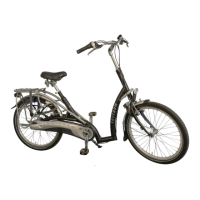
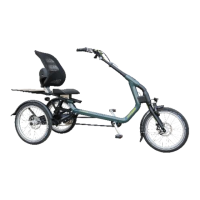
Important safety points for the rider
• Ride very carefully on the first ride.
• Keep your hands on the handlebars and feet on the pedals while riding.
• Test the driving behaviour of the bicycle at an appropriate speed on an uneven
surface. This way you learn to react better to unexpected movements of the
bicycle and the handlebars during use.
• Small obstacles must be ridden over at an appropriate speed.
• Obstacles higher than five centimetres should be avoided.
• One of the brake levers operates the brake on the front wheel. Extra caution is
required here, because the front wheel can lock if the brakes are pulled too
strongly. Practice with phased braking.
Check before every ride
Contact your dealer and do not use the bicycle if you notice irregularities during the check!
• Check that the brakes are working correctly. The brakes should work and you
should feel pressure on the brake lever.
• Make sure there is enough air in the tires. The tires may be inflated to the
maximum pressure indicated on the side of the tire. Tip for extra comfort: You do
not have to inflate the front wheel to the maximum pressure, but make sure you
always stay above the minimum specified pressure.
• Check that the lights are working correctly. See chapter ‘Before use’ for the
correct setting of the lighting.
• Check that the seat and handlebars are secure. See chapter ‘Adjusting the bicycle’
for the correct adjustment of the seat and handlebars.
• Make sure the battery is sufficiently charged (optional).
As with all mechanical parts, the bicycle is subject to wear and tear and high loads. If a
component fails, it can lead to very dangerous situations and to damage or injury to the
bicycle user. Any cracks, scratches or change of colour in heavily loaded parts of a
component is an indication that the part must be replaced.


 To Next Page
 Loading...