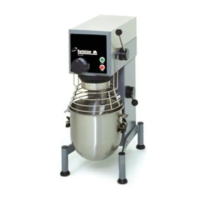
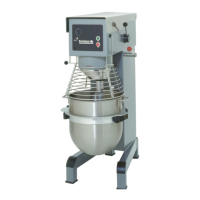
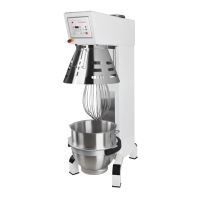
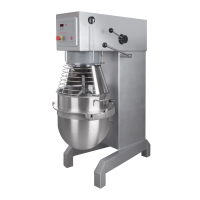
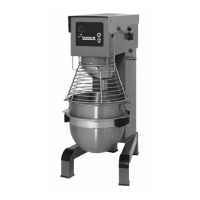
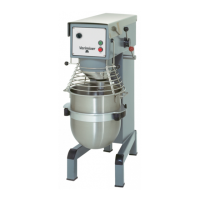
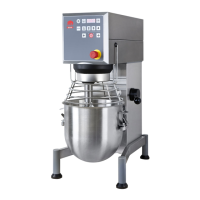
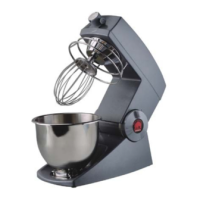
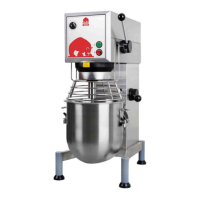
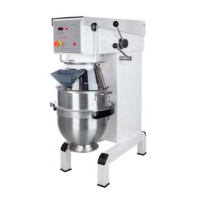
The KODIAK mixer, available in KODIAK 20 and KODIAK 30 models, is a robust commercial-grade planetary mixer designed for use in kitchens, catering outlets, and bakeries. It is engineered to handle a variety of tasks, from whipping and beating to mixing dough, with an emphasis on user-friendliness, safety, and durability.
Function Description
The KODIAK mixer is designed for mixing various ingredients. Its planetary mixing action ensures thorough and consistent results. The mixer can be used for tasks such as whipping cream and egg whites, beating butter and mashed potatoes, and mixing different types of dough (bread, ciabatta, pizza, layer cake base, meatball mix, and icing). The machine features a variable frequency drive (VFD) that allows for precise speed control, indicated by a digital display on the control panel. This enables users to adjust the mixing speed to suit the specific ingredients and desired consistency.
The mixer is equipped with a filling chute for adding ingredients during operation, and a safety guard to ensure safe use. It can be operated with various mixer tools, including a whip, beater, and hook, each designed for specific mixing tasks. The bowl can be easily attached and detached, and the mixer is available in both table and floor models, with the floor models featuring a bowl truck for easy maneuverability.
Important Technical Specifications
The KODIAK mixer models have distinct capacities and power specifications:
KODIAK 20:
- Capacity:
- Bread dough (50% AR): 10 kg
- Ciabatta dough (70% AR): 12 kg
- Pizza dough (60% AR): 12 kg
- Whipping cream: 5.0 l
- Egg whites: 2.4 l
- Mayonnaise: 16 l
- Herb butter: 10 kg
- Mashed potatoes: 12 kg
- Muffins: 14 kg
- Layer cake base: 5.0 kg
- Meatball mix: 15 kg
- Icing: 14 kg
- Doughnut (50% AR): 12.0 kg
- Gross weight:
- Table model: 97 kg
- Floor model: 179 kg
- Net weight:
- Table model: 72 kg
- Floor model: 154 kg
- Power: 0.7 kW
- Power connection: 50/60 Hz
- Tool speed: 64 - 353 rpm
KODIAK 30:
- Capacity:
- Bread dough (50% AR): 12 kg
- Ciabatta dough (70% AR): 15 kg
- Pizza dough (60% AR): 15 kg
- Whipping cream: 7.0 l
- Egg whites: 3.5 l
- Mayonnaise: 20 l
- Herb butter: 14 kg
- Mashed potatoes: 12 kg
- Muffins: 16 kg
- Layer cake base: 7.0 kg
- Meatball mix: 20 kg
- Icing: 20 kg
- Doughnut (50% AR): 15 kg
- Gross weight:
- Net weight:
- Power: 1.2 kW
- Power connection: 50/60 Hz
- Tool speed: 64 - 353 rpm
Dimensions (approximate):
- KODIAK 20 Table model: 745mm (H) x 442mm (W) x 533mm (D)
- KODIAK 20 Floor model: 1292mm (H) x 539mm (W) x 1080mm (D)
- KODIAK 30 Floor model: 1365mm (H) x 539mm (W) x 1153mm (D)
The mixer is equipped with a 1-phase VFD (Variable-frequency drive), together with the built-in filter, EMC/EMI and leakage currents are reduced to a minimum. The machine is designed for commercial use in kitchens, catering outlets and bakeries. The constant noise level of the workplace of the operator is lower than 70 dB (A).
Usage Features
Installation and Adjustments:
- Transport: The machine should always be moved using lifting equipment, ensuring it is pulled or lifted by the bowl lift handle. When moved, it should be in a vertical position at all times.
- Environment: The ambient temperature around the machine must not exceed 45 °C. The machine should be arranged for normal use and maintenance, with sufficient workspace around it.
- Floor Model Adjustments: The height of the bowl should be adjusted so that the bowl on the bowl trolley fits perfectly into the bowl arms. The bowl arms should be at the correct height above the floor before the machine is taken into use. For KODIAK 20, the bowl arms should be 79 cm from floor to centre of the knobs, and for KODIAK 30, 86.5 cm.
- Table Model Adjustments: The KODIAK 20 table model must be fixed to the table it is placed on using bolts with dimensions M10 x 20 mm + table top thickness and a washer. The table must be suitable for the machine's weight and operation.
- Height Adjustment: If the bowl is not fully even, adjustments can be made by adjusting the two front legs.
- Electrical Connection: The machine connects to the mains, with the voltage and frequency printed on the name plate. A 1-phase VFD (Variable-frequency drive) is used. Upstream protection by means of a "residual current device" is required.
- Safety: The mixer is designed with safety in mind. It features a safety guard that must be in place and the bowl lifted before operation. The machine has an emergency stop button. It is not possible to attach the guard incorrectly. The mixer is equipped with strong permanent magnets. Users with implants (e.g. pacemakers, defibrillators) should maintain a safe distance (between the field source and implant) of 30 cm.
Operating the Mixer:
- Before Starting: Place the bowl in the bowl trolley. Push the trolley into position between the bowl arms. Ensure the bowl is correctly engaged with the bowl arms. For table models, put the bowl into place and the bowl in the bowl arms.
- Filling Chute: The safety guard and turn it so the filling hole is accessible while the machine is running. The loose filling chute must be used if it is necessary to add ingredients during the process (i.e. ingredients at temperatures above 60°C).
- Tool Attachment: Turn the tool to lock it into the bayonet fitting.
- Lifting Handle: Lift the bowl with the aid of the lifting handle. The mixer is now ready to start.
- Starting the Machine: Press the "Start" button to start the mixer. Use the "+" and "-" buttons to increase or decrease speed. The speed is shown as a number on the display (12345678).
- Display: The display shows the lowest speed (12345678) and the highest speed (12345678). A specific start speed can be set.
- Running Time: The mixer can run for up to 90 minutes. If no running time is selected, the display will show the time elapsed since the mixer was started.
- Inspection of Ingredients: If the mixer needs to be stopped temporarily without affecting the running time, press the "Stop" button. The mixer will slow down and then stop. To continue, press "Start".
- Bowl and Mixer Lift: Lift the bowl and press the "Stop" button, and the mixer will start and the running time will resume.
- Stopping the Machine: Press "Stop" to stop the mixer. Press "Stop" twice for running time reset. Press "Emergency Stop" for emergency stop.
- Recommended Speeds: The manual provides recommended speed settings for different tools and ingredients (e.g., Whip for cream/mayonnaise, Beater for cake mix/butter mix/waffle mix/food meat, Hook for bread dough/rye bread).
- Attachment Drive: For machines with outlets for meat mincer and vegetable cutter, the following must be observed: Use only accessories intended for the machine. Always read and follow the operating instructions for the tool. When placing/removing tools, disconnect the power supply to the machine by disconnecting the connection cable from the connection point. Before start: remove any mixing tools from the machine, empty bowl is placed in working position, close the safety screen.
- Overloading: The mixer must not be overloaded. Possible overload situations include working with excessively tough and heavy dough, mixer tool exceeding the recommended speed, wrong mixer tool being used, and large lumps of fat or chilled ingredients. Overloading will cause the VFD (variable frequency drive) to stop the machine. The display will show "0.0.1", "0.0.2", or "0.0.3".
Maintenance Features
Cleaning:
- General: Cleaning must only be performed by trained personnel and must be over 14 years of age. Before any cleaning, disconnect the power supply to the machine by disconnecting the connection cable from the connection point. The machine should never be rinsed with a hose.
- Safety Screen: The plastic safety screen may be damaged if exposed to high temperatures for extended periods of time (General maximum temperature 60 °C, rinse maximum 90 °C, for a maximum of 30 seconds).
- Cleaning Guide: A risk assessment must always be used for all cleaning processes involved in food production. The mixer's parts are mainly stainless steel. The following guidelines must be followed: Chloride (Cl) content under 50 ppm at temperatures up to 60°C. Never use hard steel wool/sponges or other hard objects that can scratch the steel surface. After using chemicals, the mixer must always be washed off with clean water of drinking-water quality. The bowl clamping system is made of aluminium. When washing aluminium, pH value must be kept between 5.0 and 8.0.
- Safety Guards and Tools: Remove all safety guards and tools before starting cleaning.
- Bowl: Empty the bowl and rinse with water. Put bowl in the dishwasher, or wash by hand with a soft sponge or brush.
- Tools: Remove any food residue from tools, and rinse with water. Never tap the whip against the bowl lip or other objects. Wash tools by hand or in a dishwasher. Always remove the stainless steel part of the scraper blade before cleaning.
- Safety Guards: Wash safety guards by hand or in a dishwasher.
- Bayonet Housing: Always check the bayonet where tools are attached for food residues. A damp cloth or sponge can be inserted into the bayonet to loosen food residues.
- Front Panel: The front panel can be washed off with foam when washing the mixer/stand. Alternatively, it can be wiped off with a lightly-wrung cloth. Remember the emergency stop.
- Mixer/Stand: Always wash the mixer with the bowl clamping system in high and low position. Remember to wash the lift arm. The mixer is classified to IP44. The mixer can tolerate being washed with foam. Never allow foam to remain on the machine, apart from the recommended working time for the detergent. Rinsing-off must be restricted to thin streams of water, equivalent to normal rain. The water must be clean and of drinking-water quality. Never rinse off with pressurised water.
- Bowl Clamping System: Wash the bowl clamping system as for washing the mixer/stand. Check the detergent's pH value, must be kept between 5.0 and 8.0 for washing aluminium. The bowl arm is aluminium.
- Storage: The bowl can be fitted on the mixer after cleaning. If the bowl is stored on the mixer, we recommend covering it. To avoid steel corrosion, never store foods with high concentrations of acid or salt in the bowl.
- Disinfection: Disinfection requires strong chemicals. Always perform an assessment of whether disinfecting the mixer will make any difference to food safety for the end product. Always obtain the recommendations from the supplier/manufacturer of cleaning/disinfection products before use. If water is left from cleaning and disinfection to evaporate on the mixer surface, the concentration of chlorides and other chemicals will be higher than during the cleaning process. Always rinse and wipe off the mixer with clean water of drinking-water quality after using chemicals. All oxidising chemical disinfectants require rinsing off with clean water of drinking-water quality. When accessing clean water of drinking-water quality, disinfection using hot water, steam and disinfection using hyp, ethanol and ethanol can be used. Always obtain a written declaration from the supplier/manufacturer of the disinfectant that it is safe and can be used without rinsing off using clean water of drinking-water quality. Incorrect use of disinfectants can damage the mixer.
- Acid-proof Stainless Steel: When producing strongly acidic and/or products with a high salt content, and when cleaning using strong chemicals, we recommend buying the mixer bowl and tools in acid-proof stainless steel EN 1.4401 (AISI 316). Acid-proof stainless steel is more corrosion-resistant, and by way of comparison tolerates chloride (Cl) concentrations below 50 ppm at temperatures up to 100°C.
Systematic Maintenance:
- Safety Guard: Check the safety guard daily. Does the tool stop rotating (≤ 4 sec.) when the guard is tilted/removed? If any malfunction, contact a technician.
- Emergency Stop: Test the emergency stop daily. Does the tool stop rotating (≤ 4 sec.) when the emergency stop is activated? If any malfunction, contact a technician.
- Mixer Head: The mixer head should only be lubricated during repairs. See section "Lubrication and grease types".
- Machine's Other Moving Parts: The moving parts that belong to the bowl's lifting mechanism all run in maintenance-free plain bearings and should not therefore be lubricated. Never.
- Attachment Drive: The rubber plug for covering the opening of the attachment drive should be on the machine and be intact. Daily. The rubber plug must cover the opening on the attachment drive when the latter is not in use.
- Cleaning: Follow the instructions in the section "Cleaning". Follow the instructions in the section "Cleaning".
- Lubrication and Grease Types: Lubrication and other servicing may only be carried out by trained staff over 14 years of age. The lid of the mixer may only be removed when the cable to the mains supply has been removed. When repairs are made to the mixer head, the gear wheel and internal gear should be lubricated with Molykote G-1502 FM. The needle bearings in the mixer head can also be lubricated with this type of grease. If the machine is supplied with an attachment drive, the gear for the attachment drive should be lubricated with Renolit GreaseWay LiCa 80. Do not use any other grease types than those specified above.
Error Codes and Possible Solutions:
The control system will show an error code in the display for various issues:
- EE:1: User pressed "Start" without raising the bowl to working height. Solution: Raise bowl to working height.
- EE:2: User pressed "Start" without fitting the safety guard. Solution: Fit the safety guard.
- EE:4: The thermal sensor in the motor has overheated. Solution: The error will disappear when the temperature has dropped to an acceptable level.
- EE:6: There is an error in communication between the control panel and the VFD (variable frequency drive). Solution: Please contact a technician for assistance.
- EE:7: Error in VFD (variable frequency drive). Solution: Please contact a technician for assistance.
- EE:8: Thermal sensor in the VFD (variable frequency drive) has cut out. Solution: The error will disappear when the temperature has dropped to an acceptable level.
- EE:9: Intermittent low voltage in the power supply. Solution: Contact a technician to control the power supply to the mixer.
- EE:10: Intermittent high voltage in the power supply. Solution: Please contact a technician for assistance.
- EE:14: Wrong parameter in VFD (variable frequency drive). Solution: Please contact a technician for assistance.
- OL:1: The mixer is overloaded - continuously for 50 seconds. Solution: Reduce the quantity in the bowl. Alternatively, the product may need to be divided into smaller parts or diluted before the machine is restarted. When restarted, select a lower speed, if speed was the problem.
- OL:2: The mixer is overloaded - momentarily (overloaded 8 times within 20 seconds). Solution: Reduce the quantity in the bowl. Alternatively, the product may need to be divided into smaller parts or diluted before the machine is restarted. When restarted, select a lower speed, if speed was the problem.
- OL:3: Blockage. Solution: Remove the object that caused the blockage.
- OL:1, OL:2, and OL:3 can also occur when using the attachment drive.
Reading the Machines Data:
The machine's data will be displayed as alternating text in the display. Press the stop button for 5 seconds to view the data sets:
- Data set 1: States firmware version (e.g., "F" followed by three figures, e.g., "0.0.3" = firmware version 3).
- Data set 2: States the machine's running time, displayed as "t" followed by three figures, which indicate the number of 9999-minute cycles, e.g., "0.0.0.2" = 2 x 9999 min., or 19998 min.
- Data set 3: Displays four figures, which indicate the number of minutes the current cycle has been running, e.g., "0.0.0.1" = 1234 min. I.e., if "0.0.0.1" is displayed followed by "0.0.0.1", the machine has been running for 19998 min. + 1.234 min., or a total running time of 21232 min.
- Data set 4: States the number of times the machine has been disconnected from the power supply (plug pulled out of the machine/powercut/switched off) and restarted, displayed as "r" followed by three figures, which indicate the number of restarts, e.g., "0.0.0.2" = 2 x 9999 restarts, or 19998 restarts.
- Data set 5: Displays four figures, which indicate the number of restarts which have happened in the current cycle, e.g., "0.0.0.1" = 1234 times. In other words, if "0.0.0.1" is displayed followed by "0.0.0.1", the machine has restarted a total of 19998 + 1234 times, or 21232 times.
- Data set 6: Indicates machine type followed by size e.g., "0.0.2.0" Cr = KODIAK, size = 20.
- Data set 7: Indicates voltage to VFD (variable-frequency drive), A followed by voltage "0.2.3.0" = 230 V.
Reading the Error Log:
It is possible to display a log of the errors that have occurred:
- Hit emergency stop and press "Next" to scroll through the errors.
- The display shows the latest error first.
- To scroll back through the errors, press "Next" to scroll forward, press "Next" to scroll back.
- The last eight errors can be displayed.
- Deactivate emergency stop to cancel the display.

 Need help?

 To Next Page
 General