Need help?
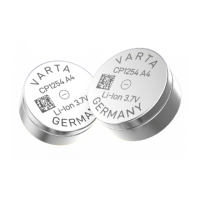
Do you have a question about the Varta CoinPower CP 1654 A4 and is the answer not in the manual?
Explains key terms such as Open Circuit Voltage (OCV), Nominal Capacity, and discharge rates.
Details the advantages and customer benefits of VARTA CoinPower batteries, highlighting high energy density and small size.
Lists suitable modern electronic applications for CoinPower batteries, including wearables and medical devices.
Outlines criteria for selecting batteries based on operating time, current drain, voltage, temperature, and space.
Describes the cell housing, internal electrode winding, and the movement of lithium ions during charge/discharge.
Presents a table detailing VARTA CoinPower rechargeable button cells with type designation, voltage, capacity, and dimensions.
Explains the structure of VARTA CoinPower battery model numbers, breaking down type, diameter, height, and version.
Details the two-dimensional data matrix codes printed on cells for traceability, including production date and identification.
Covers standard, rapid, and fast charging procedures for CoinPower batteries, including C-rates and voltage limits.
Discusses discharge currents, temperature ranges, and the risks and prevention of over-discharging for CoinPower cells.
Recommends suitable charging ICs for CoinPower batteries and explains the Constant-Current Constant-Voltage (CC/CV) procedure.
Shows graphs illustrating typical cycle performance under 1C and 0.2C discharge rates, indicating capacity retention over cycles.
Details recommended storage conditions, state-of-charge (SoC), and temperature to minimize self-discharge.
Lists safety standards (UL 1642, IEC 62133, UN IATA 38.3) and specific tests performed on CoinPower batteries.
Highlights safety features integrated into CoinPower battery components and mechanical design for safe operation.
Explains the function of PCMs for battery protection against overcharge, discharge, and short circuits.
Provides general safety advice for Lithium batteries, emphasizing risks like short-circuiting and mistreatment.
Specifies charging current, voltage, temperature limits, and prohibits reverse charging to ensure safety and performance.
Defines discharge current limits, temperature range, and precautions against over-discharging.
Details PCM functions required for CoinPower cells, including over-discharge prevention and overcurrent protection.
Specifies intended use conditions, technician-replaceability, and required warnings for end-product manuals.
Provides guidelines for storing cells and assembled cells, focusing on proper temperature and state of charge.
Covers cell connection, ultrasonic welding, short-circuit prevention, assembly, and disassembly prohibitions.
Outlines requirements for end-user instructions and markings, including warnings for handling and replacement.
Describes standard and custom cell configurations with solder tags, wires, and insulation tape for PCB connection.
Explains how multiple cells can be connected in series or parallel to achieve higher capacity or voltage.
Provides guidance on soldering CoinPower batteries to PCBs, including safe methods and prohibited techniques like reflow.
Definition of Original Equipment Manufacturer and its evolving meaning in the industry.
Definition of a battery as one or more electrochemical cells connected to provide operating voltage and current.
Definition of a cell as the basic electrochemical unit providing electrical energy.
Definition of a secondary battery that can be reused after charging, unlike a primary battery.
Definition of a primary battery designed for single use and not rechargeable.
Definition of a separator as a film between electrodes to prevent short-circuits and maintain spacing.
Definition of a cathode as an electrode at higher potential during discharge.
Definition of an anode as an electrode at lower potential where current flows from the external circuit.
The voltage of a battery when it is disconnected from external circuits.
The voltage of a battery when it is connected to an external circuit.
Capacity representing a battery's capacity, usually in ampere hours (Ah or mAh).
The expected voltage of a battery or cell over its entire discharge cycle.
The number of cycles a secondary battery can perform before failing to meet specified performance criteria.
The limiting voltage that terminates discharge, corresponding to the lower usable voltage limit.
Battery capacity decline without current flowing to an outside circuit.
Amount of energy extracted per unit battery weight or volume (Wh/kg or Wh/l).
Charging a battery after it has reached the fully-charged state, leading to instability.
Discharging a battery below the specified cutoff voltage, potentially dissolving the anode current collector.
Constant-Current Constant-Voltage charging algorithm for Li-Ion batteries.
Protection Circuit Module to protect batteries against abnormal events like over-discharge or short circuits.
Printed Circuit Board that mechanically supports and electrically connects electronic components.
Through-hole technology for mounting electronic components onto PCBs.
Surface-mount device technology for mounting electronic components onto PCBs.
 General
| Brand | Varta |
|---|---|
| Model | CoinPower CP 1654 A4 |
| Category | Camera Accessories |
| Language | English |

 To Next Page