Need help?
Do you have a question about the VEE GEE BX-3 and is the answer not in the manual?
Table providing temperature correction values for refractometer readings based on ambient temperature.
Protects the focusable lens and prevents ambient light entry during use.
Mechanism for zeroing or calibrating the refractometer without extra tools.
Prevents instrument damage when placed down between measurements.
Covers the prism and sample during readings.
Provides insulation against hand heat for accurate results.
Secures the calibration ring to prevent shifts during use.
Apply one or two drops of liquid standard onto the prism surface for calibration.
Close the daylight plate, ensuring the liquid standard covers the entire prism surface evenly.
Adjust the eyepiece to bring the scale into focus by turning it clockwise or counterclockwise.
Confirm the boundary line crosses the scale at the correct calibration point (e.g., '85').
Loosen the calibration ring and adjust it until the boundary line is at the correct calibration point.
Gently wipe the prism with tissue paper after calibration is complete.
Apply one or two drops of sample solution to the prism surface, holding it at an angle.
Gently close the daylight plate, ensuring the sample covers the prism surface evenly.
Adjust the eyepiece to bring the scale into focus by turning it clockwise or counterclockwise.
Read the Brix% value where the boundary line of blue and white fields crosses the scale.
Clean the prism using tissue paper and water after each measurement.
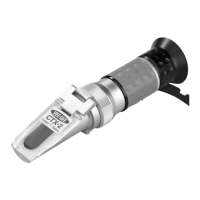
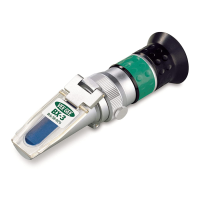
The VEE GEE Refractometer, specifically the Model BX-3, is an optical instrument designed for measuring the Brix% of solutions. It is built with modern designs to provide reliable performance over many years, provided it is handled with proper care. The device is calibrated at 20°C (λ=589nm) and includes a temperature correction table to account for ambient temperature changes, eliminating the need for frequent recalibration.
The primary function of the VEE GEE Refractometer is to determine the Brix% of a liquid sample. Brix% is a measure of the sugar content in a solution, and the device provides a direct reading on an internal scale. The refractometer operates by measuring the refractive index of a liquid sample, which correlates to its concentration.
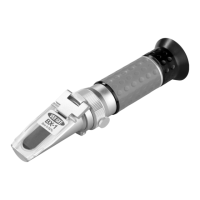
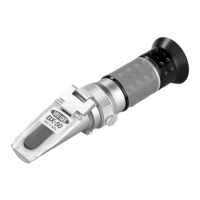
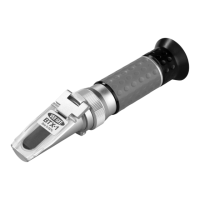
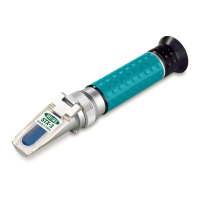
The instrument features a Rubber Hood that houses and protects the focusable lens, preventing external light from interfering with readings through the eyepiece. The Eyepiece allows the user to view the internal scale and the boundary line between the blue and white fields, which indicates the Brix% reading.
A Calibration Ring is integrated into the design, allowing for easy zeroing or calibration of the refractometer without the need for additional tools. This ring can be turned clockwise or counterclockwise to adjust the boundary line during calibration. A Calibration Ring Set Screw secures the calibration ring in place, protecting it from accidental shifts.
The Rubber Grip insulates the refractometer from hand heat, ensuring accurate results by preventing temperature fluctuations from the user's hand from affecting the measurement.
The Daylight Plate & Prism assembly is where the sample is placed. The prism is made of optical glass and is covered by the daylight plate during readings. The daylight plate is opened to apply the sample and then closed to create a thin, even layer of the liquid over the prism surface.
A Non-Roll Stand is included to protect the instrument from damage when it is set down between measurements.
Before using the refractometer for general measurements, it must be calibrated. Calibration should be performed at the start of each day or whenever significant shifts in ambient temperature occur. The standard calibration procedure involves opening the daylight plate and applying one or two drops of a liquid standard (e.g., a Brix 85.0% oil standard or a prepared sucrose solution of known concentration, minimum Brix 60.0%) onto the prism surface. It's crucial that the liquid standard covers the entire prism surface without bubbles or gaps; if not, it must be reapplied.
Once the standard is applied, the daylight plate is gently closed. The user then looks through the eyepiece, directing the daylight plate towards a light source. If the scale is out of focus, the eyepiece (rubber hood) can be gently turned clockwise or counterclockwise to bring it into focus. The internal view will show an upper blue field and a lower white field, with a boundary line separating them. For calibration, this boundary line must align with the known value of the liquid standard (e.g., "85" for an 85.0% Brix standard). If the boundary line is not aligned, the set screw on the calibration ring is gently loosened, and the calibration ring is turned until the boundary line aligns correctly. After alignment, the set screw is gently tightened.
As an alternative to recalibration due to ambient temperature changes, a temperature correction table is provided. This table allows users to adjust their readings based on the ambient temperature and the measured Brix%. For example, if a reading of Brix 40.0% is taken at 25°C, the corrected value would be Brix 40.4%. Similarly, a Brix 65.0% reading at 10°C would be corrected to Brix 64.25%. This feature ensures accuracy even when the ambient temperature deviates from the 20°C calibration temperature.
For general use, the process is similar to calibration. The daylight plate is opened, and one or two drops of the sample solution are applied to the prism surface. The plate is then gently closed, ensuring the sample spreads evenly across the prism. The user looks through the eyepiece, directing the daylight plate towards light, and adjusts the focus if necessary. The reading is taken at the point where the boundary line between the blue and white fields crosses the scale. This value represents the Brix% reading of the sample.
Proper care and maintenance are essential for the longevity and accurate performance of the refractometer.
The instrument is an optical device and should be handled gently to prevent damage from drops or rough handling.
The prism, being made of optical glass, is susceptible to scratches. Therefore, no rough or abrasive materials should be used for cleaning the prism.
After each use, the prism surface and daylight plate must be cleaned. This is done by wiping them with a soft cloth or tissue soaked in water, followed by wiping with a dry cloth or tissue.
It is important not to hold the refractometer under a stream of water from a faucet, nor should it be splashed with or dipped in water.
If the prism surface becomes coated with an oily solution or similar residue, it may repel test samples and lead to inaccurate readings. In such cases, the prism should be cleaned with a weakened detergent or a similar solvent.
These maintenance practices ensure the refractometer remains in optimal condition for consistent and reliable measurements.
 General
| Scale | Brix |
|---|---|
| Brix Range | 0-32% |
| Accuracy | ±0.2% |
| Display | LCD |
| ATC | 10-30°C |
| Measurement Range | 0-32% Brix |
| Resolution | 0.2% Brix |
| Power Supply | 2 x AAA batteries |

 To Next Page