
 Need help?
Do you have a question about the Velodyne Deep Blue Series and is the answer not in the manual?
Guidelines for positioning the subwoofer in the room for optimal listening enjoyment.
Details on connecting the subwoofer using speaker-level and line-level inputs.
Guide to setting the upper limit of the subwoofer's frequency response.
Details on LINE IN, LFE IN, and LFE OUT RCA connections for audio input and daisy-chaining.
Instructions for connecting the subwoofer using speaker-level inputs from an amplifier.
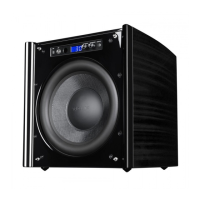
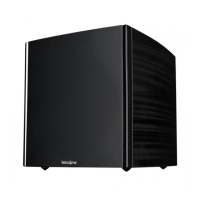
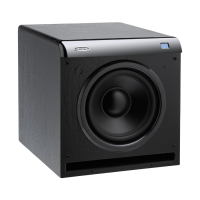
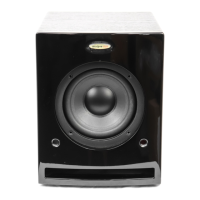
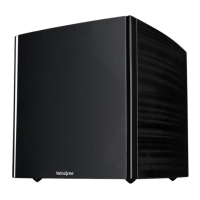
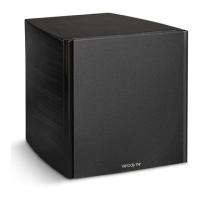
The Velodyne Acoustics Deep Blue Series subwoofer is a high-performance audio device designed to enhance your home listening experience with powerful, low-distortion bass. This user's manual provides comprehensive instructions for installation, operation, and maintenance, ensuring you get the most out of your subwoofer while maintaining safety and longevity.
The Deep Blue Series subwoofer is engineered to reproduce extremely low frequencies, adding depth and impact to music, movies, and other audio content. It integrates seamlessly into various audio systems, whether you're connecting it to a pre-amp, signal processor, or a receiver. The subwoofer features a built-in amplifier, eliminating the need for an external power amplifier for the bass frequencies. Its design focuses on delivering accurate and dynamic bass, crucial for a truly immersive audio experience. The subwoofer is equipped with both line-level (RCA) and speaker-level inputs, offering flexibility in connecting to different audio sources. For optimal performance, it's designed to work with full-range audio signals, utilizing its internal crossover for precise frequency management. The inclusion of an LFE (Low-Frequency Effects) input allows for direct connection to dedicated subwoofer outputs found on many home theater receivers and processors, ensuring compatibility with multi-channel audio formats like Dolby Digital, DTS, and THX.
Setting up your Deep Blue Series subwoofer involves several key steps to maximize your listening enjoyment. The manual emphasizes the importance of proper placement, noting that while subwoofers primarily produce omni-directional sound at low frequencies, their position can significantly influence frequency response and output level. Experimentation with placement is encouraged to find the sweet spot in your listening room, taking into account room size, furnishings, and acoustic properties. For stereo setups with two subwoofers, it's recommended to feed each subwoofer with one channel and place it near the satellite speaker of the same channel. The subwoofer must always be kept in an upright position to prevent damage.
The device offers several adjustable controls to fine-tune its performance to your specific system and room acoustics. The Volume Control allows you to balance the subwoofer's output with your main speakers, ensuring a cohesive soundstage. A good starting point is two or three graduations from minimum, then adjusting to taste. The manual also warns about potential issues with receiver Sub-Out channel signals being set too low, which can lead to weak output, noise, distortion, or improper operation of the auto-on/off feature.
The Low-Pass Crossover is a crucial control, allowing you to set the upper frequency limit of the subwoofer's response, ranging from 50 to 200 Hz. This control helps achieve a smooth and seamless transition between the subwoofer and your main speakers. Smaller main speakers may benefit from a higher crossover frequency (e.g., 100-120 Hz), while larger speakers might start lower (e.g., 80 Hz). If using an A/V receiver's crossover, the subwoofer's crossover should be set to its maximum setting. The manual also discusses the possibility of combining the subwoofer's internal crossover with a receiver's crossover for a steeper slope, though it advises bypassing one if low output or increased noise occurs.
The Phase Adjustment (0° to 180°) helps correct any mismatch or cancellation between the subwoofer and main speakers. By adjusting this knob while music is playing, you can listen for a change in mid-bass frequency output, with the correct position yielding a greater apparent mid-bass presence.
A convenient Auto Turn-on Function automatically powers on the subwoofer when an audio signal is detected. If no signal is present for approximately ten minutes, the unit switches to a low-power standby mode (indicated by a red LED). The manual also provides a manual power switch for complete control.
The rear panel connections are clearly labeled and described. LINE INPUT RCA jacks connect to the line out jacks of an amplifier, while the LFE INPUT RCA jack connects to the LFE out jacks of an amplifier. An LFE OUTPUT RCA jack is available for daisy-chaining additional subwoofers. SPEAKER LEVEL INPUT terminals connect directly to the speaker outputs of an amplifier or receiver, offering a high impedance connection that won't load down your main amplifier. The POWER INDICATOR LED changes color (red for standby, blue for operation) to show the unit's status.
The Deep Blue Series subwoofer is designed for reliability and ease of care. For general maintenance, normal dusting or cleaning of the surface is all that's required. The manual advises against using harsh detergents, chemicals, abrasives, or cleaning solutions, as these can damage the cabinet's finish. A damp cloth is recommended for cleaning.
The unit is equipped with Protection Circuitry to ensure maximum performance and reliability. This circuitry safeguards against:
If either of these conditions occurs, the unit may cycle on and off, or shut down completely. In such cases, reducing the volume setting or turning off the unit until normal operating conditions return is recommended. Plugging the unit into a different wall outlet may also help if power line voltage drops are an issue. Upon cooling, normal operation should resume, though you might need to power cycle the unit to reset it.
The manual also provides a Troubleshooting Guide to help users diagnose common issues before contacting service personnel. It covers checks such as verifying power connection, switch status, input signal presence, control settings, and speaker wire connections. It also outlines conditions that require service by a qualified technician, such as damaged power cords, abnormal operation, water exposure, or physical damage to the cabinet or circuitry.
For interconnect cables, shielded phono cables are recommended for line-level connections, keeping them as short as possible to avoid noise. For speaker-level connections, high-quality speaker cables that mate well with the connectors are advised, with a caution against loose strands or frayed wires that could cause shorts. The manual also notes that excessively large gauge wires are not necessary and may not fit properly, leading to poor connections.
The Deep Blue Series subwoofers are not magnetically shielded, so it's advised to keep them at least two feet away from older CRT monitors or TVs to prevent picture distortion.
Overall, the Velodyne Acoustics Deep Blue Series subwoofer is a robust and user-friendly device, built to deliver exceptional bass performance with thoughtful features for easy integration and long-term enjoyment.
 General
| Type | Powered Subwoofer |
|---|---|
| Auto On/Off | Yes |
| Inputs | Line-level, Speaker-level |
| Phase Control | Yes |
| Woofer | Forward Firing |


 To Next Page