
 Need help?
Do you have a question about the VENOM HSS2006 and is the answer not in the manual?
Key safety guidelines for operating the log splitter, including passenger restrictions and inspection procedures.
Safety precautions to avoid injury from moving parts and debris during operation.
List of necessary tools for assembling the 22 Ton Log Splitter.
Step-by-step guide on how to use the log splitter safely and effectively.
Important safety information regarding tire inflation and towing speed limits.
Critical safety rules for towing the log splitter, including chain usage and speed limits.
Guidelines for regular checks and lubrication of hoses, fittings, and moving parts.
Instructions for cleaning, lubricating, and storing the log splitter to prevent rust.
Table listing common issues with the log splitter and their corresponding causes and solutions.
This document provides the instruction and assembly manual for the Venom 22-Ton Log Splitter, model HSS2006 (V13A). It is designed to assist operators in the safe and effective use, assembly, and maintenance of the equipment.
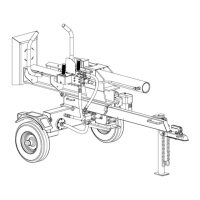
The Venom 22-Ton Log Splitter is a robust hydraulic machine engineered for splitting wood logs. Its primary function is to convert raw logs into smaller, more manageable pieces, typically for firewood or other applications. The log splitter is built with heavy-duty steel construction and boasts a significant ram force, making it suitable for demanding outdoor power equipment tasks. A key feature of this log splitter is its versatility, as it is designed to operate in both horizontal and vertical positions, accommodating different log sizes and user preferences. The horizontal position is particularly recommended for lighter logs that can be easily loaded onto the beam, helping to prevent back injuries that might result from improper lifting techniques.
The log splitter is powered by an air-cooled 208cc engine, which drives the hydraulic pump responsible for generating the splitting force. The hydraulic system includes a 4-inch bore and 23-1/4-inch stroke hydraulic cylinder, rated to 3600 psi. The splitting mechanism features an 8-inch wedge with wedge wings and tapered ends, designed to facilitate easier splitting. A control valve lever allows the operator to manage the forward and backward movement of the splitting wedge, providing precise control over the splitting process.
For ease of transport, the log splitter is equipped with tires and a tow bar, allowing it to be moved with an ATV or lawn/garden tractor. Safety chains and a 50mm coupler are included to secure the log splitter to a vehicle hitch during towing, preventing accidental detachment. The maximum rated towing speed is 45 MPH, and operators are cautioned to reduce speed on rough terrain, along creeks, ditches, and hillsides to avoid personal injury or equipment damage. A support leg is provided to stabilize the log splitter during operation, preventing unwanted movement.
The manual emphasizes the importance of safety through various warnings and instructions. Hazard signal words such as DANGER, WARNING, and CAUTION are used to highlight potential personal injury hazards and property damage risks. Operators are strongly advised to read and understand the entire manual before using the equipment to prevent serious injury to themselves or bystanders.
Key operational warnings include never carrying passengers, sitting, or standing on the log splitter, and preventing children from playing on or climbing the equipment. Regular inspection of the log splitter for good working condition and immediate replacement or repair of damaged parts are crucial. All hardware and assembled parts must be checked and tightened before operation. The equipment's maximum load capacity of 22 tons should never be exceeded. Operation should always be on clear and level ground, and only during daylight hours.
Crush and cut hazards are specifically addressed, with instructions to keep hands and feet clear from moving parts and to maintain a clean work area free of debris. Operators are required to wear appropriate safety gear, including eye protection, gloves, and work boots. The engine exhaust contains carbon monoxide, a colorless, odorless, and poisonous gas, necessitating operation outdoors in a well-ventilated area to prevent nausea, dizziness, fainting, or death.
Assembly of the log splitter is required before use, and the manual recommends the assistance of another adult due to the equipment's weight and size. Upon receipt, all components should be closely inspected for missing or damaged parts. Tools required for assembly include a rubber or wooden hammer, various wrenches (13mm, 16mm, 17mm, 18mm, 19mm, 24mm, 27mm), a large adjustable wrench, a Phillips screwdriver, and pliers.
Before initial operation, several critical steps must be followed. The engine is shipped without oil and must be filled with SAE 10W-30 motor oil according to the engine manual's capacity. Similarly, the hydraulic oil tank is shipped without oil and needs to be filled with approximately 3 gallons of hydraulic oil (10W AW, AW-32, ASLE H-150, ISO 32, Universal Hydraulic Fluid, or Dexron III Transmission Fluid). The oil level should be verified using the oil filter/dipstick. After filling, the engine should be started, and the control lever should be extended and retracted several times to remove air from the hydraulic lines, then the hydraulic oil level checked again and topped off if necessary.
When operating, the log splitter must be on a flat, level surface with at least seven feet of clearance from combustible material. The work zone must be maintained at all times, and other people should be kept outside this zone. The hydraulic oil needs to be above 10°F (-12°C) before starting the engine; if outdoor air temperature is below 32°F (0°C), the log splitter should be warmed up by extending and returning the wedge several times before splitting wood. Both support legs should be in the down position, and tires blocked to prevent movement.
Loading logs onto the beam should be done against the endplate, with a maximum log length of 25 inches. Hands must be kept clear of the wedge and crush hazard areas. If a log gets stuck or does not split completely, the control lever should be pushed in reverse to strip the log from the wedge. If it remains stuck, the machine should be turned off, and a sledgehammer and crowbar used to remove the log, always keeping hands clear of the log and wedge during retraction. The work zone should be kept clean and free of split wood and debris.
Maintenance is crucial for the longevity and safe operation of the log splitter. Before any maintenance, the engine must be turned off, and the control lever moved forward and backward to relieve hydraulic pressure. All guards, shields, and safety features must be reinstalled after maintenance. Tires should be checked for recommended pressure before operation. Regular greasing of the axle and wheel bearing area is necessary, ensuring axle nuts and pins are secure afterward. Fasteners and hoses should be periodically checked for tightness and leaks. Annually, all moving parts should be cleaned and lightly lubricated. Scratched or worn painted metal surfaces can be touched up with glossy enamel spray paint. The 22-ton load capacity should never be exceeded to prevent damage.
Specific maintenance tasks include inspecting hoses for exposed wire mesh and leaks, and hydraulic fittings for cracks and leaks, replacing any damaged components. Nuts and bolts should be checked for looseness and tightened. The beam surface requires grease, and debris should be cleared from moving parts. For engine maintenance, operators are directed to refer to the Engine Owner's Manual. Only manufacturer-specified replacement parts should be used to avoid safety hazards or poor operation.
For storage, the log splitter should be clean and dry. All surfaces and moving parts should be lightly lubricated to prevent rust. The equipment should be stored indoors or in a protected area during severe weather and winter months.
Troubleshooting guidance is provided for common issues such as the cylinder rod not moving, slow rod speed, wood not splitting, engine bogging down, or stalling under low load conditions. Solutions often involve checking hydraulic oil levels, inspecting hoses for blockages, flushing hydraulic systems, adjusting control valves, or returning damaged components for authorized repair. For engine control issues, adjusting idle control nuts or using shorter log lengths is suggested.
 General
| Engine | 6.5 HP |
|---|---|
| Tonnage | 20 tons |
| Max Log Length | 20.5 Inches |
| Maximum Log Diameter | 12 inches |
| Power Source | Gasoline |
| Maximum Splitting Force | 20 tons |

 To Next Page