This document serves as a user manual for the Vermeiren Eagle 620 and Eagle 625 patient hoists, providing comprehensive instructions for their operation, maintenance, and technical specifications.
Function Description
The Vermeiren Eagle 620 and Eagle 625 are patient hoists designed as transport/transfer aids for elderly persons or individuals with mobility impairments such as paralysis, limb loss or defects, stiff or damaged joints, cardiovascular problems, or cachexia. These hoists are intended for indoor use and are operated by an attendant to transfer sitting patients between various locations like wheelchairs, nursing beds, and bathrooms. They are designed to transport/transfer only one person at a time, up to a maximum weight specified in the technical specifications. The hoists are not intended for transporting goods or objects.
The hoists feature a cantilever arm, a spreader bar, and a motor for lifting and lowering patients. The chassis includes casters, with two having brakes for stability. A control box manages the hoist's operations, including battery charging and emergency functions. The chassis width can be altered to increase stability or to navigate around obstacles. Parking brakes are available on the casters to secure the hoist during transfers.
Important Technical Specifications
General:
- Models: Eagle 620, Eagle 625
- Maximum Load: Eagle 620: 150 kg; Eagle 625: 175 kg
- Operating Temperature: +5 to +40°C
- Relative Humidity: 20% to 90% at 30°C, non-condensing
- Noise Level: < 50 dB(A)
- Air Pressure: 700 to 1060 hPa
- Insulation Class: II - Type B
- Operational Performance: Approximately 40 lifts per charge
- Periodic Operation: Max. 10%, or 2 min. continuous operation/18 min. pauses
- Expected Lifespan: 8 years (average)
Dimensions (Eagle 620 / Eagle 625):
- Lowest CAP position: 728 mm / 766 mm
- Highest CAP position: 1740 mm / 1840 mm
- Lifting range (range of heights): 1012 mm / 1074 mm
- Leg length: 1000 mm / 1150 mm
- Total length: 1115 mm / 1290 mm
- Minimum leg separation: 463 mm / 554 mm
- Maximum leg separation: 833 mm / 945 mm
- Leg height / Frame height: 111.5 mm / 111.5 mm
- Overall width (closed), external dimension: 550 mm / 680 mm
- Overall width (opened), castors forwards: 1035 mm / 1225 mm
- Folded length: 1180 mm / 1220 mm
- Folded height: 480 mm / 480 mm
- Folded width: 550 mm / 680 mm
- Turning circle: 1160 mm / 1290 mm
- Total weight: 37 kg / 42 kg
- Weight of chassis + motor: 17 kg / 20 kg
- Weight of cantilever arm / spreader bar: 20 kg / 22 kg
- Free height, minimum: 51.5 mm / 51.5 mm
Battery and Charging (Eagle 620):
- Primary Voltage (charger): 100-240VAC / 50/60 Hz
- Secondary Voltage (charging voltage): 27.6VDC (+/- 2%)
- Secondary Current (charging current): Max. 500 mA
- Battery Capacity: 2.9 Ah
- Charging Time: Approximately 4 hours (for initial charge)
- Safeguards: Protected against reverse polarization, electrical surges, and extreme temperature.
- Conformity: Tested in accordance with IEC 60601-1
Battery and Charging (Eagle 625):
- Battery Voltage: 24 VDC (replaceable with integrated clip system)
- Control Box Primary Voltage: 100-240 VAC / 50/60 Hz
- Control Box Secondary Voltage (charging voltage): 24 VDC, max. 250 VA
- Control Box Secondary Current (charging current): Max. 10 A
- Battery Capacity: 2.9 Ah
- Charging Time: Approximately 24 hours (for initial charge via control box)
- Safeguards: Protected against reverse polarization, electrical surges, and extreme temperature.
- Conformity: Tested in accordance with IEC 60601-1
Motors and Control:
- Control Box: Linak CBJ Home (Eagle 620), Linak CBJ2 (Eagle 625)
- Battery: Not applicable (Eagle 620), Linak BAJ1 (Eagle 625)
- Manual Control: Linak HB7X (≤ 5N force required to operate)
- Motor: Linak LA31C (6000N) (Eagle 620), Linak LA34 (10000N)
- Control box protection class: IPX4
- Battery protection class: Not applicable (Eagle 620), IPX5 (Eagle 625)
- Manual control protection class: IP66
- Motor protection class: IP54
Usage Features
- Operation by Qualified Staff: The patient hoist must only be operated by qualified staff who have been instructed or trained in its specific application.
- Weight Limits: Do not exceed the maximum load. If different user weights are specified for the hoist and slings, always observe the lowest user weight.
- Attendant Presence: An attendant must be present during the lifting operation.
- Surface Requirements: Use the patient hoist only on flat surfaces where all casters touch the ground, ensuring sufficient contact for safe operation. Avoid obstacles during transfers.
- Environmental Conditions: Do not use the patient hoist in wet or humid environments. Be aware that parts may become hot or cold due to ambient temperature or heating devices.
- Electromagnetic Compatibility: The hoist complies with electromagnetic compatibility standards, but users should be aware of potential interference from mobile phones, power generators, or high-power energy sources. The hoist's electronics can also affect other electronic appliances.
- Chassis Width Adjustment: The chassis width can be altered using a pedal to increase stability or navigate tight spaces.
- Parking Brakes: Two casters at the back of the chassis have brakes. Push the brake plate down to engage and up to release.
- Cantilever Arm Adjustment: The cantilever arm can be raised and lowered using controls on the control box.
- Moving the Patient Hoist: When moving the hoist, ensure both back caster brakes are released. Push the hoist slowly to the desired position. When unloaded, pull the hoist backward to navigate obstacles.
- Turning the Patient Hoist: To turn the hoist around its axle, open the legs for stability, activate the brakes, place the patient in the sling, lift the patient, loosen both brakes, and carefully turn the hoist.
- Slings: Only appropriate, undamaged, and Vermeiren-approved slings should be used. The mounting straps of the slings have 4 loops in different colors for various positions (shoulders, legs, head) and methods (crossed legrests, crossed under thighs, each legrest separately). The spreader bar must always be perpendicular to the patient's body.
- Emergency Stop: The hoists are equipped with an emergency stop button (red pushbutton) on the control box. Pressing it activates the emergency stop. For Eagle 620, push and turn in the direction of the arrows to activate/deactivate. For Eagle 625, press the red button to activate, and turn to deactivate.
- Emergency Lowering: In an emergency, the patient can be manually lowered. For Eagle 620, press the bottom button on the control box panel. For Eagle 625, pull the red pull button at the lower end of the motor. This emergency lowering is factory-set for a patient weight of 75 kg.
Maintenance Features
- Regular Checks: To ensure safety and prolong the product's lifetime, regular checks and servicing are essential.
- Warranty: The warranty is based on normal use and maintenance as described in the manual. Damage from improper use or lack of maintenance will void the warranty.
- Information Availability: The most recent version of the manual and updates are available on the Vermeiren website. Visually impaired people can download an electronic version.
- Delivery Check: Upon delivery, verify that all items are included and free from visible defects.
- Assembly: The hoist is delivered fully assembled. Instructions for assembly (e.g., raising the pole, inserting safety spindle) are for specialist dealers. Ensure the emergency stop is pressed before assembly.
- Battery Charging (Eagle 620): Insert the recharge cable into the control box, then the mains adapter into the socket. A yellow light on the upper LED indicates charging. Remove the mains plug first, then the charger from the control box after charging. Do not use the lift while charging. Recharge at least once a month even if not in use to prevent deep discharge.
- Battery Charging (Eagle 625): The Eagle 625 has an integrated battery charger in the control box. Insert the supply cable into the control box and the plug into the socket. The right LED will light green during charging; all three LEDs on indicate a full charge. Do not use the lift while charging. Recharge at least once a month.
- External Charger (Optional for Eagle 625): An optional external charger can be wall-mounted to charge a spare battery, allowing continuous hoist use.
- Battery Swapping (Eagle 625): The battery is replaceable via an integrated clip system. Pull the clip system to lift the plate and remove the battery from the holder. Use only proper batteries and avoid temperatures below +5°C or above +50°C. Opening the battery voids the manufacturer's liability.
- Before Each Use: Inspect the following: all parts present and undamaged, clean, frame parts for deformation, stability, or loose connections, brakes for damage, control box, manual control, battery charger, and relevant cables for damage or wear. Check that the cantilever arm is working properly.
- Approx. Every 8 Weeks: Lubricate joints of the cantilever arm, check caster condition, check for visible damage to control box casing, battery, and manual controls, check cable fit, and recharge the battery.
- Approx. Every 6 Months or for Every New User: Cleanliness, general condition, battery charger functionality, and caster operation.
- Yearly or More Often: Have the patient hoist inspected and serviced by a specialist dealer. The minimum maintenance frequency depends on use.
- Shipping and Storage: Store the hoist dry, prevent cable damage, disconnect power plugs, protect against rust and foreign bodies, and store all removed parts together.
- Cleaning: Never use a hose or high-pressure cleaner. Use mild commercial detergent, a sponge, or a soft brush. Avoid strong cleaning liquids or hard brushes. Clean plastic parts with commercial plastic cleaners. For coated surfaces, use warm water and normal household detergents. Wipe the control box, motor casing, and manual controls with a cloth moistened with cleaner. Avoid abrasives or sharp-edged polishing equipment. Regularly check plug connectors for corrosion or damage.
- Disinfection: Disinfection is restricted to authorized personnel. All parts can be scrubbed with a commercial disinfectant. Follow disinfectant instructions. Slings have separate washing instructions.
- Inspection (Annual): A minimum of one inspection per year by authorized persons is recommended. Checks include cabling, frame parts, paintwork, casings, metal joints, plastic parts, charger/control box residual discharge current and insulation resistance, functional test of cantilever arm, hoist drives, emergency stop, and emergency lowering. Only electricians can release the hoist for use after measurements and servicing.
- Reuse: Before each reuse, disinfect, inspect, and service the patient hoist.
- End of Use: Dispose of the patient hoist according to local environmental legislation, disassembling it to facilitate recycling.

 Need help?
 General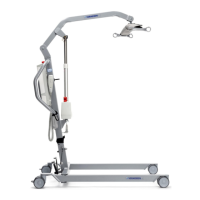

 To Next Page