The VEVOR Mechanical Jack is a robust lifting tool designed for various applications, particularly in agricultural and off-road settings, often referred to as a "Farm Jack." It is built for tough tasks, offering a competitive price point as suggested by the "TOUGH TOOLS, HALF PRICE" slogan. The jack's primary function is to lift heavy loads, providing a mechanical advantage for tasks such as changing tires, lifting vehicles, or assisting in recovery operations.
Important Technical Specifications:
The VEVOR Mechanical Jack comes in two main models, AH081048 and AH081060, differing primarily in their maximum raised height and corresponding weight capacities.
Model AH081048:
- Maximum Raised Height: 48 inches
- Product Weight: 12.3 kg
- Rated Load (kg) based on lifting height (H):
- H ≥ 915mm: 750 kg
- 610mm ≤ H < 915mm: 1500 kg
- 305mm ≤ H < 610mm: 2250 kg
- 125mm ≤ H < 305mm: 3000 kg
Model AH081060:
- Maximum Raised Height: 60 inches
- Product Weight: 13.5 kg
- Rated Load (kg) based on lifting height (H):
- H ≥ 1220mm: 375 kg
- 915mm < H < 1220mm: 750 kg
- 610mm < H < 915mm: 1500 kg
- 305mm < H < 610mm: 2250 kg
- 125mm < H < 305mm: 3000 kg
These specifications highlight the inverse relationship between lifting height and rated load capacity, a common characteristic of mechanical jacks. The lower the lifting point, the higher the load the jack can safely support.
Usage Features:
The VEVOR Mechanical Jack is designed for straightforward operation, with specific procedures for both raising and lowering loads.
Basic Safety Precautions for Use:
- Ensure the jack's base is on firm and level ground to prevent instability.
- Verify that the jack will not slip once the load is applied.
- Confirm that the lifting arm is fully under the load.
- Stabilize the load before lifting or lowering to prevent shifting.
- Never work under a vehicle supported only by the jack; always use appropriate jack stands.
- Lower the load carefully; do not push it off the jack.
- Avoid using handle extensions, as this can compromise safety and the jack's integrity.
- Do not carry the jack by its handle.
To Raise a Load:
- Position the jack's foot beneath the load, adhering to all safety precautions.
- Lift the Reversing Latch (20) to its "UP" position, ensuring it is securely locked with the indentation firmly engaged in the notch on the Reversing Switch (18).
- Jack up the nose until it makes contact with the load at the desired lifting point. Pause to check for any obstacles that might hinder a clean lift.
- Pull down firmly and evenly on the handle. As the handle is pulled down, the climbing pin (15) will click into place in a hole in the steel bar (3).
- Relax the handle, allowing the pin (15) to bear the load.
- Raise the handle to the top of its stroke to take a fresh purchase, then pump the handle again to continue lifting.
- Important: Do not use handle extensions and always maintain a firm grip on the handle.
To Lower a Load:
- Important: The jack requires a minimum load of 50kg (110 lbs) to lower step-by-step. Without this minimum load, the lifting nose may drop abruptly.
- Take the load with the jack (i.e., lift the load slightly) while ensuring the handle is in the FULLY UPRIGHT position.
- Trip the Reversing Latch (20) to its "Down" position. This disengages the indentation on the Latch from the notch on the Reversing Switch.
- Keeping a firm grip on the handle, pump it as if raising a load. This action will cause the jack to lower the load in controlled steps.
Product Structure (Part List):
The jack comprises several key components:
- Top Clamp-Clevis Bolt
- Top Clamp-Clevis
- Steel Standard (Bar)
- Steel Handle w/Cotter Pin
- Handle Socket
- Pin
- Hex Bolt
- Connecting Rod
- Small Runner
- Screw Bolt
- Base
- Climbing Pin Spring (2 required)
- Climbing Pin (2 required)
- Cross Pin (2 required)
- Reversing Switch Cam Bar and Spring
- Cap Screw w/Washer
- Reversing Latch
- Reversing Switch Spring
- Large Runner
- Running Gear (assembled)
Maintenance Features:
While the manual does not explicitly detail a maintenance schedule, the exploded diagram indicates areas for lubrication ("LUBE") on the steel standard (3) and the running gear (20). Regular lubrication of these moving parts is crucial for smooth operation and to prevent wear and tear.
Common Fault Analysis:
- Fault Phenomenon: The jack deformation.
- Failure Cause: The actual load weight exceeds the maximum product load.
- Solution: Ensure the actual load weight does not exceed the maximum product load. This highlights the importance of adhering to the specified load capacities to prevent structural damage and ensure safe operation.
The VEVOR Mechanical Jack is a practical tool for heavy-duty lifting, emphasizing user safety through clear operating instructions and warnings against exceeding load limits. Its design, with distinct components for lifting and lowering, makes it a versatile asset for various demanding tasks.

 Need help?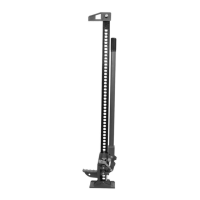

 To Next Page
 General