This document describes the VEVOR Telescopic Ladder, models DLT215F and DLT218F, designed for various tasks requiring elevated access.
Function Description
The VEVOR Telescopic Ladder is a versatile tool for reaching elevated areas. Its telescopic design allows for easy extension and shortening, making it suitable for light work of short duration. The ladder features an automatic locking mechanism for each step/rung, ensuring safety during use. It is designed for both complete and partial extension, providing flexibility for different work requirements.
Important Technical Specifications
The ladder models DLT215F and DLT218F have distinct specifications:
Model DLT215F:
- Extended Height: 15 ft
- Number of Floors: 12 Layers
- Maximum Load Capacity Each Layer: 420 lbs (190 kg)
- Overall Dimensions (LWH): 96548095mm
Model DLT218F:
- Extended Height: 18.5 ft
- Number of Floors: 14 Layers
- Maximum Load Capacity Each Layer: 420 lbs (190 kg)
- Overall Dimensions (LWH): 1135480100mm
Both models share a maximum total load capacity of 420 lbs.
Usage Features
Before Using:
- Ensure the user is fit enough to use the ladder. Avoid use under the influence of medication, alcohol, or drugs.
- The weight capacity is 420 lbs.
- When transporting, ensure the ladder is suitably placed on roof bars of a vehicle to prevent damage.
- Inspect the ladder after delivery and before first use to confirm its condition and operation.
- Visually check the ladder for damage and ensure it is safe to use.
- Professional users should perform regular periodic inspections.
- Ensure the ladder is suitable for the task.
- Do not use a damaged ladder.
- Remove any contamination from the ladder, such as wet paint, mud, oil, or snow.
- When using the ladder at work, a risk assessment should be carried out respecting the legislation in the country of use.
Positioning and Erecting the Ladder:
- The incline angle should not exceed 75 degrees.
- The ladder should be on an even, level, and unmovable base.
- Leaning ladders should be leaned against a flat non-fragile surface and secured before use, e.g., tied or use a suitable stability device.
- When positioning the ladder, consider the risk of a collision with pedestrians, vehicles, or doors (no fire exists) and windows in the work area.
- Identify any electrical risk areas, such as overhead lines or exposed electrical equipment.
- The ladder must be on its feet, not the rungs or steps.
- Avoid positioning ladders on slippery surfaces (ice, shiny waxed surfaces, or contaminated solid surfaces) unless additional effective safety measures are taken or surfaces are sufficiently cleaned.
Using the Ladder:
- Do not exceed the maximum total load of 420 lbs.
- Avoid overreaching; users should keep their buckle (navel) inside the stiles and both feet on the same step/rung.
- Do not step off a leaning ladder at a higher level without additional security or a suitable stability device.
- Do not use standing ladders for access to another level.
- Do not stand on the top three steps/rungs of a leaning ladder.
- Ladders should only be used for light work of short duration.
- Avoid using ladders outdoors in adverse weather conditions, such as strong winds.
- Take precautions against children playing around the ladder.
- Face the ladder when ascending and descending.
- Maintain a secure grip on the ladder when ascending and descending.
- Do not use the ladder as a bridge.
- Wear suitable footwear.
- Avoid excessive side loading (e.g., drilling brick and concrete).
- Do not spend long on a ladder without regular breaks (fatigue is a safety risk).
- Leaning ladders used for access to a higher level should be extended at least 1m above the landing point.
- Equipment carried should be light and easy to handle.
Opening the Ladder:
- The actual number of ladder steps may vary.
- Each step/rung has two locking pins that automatically insert into the slots of the uprights when extended.
- Unlocked position: A gap exists between the buttons and the spar.
- Locked position: The buttons are located directly on the leg.
Complete Extension:
- Place the ladder on firm, level ground, and put one foot on the lowest step/rung.
- Extend the top rung and check if the buttons are locked. Repeat this process with the next lower rungs until the arms are fully extended.
- Caution: Always check that all buttons are in the "locked" position before climbing.
Partial Extension:
- Place the ladder on firm and flat ground, move one foot onto the lowest rung.
- Extend the lowest rung and check if the buttons are locked. Repeat with each higher rung until the arms are completely extended to the desired height.
- Caution: Always check that all buttons are in the "locked" position before climbing.
Shortening the Ladder:
- Place the ladder on firm and level ground.
- Shorten the ladder from the lowest rung.
- Use the two keys to unlock the rungs.
Maintenance Features
Cleaning Instructions:
- Store the ladder in the closed position.
- Properly secure and support the ladder while in transit.
- Keep the ladder clean and free from all other harmful materials.
Troubleshooting:
- If the rear ladder opens to lean left and right, and the section of the ladder does not expand properly, the solution is to take back the ladder and check whether each section is stuck. Ensure normal shrinkage. Re-open it and make sure that each section is in place (there are lock marks on both sides of the pedal).
Disposal:
- Dispose of all packaging (paper, cartons, plastic, plastic bags) according to local recycling regulations.
- At the end of the product's lifespan, dispose of it at an authorized household waste recycling center.

 Need help?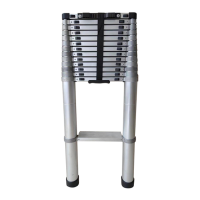

 To Next Page
 General