This document describes a single-phase induction motor manufactured by VEVOR, a brand known for providing "Tough Tools, Half Price." The manual provides essential information for the safe operation, maintenance, and troubleshooting of the motor, which is available in several models: DP120356L, DP123756, DP120556S, and DP120556HZ.
Function Description
The device is a single-phase induction motor designed for various applications requiring rotary motion. It operates on a single-phase alternating current supply and converts electrical energy into mechanical energy. The motor is intended for continuous operation (Cont. S1 duty) and includes overload protection with a manual reset feature to prevent damage from excessive loads. Its design allows for rotation in both counter-clockwise (CCW) and clockwise (CW) directions, which can be adjusted by modifying the wiring.
Important Technical Specifications
The motor models covered in this manual share several core specifications while differing in horsepower, rated current, and shaft diameter.
General Specifications:
- Phase: One/Single Phase
- Voltage: 230V
- Frequency: 60 Hz
- Rated Speed: 3450 RPM
- Rotation: CCW/CW (adjustable)
- Enclosure: ODP (Open Drip Proof)
- Insulation: F
- Service Factor: 1
- Duty: Cont. S1 (Continuous operation)
- Class of Protection: IP23
- DES-AMB (Design Ambient Temperature): 40 °C
- Protection: Overload Protection with Manual Reset
Model-Specific Specifications:
- DP120356L:
- Horsepower: 3HP
- Frame Size: 56
- Rated Current: 15.0 A
- Shaft Length: 1.88"
- Shaft Diameter: 5/8" Keyed shaft
- DP123756:
- Horsepower: 3.7HP
- Frame Size: 56
- Rated Current: 17.2 A
- Shaft Length: 1.88"
- Shaft Diameter: 5/8" Keyed shaft
- DP120556S:
- Horsepower: 5HP SPL
- Frame Size: 56
- Rated Current: 15.0 A
- Shaft Length: 1.88"
- Shaft Diameter: 5/8" Keyed shaft
- DP120556HZ:
- Horsepower: 5HP
- Frame Size: 56HZ
- Rated Current: 22.0 A
- Shaft Length: 2.25"
- Shaft Diameter: 7/8" Keyed shaft
Usage Features
The motor is designed for ease of use and reliability, but requires careful adherence to safety guidelines and proper installation.
Installation and Wiring:
- The motor's voltage, frequency, and wiring style must match the nameplate specifications.
- Power supply voltage should be maintained within ±5% of the rated operating range.
- A good grounding device is mandatory for safety.
- Before initial operation, the winding insulation resistance to ground must be measured (500-volt megohm table) and should exceed 0.2 megohm. If lower, the motor needs to be dried.
- The factory setting for wiring is 230V. The manual provides a detailed wiring diagram, indicating how to connect the motor lead wires (T1-T7) to the power cable (Line 1 and Line 2) via the terminal block.
- Rotation direction can be changed from counter-clockwise (CCW) to clockwise (CW) by exchanging the T2 and T3 connections.
Operational Considerations:
- Before starting, the action shaft should rotate flexibly without friction or collisions, running smoothly and lightly. Any strange noise, overheating, burning smell, smoke, or slow speed requires immediate power shutdown, inspection, and repair.
- The surrounding environment must be kept clean, dry, and well-ventilated.
- The motor should not be allowed to run backward slowly or be subjected to frequent starts.
- Capacitor-running motors are not suitable for long-term light-load use.
- The maximum permissible temperature rise for the winding, core, and rolling parts should not exceed 75 °C, 75 °C, and 55 °C respectively during continuous operation at rated power.
- The motor is suitable for use in wet and dusty places, but regular cleaning and inspection are crucial to prevent foreign bodies from damaging the interior.
Troubleshooting:
The manual outlines common problems and their remedies:
- Motor shaft not rotating upon receipt: This may be due to concentricity damage during transportation. The solution involves gently hammering the shaft, front end cover, and back end cover with a wooden or rubber hammer to adjust concentricity until the shaft turns flexibly.
- Motor does not work when powered on: Check the power supply output voltage, verify wiring against the diagram, and press the red protector button to reset (listen for a "click" sound).
- Motor rotates slowly and cannot start normally: Check power supply voltage, verify wiring, and ensure the motor's capacitance is in good condition.
- Motor heats up and stops working after a period: This indicates an overloaded condition triggering the protector. Allow the motor to cool for half an hour, then press the red protector button to reset and retry.
Maintenance Features
Regular maintenance is crucial for the longevity and optimal performance of the motor.
Routine Maintenance:
- Bearing Grease: Bearing grease should be changed every six months, filling approximately 60% of the bearing chamber gap.
- Fastening: Regularly check that the motor fastening is secure.
- Electrical Contacts: The electrical contacts in the outlet box must be kept clean and ensure good contact. The motor's air inlet plug should also be checked to prevent issues affecting motor life.
- Cleaning: Every six months, the motor should be inspected and cleaned to remove dust, oil, grease, and abrasions.
- Operational Checks: During operation, continuously monitor the load data against requirements. Check for bearing heat or leakage. Any abnormal sound or issue requires immediate shutdown for inspection. Do not attempt to restart until the fault is identified and rectified.
The motor is designed to operate effectively up to 1000 meters above sea level and in ambient air temperatures not exceeding 45 °C. The IP23 protection class indicates that it is protected against solid objects larger than 12.5 mm and against direct sprays of water up to 60 degrees from the vertical.

 Need help?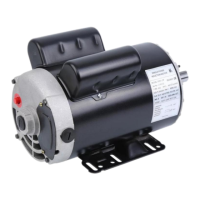

 To Next Page
 General