EasyManua.ls Logo

VGOOD Airplane-32 Series - User Manual

VGOOD Airplane-32 Series
3 pages
Print Icon
To Next Page IconTo Next Page
Loading...
VGOOD Airplane-32 Series ESC Manual
Introduction:
Thank you for purchasing V-GOOD Airplane-32 ESC product!
Brushless power systems can be very dangerous. Any improperuse may cause personal injury
and damage to the product andrelated devices. We strongly recommend reading through this
user manual before use.
Because we have no control over theuse, installation, or maintenance of this product, no liabil
itymay be assumed for any damage or losses resulting from theuse of the product. We do not
assume responsibility for anylosses caused by unauthorized modifications to our product.For t
he latest specifications, please visit the company website: www.vgoodrc.com
Product Features:
1.32 bit ARM MCU, small size, light weight and rapid running speed.
2. High resolution, smooth and responsive throttle linear. Throttle signal loss protect
implemented.
3. Synchronous rectification, regenerative braking, more energy-efficient compared with the
other regular ESCs.
4. Automatically detect input signal. Throttle is available for setting to compatible with
different controllers.
5. Good compatibility to motors, it can work well for most motors in the market.
6. Easy to program with prog-card, specially designed for fixed wing, complete independent
intellectual property rights with software and can keep on upgrading.
Specification:
1. Support 6A-150A, 2- 8S (Please check ESC sticker to verify the specified cells and power,
more high voltage items to be added)
2. PWM output frequency range is 8-24KHz. Different PWM frequency can be set by
programming card.
3. Regular throttle range is: 900us~2400us
4. Max RPM: 300,000 rolls (2poles), 100,000 rolls (6poles), 50,000 rolls (12poles).
5. Customized settings can be done with prog-card and controller (Brake/Non Brake).
6. 60A and above supports adjustable temperature protection
7. It supports setting motor forward/Backward by prog-card.
Connection Diagram:
Question and Answer IconNeed help?

Do you have a question about the VGOOD Airplane-32 Series and is the answer not in the manual?

Summary

Introduction and Product Overview

Product Introduction and Disclaimer

Introduces the V-GOOD ESC, emphasizes safety, and provides a disclaimer for product usage.

Product Features

Core Performance and Control

Features 32-bit ARM MCU, rapid speed, high-resolution smooth throttle control with signal loss protection.

Efficiency and Compatibility

Synchronous rectification, regenerative braking, auto-detection, and good motor compatibility.

Programmability and Upgradability

Easy programming with a prog-card for fixed-wing aircraft, with ongoing software upgrades.

Technical Specifications

Power Handling and Battery Support

Supports 6A-150A ESCs and 2-8S LiPo batteries, with specs varying by ESC model.

Operational Parameters

PWM frequency 8-24KHz, throttle range 900us-2400us, max RPM up to 300,000 rolls.

Customization and Protection

Customizable settings via prog-card, temperature protection (60A+), and motor direction control.

ESC Operation Procedures

Throttle Calibration Process

Step-by-step guide for calibrating the ESC's throttle range with the transmitter.

Brake Setting via Controller

Procedure to enable or disable brake function using the transmitter stick and ESC beeps.

Normal Startup Sequence

Describes the standard procedure for powering on the ESC and motor after connection.

Programming Card Settings

Battery Type and Cutoff Voltage

Configuration options for battery type (LiHv, LiPo, NiMh) and low voltage cutoff levels.

Lithium Cell Count and Timing

Settings for the number of lithium cells (2-8S) and advanced timing adjustments (0-30 degrees).

Protection and Motor Settings

Adjustable temperature protection, brake strength, motor direction, and startup power.

Safety and Attention Points

General Safety Warnings

Crucial safety guidelines to prevent injury and device damage when operating brushless power systems.

Operational Cautions

Important notes on motor rotation, polarity, timing, and propeller clearance during operation.

Troubleshooting and Revisions

Fault Analysis by Beeps

Interpreting ESC warning beeps for issues like under-voltage, over-temperature, or signal failure.

Revision History

Log of document revisions, including initial release and updates for new features like temperature protection.

Overview

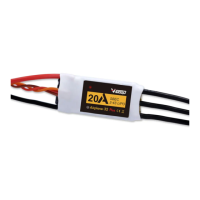
The VGOOD Airplane-32 Series ESC (Electronic Speed Controller) is a sophisticated device designed for brushless power systems in remote-controlled aircraft. It utilizes a 32-bit ARM MCU, ensuring rapid processing and efficient operation. This ESC is characterized by its compact size and lightweight design, making it suitable for a wide range of fixed-wing applications.

Function Description:

The primary function of the VGOOD Airplane-32 Series ESC is to control the speed and direction of brushless motors in RC airplanes. It translates the throttle input from the receiver into precise motor commands, enabling smooth and responsive control. The ESC incorporates synchronous rectification and regenerative braking, which contribute to its energy efficiency compared to conventional ESCs. It automatically detects the input signal, allowing compatibility with various controllers. A key safety feature is throttle signal loss protection, which helps prevent uncontrolled operation in case of signal interruption. The device is designed for easy programming using a dedicated programming card, offering a comprehensive set of adjustable parameters tailored for fixed-wing aircraft. It also boasts complete independent intellectual property rights with its software, allowing for continuous upgrades and improvements.

Important Technical Specifications:

  • Processor: 32-bit ARM MCU
  • Current Range: Supports 6A to 150A (specific current rating should be verified from the ESC sticker)
  • Battery Cells: Compatible with 2 to 8S LiPo batteries (more high voltage items to be added in future revisions)
  • PWM Output Frequency: Adjustable from 8KHz to 24KHz via programming card.
  • Throttle Range: Standard range is 900us to 2400us.
  • Maximum RPM:
    • 300,000 rolls for 2-pole motors
    • 100,000 rolls for 6-pole motors
    • 50,000 rolls for 12-pole motors
  • Temperature Protection: 60A and above models support adjustable temperature protection.
  • Motor Direction: Supports setting motor forward/backward via programming card.

Usage Features:

  1. Throttle Calibration: Essential for initial setup. It involves powering on the ESC with the throttle stick at the highest position, waiting for a "♪♪" beep, then moving the stick to the lowest position, and waiting for two "♪♪" beeps to confirm calibration.
  2. Brake ON/OFF Setting: Configurable via the controller. After powering on the ESC with the stick at mid-throttle, a sequence of beeps indicates entry into the brake setting procedure. Moving the stick to max throttle sets Brake ON, while moving it to min throttle sets Brake OFF. Two "♪♪" beeps confirm the setting.
  3. Normal Start Procedure: Begin by setting the controller's throttle stick to minimum. Connect the ESC according to the diagram and power it on. The ESC will detect battery cells and motor beeps will indicate the number of cells (e.g., "♪♪♪♪" for 4 cells). Two "♪♪" beeps confirm readiness.
  4. Programming Card Settings: The programming card allows detailed customization of various parameters:
    • Cutoff Mode: Options include Off, Slow down, and Cut off, with battery types such as LiHv, LiPo, and NiMh.
    • Cutoff Voltage: Adjustable from 2.9V to 3.5V.
    • Lithium Cells: Manual selection from 2 to 14 cells, or an Auto-detection option.
    • Protect Temperature: Adjustable from Off, 90°C, 100°C, 110°C, 120°C, 130°C, to 140°C.
    • Advanced Timing: Adjustable from 0°, 6°, 12°, 18°, 24°, 30°, or Auto.
    • Brake Strength/Motor Direction: Brake strength options include Off, 25%, 50%, 75%, 100%. Motor direction can be set to Normal or Reversed.
    • Startup Power: Adjustable from 10%, 20%, 25%, 30%, 35%, 40%, to 45%.
    • Auto Rotation Restart Time: Adjustable from Off, 105, 155, 205, 305, 405, to 605.
    • Note: Red line marked settings are the default values.

Maintenance Features:

The manual emphasizes several safety and attention points that contribute to the longevity and safe operation of the ESC:

  • Battery Management: Avoid prolonged operation with under-voltage batteries to preserve battery life and ESC efficiency.
  • Temperature Management: Do not operate the ESC for extended periods when it is over temperature, as this can damage the MOS FETs. For 60A and above models, adjustable temperature protection is available.
  • Voltage Management: Prevent the ESC from being over-voltage for long durations to avoid shortening its lifespan.
  • Propeller Safety: Always keep all objects clear of the propeller when the power system is connected to the battery.
  • Motor Protection: Avoid continuous operation if the motor is blocked, as this can reduce the lifespan of both the motor and the ESC.
  • Safe Operation Environment: Always use the ESC in a safe situation.
  • Power Source: Only use battery power supply; do not plug directly into AC power.
  • Motor Rotation Direction: If the motor rotation direction is incorrect, exchange any two of the three motor cables to correct it.
  • Polarity: Pay close attention to polarity; incorrect polarity connection will cause damage to both the ESC and motor.
  • Timing Angle Adjustment: If noise occurs during acceleration, increase the timing angle. If increasing the timing angle to 30° does not resolve the issue, it may indicate an overloaded motor, requiring a smaller propeller, lower voltage, or a better motor.
  • Brake/Startup Point: Ensure there is some space between the brake point and startup point for the stick to move.
  • Timing Setting Reference:
    • Inner rotor: 0° to 12°
    • Outer rotor: 18° to 30°
    • It is recommended to set the timing as per the motor manufacturer's recommendation. A higher timing generally results in higher RPM and stronger power.

Fault Analysis Beeps:

The ESC provides audible warnings through motor beeps for specific fault conditions. These warnings are cleared after restarting the ESC:

  • 1 beep repeat: Under-voltage identification.
  • 2 beeps repeat: Temperature rise warning.
  • 3 beeps repeat: Receiver signals failed.
  • 4 beeps repeat: Startup failed.

The VGOOD Airplane-32 Series ESC is a robust and feature-rich controller designed to provide reliable and efficient performance for brushless motor systems in RC aircraft, with a strong emphasis on user configurability and safety.

VGOOD Airplane-32 Series Specifications

General IconGeneral
BrandVGOOD
ModelAirplane-32 Series
CategorySecurity Camera
LanguageEnglish