This document is a user manual for an AC drive, referred to as "Our company's" product, which is a general-purpose inverter with vector control based on BD330. The AC drive is designed for high quality, multiple functions, and low noise. It supports open-loop and closed-loop control in various modes, including speed sensorless vector control, sensor vector control, and V/F control. The device also features signal detection for PT100/PT1000 motor temperature. Its performance in motor control has been significantly improved, and it offers easy operation with perfect self-learning of motor static and dynamic states.
Function Description:
The AC drive is designed with a compact structure, easy installation, and reasonable heat dissipation to ensure product reliability. It offers various expansion cards for different needs. The manual provides comprehensive information on model selection, installation, parameter setting, field debugging, fault diagnosis, and daily maintenance.
Important Technical Specifications:
- Control Performance:
- Highest frequency: Vector control: 0–600Hz; V/F control: 0–1200Hz.
- Carrier frequency: 1K–15kHz, adjustable automatically based on load characteristics.
- Input frequency resolution: Digital setting: 0.01Hz; Analog setting: maximum frequency × 0.1%.
- Control mode: Open loop vector control (SVC), V/F control.
- Starting torque: G type machine: 0.5Hz/180% (open loop vector control); P type machine: 0.5Hz/120% (open loop vector control).
- Speed range: 1:200 (open loop vector control).
- Steady speed accuracy (speed control accuracy): Open-loop vector control: ≤±0.5% (rated synchronous speed).
- Speed control stability: Open-loop vector control: ≤±0.3% (rated synchronous speed).
- Torque Response: ≤40ms (open loop vector control).
- Overload capability: Model G: 150% rated current for 60 seconds; 180% rated current for 5 seconds. P-type machine: 120% rated current for 60 seconds; 150% rated current for 5 seconds.
- Torque boost: Automatic torque boost; manual torque boost 0.1%–30.0%.
- V/F curve: Three types: linear, multi-point, square V/F curve.
- Acceleration and deceleration curve: Linear or S-curve acceleration and deceleration mode; four kinds of acceleration and deceleration time; range 0.0s – 3000.0s.
- DC brake: DC braking frequency: 0.0Hz–maximum frequency; braking time: 0.0–36.0 seconds; braking action current value: 0.0%–100.0%.
- Jogging Control: Jog frequency range: 0.00Hz–50.00Hz; Jog acceleration and deceleration time 0.0s–3000.0s.
- Simple PLC & multi-step speed operation: Built-in PLC or control terminal, 16 steps speed can be set.
- Built-in PID: Process control closed-loop control system can be easily realized.
- Personalization:
- Automatic voltage regulation (AVR): Automatically keeps output voltage constant when grid voltage changes.
- Torque Limiting and Control: "Excavator" feature limits torque during operation to prevent overcurrent tripping; closed-loop vector mode enables torque control.
- Power-on peripheral device safety self-check: Detects grounding, short circuit, etc.
- Common DC bus function: Allows sharing the DC bus among multiple inverters.
- JOG key: Programmable for forward/reverse running/jog running function selection.
- Textile swing frequency control: Various triangular wave frequency control functions.
- Fast current limiting function: Built-in algorithm reduces overcurrent probability and improves anti-interference ability.
- Timing control: Set time range 0h–65535h.
- Standardized keyboard extension cables: Customers can use standard network cables to extend the keyboard.
- Run:
- Run command channel: Three channels: operation panel, control terminal, serial communication port. Switchable in various ways.
- Frequency source: 10 kinds of frequency sources: digital, analog voltage, analog current, pulse, serial port. Switchable in various ways.
- Auxiliary frequency source: 10 auxiliary frequency sources for fine-tuning and frequency synthesis.
- Input terminal: Standard five digital input terminals, up to ten (AI1, AI2 can be used as DI terminals), compatible with active PNP or NPN input mode. Two analog input terminals (AI1 voltage only, AI2 voltage or current). Expansion cards available.
- Output terminal: Digital output (bipolar), relay output, analog output (0/4mA–20mA or 0/2V–10V) for set frequency, output frequency, speed, etc.
- Display and keyboard:
- LED Display: Displays parameters.
- LCD Display: Optional, Chinese/English prompt operation content.
- LCD parameter copy: Fast replication of parameters using LCD.
- Key lock and function selection: Locks part or all keys, defines scope of action to prevent misoperation.
- Protection and Options:
- Protective function: Power-on motor short-circuit detection, input/output phase loss protection, overcurrent, overvoltage, undervoltage, overheating, overload protection, etc.
- Optional accessories: LCD operation panel, brake assembly, etc.
- State:
- Place of use: Indoor, no direct sunlight, no dust, corrosive gas, flammable gas, oil mist, water vapor, dripping water or salt.
- Altitude: Below 1000 meters.
- Ambient temperature: -10℃–+50℃ (derating required above 40℃).
- Humidity: Less than 95%RH, no condensation.
- Vibration: Less than 5.9m/s² (0.6g).
- Storage temperature: -20℃–+60℃.
- Pollution level: 2.
- Product Standards:
- Safety standards: IEC61800-5-1:2007.
- EMC standards: IEC61800-3:2005.
Usage Features:
- First-time Use: Users are advised to read the manual carefully.
- Motor Insulation Inspection: Recommended to use a 500V mega meter; insulating resistance should be at least 5MΩ. Motor wires must be disconnected from the inverter during inspection.
- Motor Thermal Protection: Adjust motor protection parameters or install a thermal relay if motor rating doesn't match inverter.
- Operating with Frequency Higher than Grid Power Frequency: Consider mechanical device endurance if operating above 50.00Hz.
- Mechanical Vibrations: Skip frequency parameters can be set to avoid mechanical resonance.
- Motor Heat and Noise: Inverter output is PWM wave, leading to higher motor temperature, noise, and vibration compared to grid power frequency.
- Voltage-sensitive device or capacitor on output side: Do not install power factor correction capacitors or lightning protection voltage-sensitive resistors on the output side to avoid damage.
- Contactor at I/O terminal: Do not start/stop the AC drive by switching the contactor on/off. If necessary, ensure at least one hour interval between switching.
- Rated Voltage Application: Apply with rated voltage; use a transformer if needed.
- 3-Phase Input Inverter to 2-Phase Input Applications: Do not apply to avoid faults or damage.
- Lightning Protection: Built-in over-current protection; additional devices may be needed in lightning-prone areas.
- Altitude De-rating: De-rate the AC drive if altitude is above 1000m.
- Adaptable Motor: Standard adaptive motor is quadrupole squirrel-cage asynchronous induction motor. For other motor types, consult the company. Motor parameter identification or adjustment of default values is necessary.
- Installation: Install vertically for heat dissipation. Ensure sufficient space around the inverter. Mounting bracket must be flame retardant. For metal dust applications, install the radiator outside the cabinet.
- Wiring Precautions: Power off before wiring. Electronic components are sensitive to static electricity. Ensure correct grounding. Never connect input power supply to output terminals U,V,W. Install braking resistors only at (P+) and (P- or PB).
- EMC Treatment: Install AC input reactor for poor power grid quality. Avoid installing power factor correction capacitors or surge suppressors on the output side. Ground AC drive and other electrical products well (resistance < 4Ω). Route signal wires away from main power lines. Use shielded cables for motor power lines if longer than 100m.
- Keypad Operation: Modify function parameters, monitor status, and control operation (start, stop) via the keypad.
- Start-stop Control: Select command source (panel, terminal, communication).
- Frequency Control: Set main and auxiliary frequency sources. Built-in PID regulator for process control. Wobble frequency mode for textile applications. Multi-speed mode for up to 16 operating frequencies.
- Motor Parameter Setting and Automatic Tuning: Accurate motor parameters are crucial for vector control. Supports dynamic, static, and manual tuning.
- Inverter Count Function: Collect count values via DI port.
- Serial Communication: Supports Modbus-RTU protocol for host computer communication.
- Password Setting: User password protection function available.
Maintenance Features:
- Safety during Maintenance: Do not repair or maintain equipment in a charged state. Ensure AC drive charge light is out before maintenance. Only professionally trained personnel should perform repairs.
- Fault Alarm and Countermeasures: The manual provides a comprehensive list of fault codes, troubleshooting steps, and countermeasures.
- Common Faults and Solutions: Details common issues like no display on power-on, Err20 alarm, Err15 (module overheating), motor not rotating, DI terminal failure, overcurrent/overvoltage faults, and their respective solutions.
- Synchronous Motor Specific Faults: Addresses issues like motor starting with heavy load and provides guidance on adjusting speed loop PI parameters.

 Need help?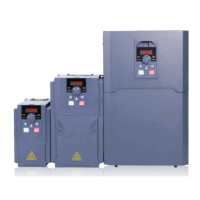

 To Next Page
 General