4-20
SET-UP AND SAFE OPERATING PROCEDURES
0056-0114
Barrel
The barrel and inner oxygen tube unit is designed to keep the oxygen and fuel gases separated. A
tube-within-a-tube design allows the oxygen supply to move through the inner tube to the head while
the fuel supply travels through the interior barrel cavity.
Torch Head
The torch head is threaded onto the barrel, creating a metal to metal seal; there are no O-rings. The
oxygen supply from the inner tube is directed through the center hole in the head while the fuel supply
passes through drilled orifices around the centered oxygen port. Tapered surfaces inside the head
mate with O-rings when the cutting or welding attachment is connected. This creates a gas-tight
seal. Never lubricate these surfaces. If damaged, the external threads and internal surfaces of the
head may be reconditioned by a qualified repair technician.
Cutting Attachment
The cutting attachment functions as a convenient and economical approach to cutting operations
where the frequency and/or application does not require a torch designed strictly for cutting. When
connected to a torch handle, the cutting attachment functions as a cutting torch. It provides the
operator with a wide range of cutting capabilities.
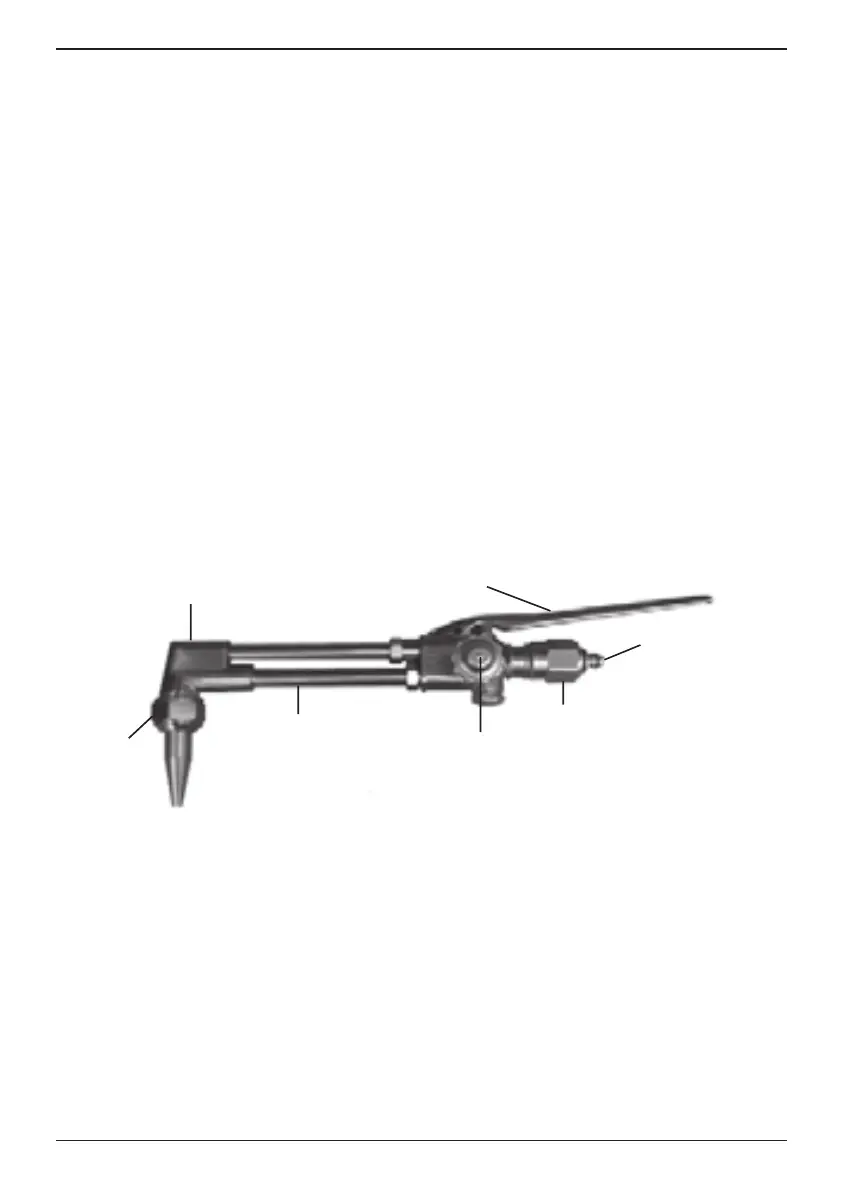
The cutting attachment consists of seven basic elements as shown in Figure 5. This figure shows:
the cone end, coupling nut, preheat oxygen control valve, mixing chamber, cutting oxygen lever and
tube, cutting attachment head, and tip nut.
CONE END
COUPLING NUT
PREHEAT OXYGEN CONTROL VALVE
MIXING CHAMBER
TIP NUT
CUTTING ATTACHMENT HEAD
CUTTING OXYGEN LEVER
dwg-00380
Figure 5: Cutting Attachment Features
Cone End and Coupling Nut
The cone end and coupling nut are designed to permit easy attachment to the torch handle. The
tapered cone end is machined to mate with the internal taper of the torch handle head. O-rings on
the cone end allow continued separation of oxygen and fuel gases. The O-rings also provide a hand-
tight seal for the connection.
Oxy-Fuel Apparatus


 To Next Page
 Loading...