SET-UP AND SAFE OPERATING PROCEDURES
6-35
0056-0114
6.02 PREVENTING THE METALS FROM WARPING
4. Begin by tacking the ends of the two pieces of metal together before welding. Longer pieces
may need to be tacked every few inches along the joint (see Figure 13, page 35).
5. Longer pieces may also require additional penetration gap, VICTOR
®
recommends
1/16” - 1/8”.
6.03 FOREHAND AND BACKHAND WELDING TECHNIQUES
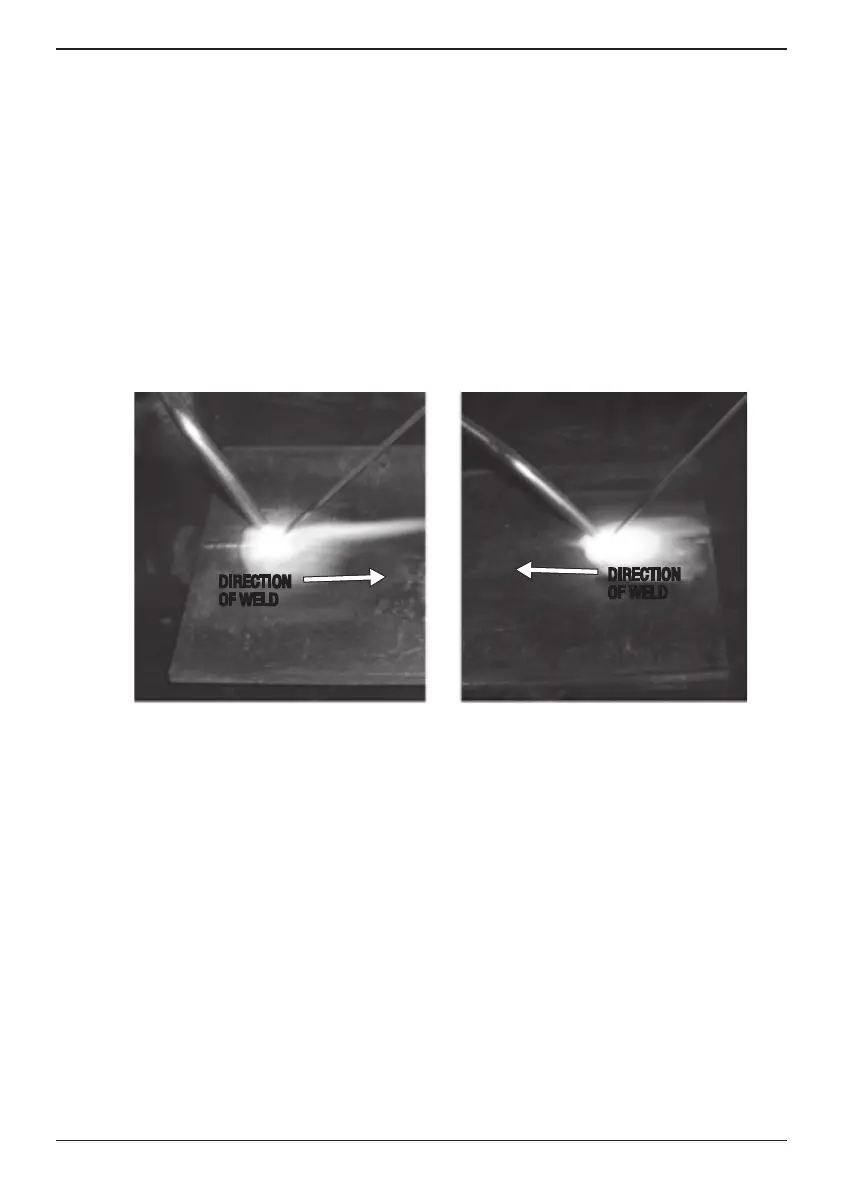
Two techniques are employed for oxy-fuel welding, forehand and backhand (see Figure 14). The
forehand technique is recommended for welding material up to 1/8” thickness because of better
control of the small weld puddle. Backhand welding is generally more suitable for materials thicker
than 1/8”. Increased speed and better fusion at the root of the weld is normally achieved with
backhand welding.
DIRECTION
OF WELD
DIRECTION
OF WELD
DIRECTION
OF WELD
DIRECTION
OF WELD
FOREHAND WELDING BACKHAND WELDING
dwg-00387
Figure 14: 1/8” Metal
In the forehand technique, the welding rod precedes the tip in the direction of the weld. The flame is
pointed in the same direction as the weld. It is directed downward at an angle which preheats the
edge of the joint. The welding nozzle and welding rod may be manipulated.
In backhand welding, the torch tip precedes the rod in the direction of the weld. The flame is pointed
back toward the molten puddle and completed weld. The end of the welding rod is placed in the
flame between the nozzle and the weld.
6.04 STARTING AND FINISHING THE WELD
The forehand butt weld with filler rod is one of the most common joints made. The basic procedures
of the butt weld can be applied to any other type of joint:
Tack or fuse the base metals at the predetermined intervals.1.
Hold the torch nozzle at an angle of approximately 45° to the joint (see Figure 15, page 37).2.
Welding Procedures


 To Next Page
 Loading...