EasyManua.ls Logo

Viking 58759 - User Manual

Viking 58759
12 pages
Print Icon
To Next Page IconTo Next Page
Loading...
Visit our website at: http://www.harborfreight.com
Email our technical support at: productsupport@harborfreight.com
Owner’s Manual & Safety Instructions
Save This Manual Keep this manual for the safety warnings and precautions, assembly,
operating, inspection, maintenance and cleaning procedures. Write the product’s serial number in the back
of the manual (or month and year of purchase if product has no number). Keep this manual and the receipt
in a safe and dry place for future reference. 22f
When unpacking, make sure that the product is intact
and undamaged. If any parts are missing or broken,
please call 1-888-866-5797 as soon as possible.
Copyright
©
2021 by Harbor Freight Tools
®
. All rights reserved.
No portion of this manual or any artwork contained herein may be reproduced in
any shape or form without the express written consent of Harbor Freight Tools.
Diagrams within this manual may not be drawn proportionally. Due to continuing
improvements, actual product may differ slightly from the product
described herein. Tools required for assembly and service may not be included.
Read this material before using this
product. Failure to do so can result in
serious injury. SAVE THIS MANUAL.
Question and Answer IconNeed help?

Do you have a question about the Viking 58759 and is the answer not in the manual?

Summary

Warning Symbols and Definitions

Hazard Severity Levels

Defines DANGER, WARNING, CAUTION, and NOTICE CAUTION hazard levels for safety communication.

Technical Unit Symbols

Defines common technical units used in battery testing, including Volts, Amps, CCA, RC, and Ah.

Safety Pictogram Explanations

Explains specific safety icons related to potential risks such as eye injury and fire.

Important Safety Instructions

Specifications

Operating Instructions

Controls

Product Function

Product; System Setup

Contrast Adjustment

How to adjust the LCD display contrast using the UP/DOWN and ENTER buttons for optimal viewing.

Tool Information

Instructions on how to view the product version and production date within the system setup menu.

Technical Parameters

Understanding CCA

Battery Test

Save Test Data

Battery In-Vehicle or Out-Of-Vehicle

Battery Location Selection

Procedure for selecting if the battery is installed in or out of the vehicle for testing.

Battery Test Procedure

Steps for performing battery testing, including surface charge elimination and terminal connection.

Battery Type Selection

Guide on selecting the correct battery type (e.g., Standard, AGM, GEL, EFB) for accurate testing.

Starting;Cranking Test

Charging Test and Ripple Test

Charging Test Procedure

Detailed steps to perform the charging system test, including engine revving and load application.

Charging Test Results

Explanation of the possible outcomes of the charging test, such as PASS, FAIL, or No Volt Output.

Battery Capacity

Battery Resistance

Battery Faults

Sulfate Accumulation

Explanation of how sulfate buildup on battery plates degrades performance over time.

Insufficient Electrolyte

Details how low electrolyte levels negatively affect battery plate function and performance.

Short Circuit of Battery Plates

Describes how damaged plates or sludge can cause battery short circuits and stop operation.

Over Discharge of the Battery

Warns against fully discharging lead-acid batteries and provides restoration methods.

Limited 90 Day Warranty

Summary

Warning Symbols and Definitions

Hazard Severity Levels

Defines DANGER, WARNING, CAUTION, and NOTICE CAUTION hazard levels for safety communication.

Technical Unit Symbols

Defines common technical units used in battery testing, including Volts, Amps, CCA, RC, and Ah.

Safety Pictogram Explanations

Explains specific safety icons related to potential risks such as eye injury and fire.

Important Safety Instructions

Specifications

Operating Instructions

Controls

Product Function

Product; System Setup

Contrast Adjustment

How to adjust the LCD display contrast using the UP/DOWN and ENTER buttons for optimal viewing.

Tool Information

Instructions on how to view the product version and production date within the system setup menu.

Technical Parameters

Understanding CCA

Battery Test

Save Test Data

Battery In-Vehicle or Out-Of-Vehicle

Battery Location Selection

Procedure for selecting if the battery is installed in or out of the vehicle for testing.

Battery Test Procedure

Steps for performing battery testing, including surface charge elimination and terminal connection.

Battery Type Selection

Guide on selecting the correct battery type (e.g., Standard, AGM, GEL, EFB) for accurate testing.

Starting;Cranking Test

Charging Test and Ripple Test

Charging Test Procedure

Detailed steps to perform the charging system test, including engine revving and load application.

Charging Test Results

Explanation of the possible outcomes of the charging test, such as PASS, FAIL, or No Volt Output.

Battery Capacity

Battery Resistance

Battery Faults

Sulfate Accumulation

Explanation of how sulfate buildup on battery plates degrades performance over time.

Insufficient Electrolyte

Details how low electrolyte levels negatively affect battery plate function and performance.

Short Circuit of Battery Plates

Describes how damaged plates or sludge can cause battery short circuits and stop operation.

Over Discharge of the Battery

Warns against fully discharging lead-acid batteries and provides restoration methods.

Limited 90 Day Warranty

Overview

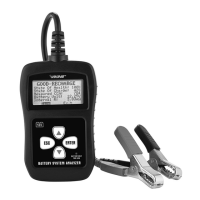
The VIKING 12V Digital Battery & System Tester is a diagnostic tool designed to analyze the health and performance of 12V vehicle batteries and their associated charging and cranking systems. It provides comprehensive data to help users determine the condition of their battery and identify potential issues with the vehicle's electrical system.

Function Description

The primary functions of the battery tester include:

  • Battery Test: This analyzes the battery's State of Charge, State of Health, Cold Cranking Amps (CCA), Current Voltage, and Internal Resistance. It provides reliable analysis data for battery maintenance and can notify the user when a battery has aged and needs replacement.
  • Cranking Test: This evaluates the battery's ability to supply starting power to the vehicle engine by assessing its capacity to maintain the required voltage under load during cranking. The tester analyzes ripple voltages during engine start to determine the condition of the starting system.
  • Charging Test: This checks and analyzes the charging system to determine if the alternator's output voltage is normal. It includes a ripple test to detect issues with the alternator's diodes and a loaded volt test, requiring the user to turn on vehicle loads and rev the engine to a specified RPM range (2000-2500 RPM).
  • Additional Functions: The device also offers system setup options, including adjusting LCD contrast and viewing tool information (product version and date produced). It has a test record storage capacity for up to 10 test records, which can be reviewed later from the Main Menu.

Important Technical Specifications

  • Display: LCD
  • Battery Voltage Application: 12V
  • Tester Voltage Range Capacity: 5V-17V
  • Battery Type Compatibility: Standard, AGM, GEL, EFB
  • Battery CCA Range: 40-2000 CCA
  • Battery AH Range: 7-250 Ah
  • Lowest Operating Voltage: >5V (If the orange LED indicator is lit, voltage is out of range, between 4-5V)
  • Test Record Storage: 10 records
  • Operating Temperature: 0°C to 50°C (32°F to 122°F)
  • Storage Temperature: -20°C to 70°C (-4°F to 158°F)
  • Power: Provided via cable from the car battery being tested.

Usage Features

The tester is designed for intuitive, step-by-step operation with on-screen instructions.

  • Controls: It features UP/DOWN buttons for menu navigation, an ESC button to return to the Main menu, and an ENTER button to confirm selections.
  • Battery Connection: The tester is powered by the battery being tested, requiring no additional battery. Users must attach the red clamp to the positive (+) terminal and the black clamp to the negative (-) terminal. Terminals should be cleaned prior to testing.
  • Battery Preparation: For accurate results, the battery should be rested for 30 minutes before testing, with the vehicle turned off and no accessories operating.
  • Single Battery Testing: The device is designed to test a single 12V battery only. It should not be connected to a series of batteries or an electrical system with more than one 12V battery, nor to any other electrical system, to prevent damage to the tester.
  • In-Vehicle or Out-of-Vehicle Testing: The tester allows selection of battery location (in-vehicle or out-of-vehicle). For in-vehicle tests, it can detect and prompt the user to eliminate surface charge by turning on lights.
  • Battery Type and Rating Selection: Users must select the correct battery type (e.g., Standard Flooded, AGM Flat Plate, GEL) and rating (e.g., CCA/SAE, AH, CA, MCA) for accurate analysis.
  • Test Results: Battery test results include "Good Battery," "Good, Recharge," "Replace," "Bad Cell, Replace," and "Charge, Retest." Cranking test results are "PASS" or "FAIL." Charging test results include "PASS," "FAIL" (low or high alternator output), "No Volt Output," and "Diode Test" (indicating a damaged diode).
  • CCA Understanding: The manual provides a table illustrating how temperature affects battery energy and drain, emphasizing that a higher CCA rated battery is desirable in colder climates.
  • Battery Capacity: Explains Amp-Hours (Ah) as continuous discharge over 20 hours and Watt-Hours (WH) as Voltage times Ah.
  • Battery Resistance: Defines resistance (impedance) as a measure of electron flow, noting that lower resistance is better (5-10 mOhms is good, over 20 mOhms indicates a problem).
  • Battery Faults: Describes common battery faults such as sulfate accumulation, insufficient electrolyte, short circuit of battery plates, and over-discharge, along with their causes and implications.

Maintenance Features

  • Durability: The tester can be used continuously without overheating.
  • Product Labels: Users are advised to maintain product labels and nameplates, which carry important safety information. Replacements can be obtained from Harbor Freight Tools if unreadable or missing.
  • No User-Serviceable Parts: The manual explicitly states that replacement parts are not available, and users should not open the housing as there are no user-serviceable parts inside. Service or repair should be performed by a qualified technician if required.
  • Cleaning: Keep the work area clean and well lit.
  • Safety Precautions: Emphasizes wearing ANSI-approved safety goggles and heavy-duty work gloves. Advises against smoking or open flames near the battery, connecting the tester while the engine is running, or disassembling the charger. Provides instructions for handling battery acid contact.
  • Storage: The tester can store up to 10 test records for later review.
  • Environmental Protection: Avoid exposing the tester to moisture or chemicals.
  • FCC Compliance: The device complies with FCC Rules for Class B digital devices, and instructions are provided for addressing potential interference.

Viking 58759 Specifications

General IconGeneral
BrandViking
Model58759
CategoryTest Equipment
LanguageEnglish

Related product manuals