Need help?
Do you have a question about the Viking VK512 and is the answer not in the manual?
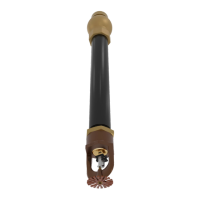
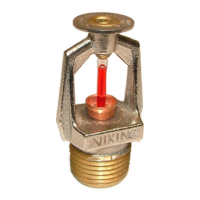
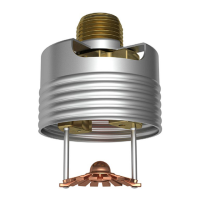
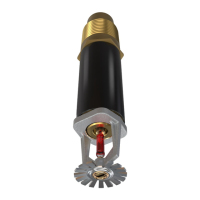
Viking ESFR Dry Pendent Sprinkler VK512 is a fast response fusible element type sprinkler for storage areas.
FM Approved: Class 2026. Refer to Approval Chart and Design Criteria for requirements.
Includes tube diameter, minimum/maximum pressure, connections, nominal K-Factor, and materials.
VK512 is FM Approved as quick response pendent Storage sprinkler. Install per standards.
Maintain minimum vertical distance between ceiling and overhead piping for dry-pendent sprinklers.
Table 3 shows NFPA exposed barrel lengths for dry sprinklers based on ambient temperature.
Store sprinklers in a cool, dry place, use original containers, keep separated, and protect operating elements.
Use designated wrench, avoid floor level installation, protect from impacts, do not over-tighten.
Remove shields/caps after installation and completion of ceiling finish work, before system service.
Remove shields by pulling apart; remove caps by turning slightly and pulling. No tools needed.
Store in cool, dry place, separate containers, protect during transport and installation.
Use special wrench, avoid cracking wax, repair coating after installation, avoid heat sources.
Viking sprinklers are available in decorative finishes, corrosion-resistant coatings, or non-corrosive materials.
Relates to temperature classification; select based on maximum expected ceiling temperature.
Viking sprinklers have K-Factors related to orifice sizes; nominal U.S. K-Factors are provided.
Describes various installation positions like Upright, Pendent, Conventional, etc.
Warning about exposure to chemicals during installation/servicing of fire protection products.
Details on warranty terms are available via price schedule or direct contact.
The Viking Early Suppression Fast Response (ESFR) Dry Pendent Sprinkler VK512 is a specialized fire protection device designed for use in areas subject to freezing temperatures, particularly storage facilities. Unlike standard sprinklers, the VK512 is supplied from a wet pipe system located in an adjacent heated area, allowing it to operate effectively in cold environments without the risk of freezing within the sprinkler itself.
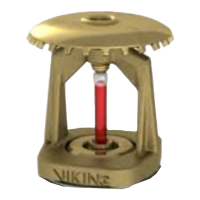
The primary function of the VK512 is to provide early suppression of high-challenge fires, particularly in storage applications. It achieves this through its unique design, which incorporates a fast-response fusible element and a special deflector. When activated by heat from a fire, the fusible element disengages, opening the waterway. Water then flows through the sprinkler's orifice and strikes the deflector, producing large, high-momentum water droplets. These droplets are distributed in a hemispheric pattern below the deflector, allowing them to penetrate the fire plume and directly wet the burning fuel surface. This action cools the atmosphere and helps to suppress the fire early in its development.
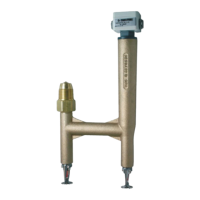
The dry ESFR sprinkler assembly consists of the fusible element-style ESFR sprinkler permanently attached to a supply nipple. The inlet of the sprinkler is made of sealed brass and features a grooved connection for secure installation. To further enhance its performance in cold environments and mitigate issues like condensation and ice build-up, the VK512 includes two insulating boot assemblies. These boots are designed to seal the clearance space around the dry sprinkler barrel, slowing the exchange of air between the inside and outside of the freezer or cold area. This helps to maintain temperature differentials and prevent conditions that could inhibit sprinkler operation or lead to premature activation.
The VK512 is intended for installation in wet pipe sprinkler systems where the protected area is subject to freezing temperatures. It is crucial to ensure that the wet pipe system supplying the dry sprinklers is provided with adequate heat to prevent freezing. The sprinkler is designed to be installed in 1-1/2" grooved run of tee fittings that meet the dimensional requirements of ANSI B16.3 (Class 150). Alternatively, it can be installed into welded outlets that meet the dimensional requirements of ANSI B16.11.
Installation requires careful attention to detail. Before final installation, it is recommended to temporarily install all components to verify correct measurements. The procedure involves inspecting the sprinkler for damage, installing all piping first, and then drilling a 3½" hole for the sprinkler. It is essential to verify that the protective cap is installed before inserting the sprinkler into the pre-drilled hole. Lubricating or sealing the gaskets on the grooved coupling, if necessary, and securing the sprinkler with a suitable grooved coupling are critical steps.
The insulating boot assemblies, which are included with each sprinkler, play a vital role in its performance in cold environments. These boots should be installed on smooth, flat, and clean surfaces. For metallic ceilings, pilot holes are required for the boots. The rubber rings of the boots are carefully pulled apart and installed onto the barrel, followed by placing the two halves of the seal casing on either side of the barrel and securing them with screws. It is important to note that in situations with corrugated ceiling panels or other specific conditions, alternative penetration sealing methods may be required.
After installation, the entire sprinkler system must be tested in compliance with installation standards. Any leaks must be repaired, and the sprinkler must be properly tightened. Air testing of the sprinkler piping prior to water testing may be considered in areas where leakage must be prevented. Crucially, the protective shields must be removed from the sprinklers by hand before placing the system in service. No tools should be used to remove these shields to avoid damaging the fusible element. The system design must adhere to ESFR design guidelines outlined in the latest standards and by the Authorities Having Jurisdiction.
Maintaining the fire protection system and its devices in proper operating condition is the responsibility of the owner. Regular inspections, tests, and maintenance are essential, following the guidelines provided in NFPA 25 or FM 2-81, as well as any additional requirements from the Authority Having Jurisdiction.
Sprinklers should be inspected regularly for signs of corrosion, mechanical damage, obstructions, or paint. The frequency of these inspections may vary depending on the corrosiveness of the atmosphere, water supplies, and the level of activity around the device. Any sprinklers that have been painted, mechanically damaged, or show signs of corrosion must be immediately replaced or tested as required by installation standards. Sprinklers that have operated cannot be reassembled or reused and must be replaced with new units.
The sprinkler's discharge pattern is critical for effective fire protection. Therefore, nothing should be hung from, attached to, or otherwise obstruct the discharge pattern. Any obstructions must be removed immediately, or additional sprinklers installed if necessary.
When replacing existing sprinklers, the system must first be removed from service. This involves notifying all Authorities Having Jurisdiction, draining all water, and relieving pressure from the piping. The dry sprinkler insulating boot assemblies must be removed, followed by the old sprinkler. The replacement sprinkler must be the correct model, style, orifice size, temperature rating, and response characteristics. After installing the new sprinkler and its boot assemblies, the system is returned to service, and all valves are secured. All replaced sprinklers are checked for leaks, and any leaks are repaired.
Sprinkler systems that have been exposed to a fire must be returned to service as soon as possible, with the entire system inspected for damage and necessary repairs or replacements. Sprinklers exposed to corrosive products of combustion, even if they have not operated, should be replaced.
 General
| Model | VK512 |
|---|---|
| Number of Stations | 12 |
| Enclosure Rating | NEMA 3R |
| Type | Controller |
| Category | Irrigation Controller |

 To Next Page