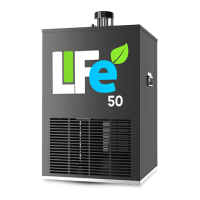
This document outlines the operation and maintenance of the VINSERVICE LIFE series of chillers, designed for cooling and dispensing beverages and food liquids. The series includes models LIFE 50, 65, 100, 115, 130, 145, 175, and 250, all utilizing R290 refrigerant.
Function Description
The VINSERVICE LIFE chillers are designed to cool pre-mixed and post-mixed beverages, beer, wine, and soft drinks through specialized plastic and stainless steel food-specific tubes. The core of the appliance is a cooler installed within a metal casing, protecting its internal components. The cooling process relies on a closed-circuit compressor operation, forming an ice bank around an evaporator. A tank-dipped probe monitors the ice bank thickness and, in conjunction with an electronic regulator (TE) or an optional mechanical thermostat (TM), controls the cooling system to maintain a constant ice bank. A stirrer pump (F) continuously circulates water in the tank and cooling coil to facilitate heat exchange and efficient cooling of beverages.
Important Technical Specifications
The LIFE series operates with R290A refrigerant, which is CFC-free and environmentally friendly, though flammable. Key specifications vary by model:
- Power: Ranges from 1/4 HP (LIFE 50, 65) to 3/4 HP (LIFE 175, 250).
- Nominal Power (-10°C/+45°C): From 539W (LIFE 50, 65) to 1742W (LIFE 250).
- Number of Cooling Coils: 1-3 (LIFE 50, 65), 1-4 (LIFE 100, 115), 1-8 (LIFE 130, 145, 175), and 1-10 (LIFE 250).
- Tank Capacity: From 18Lt (LIFE 50) to 90Lt (LIFE 250).
- Ice Bank: From 8Kg (LIFE 50) to 40Kg (LIFE 250).
- Cooling Capacity (in +25°C/out +4°C): From 50Lt/Hour (LIFE 50) to 250Lt/Hour (LIFE 250).
- Beverage Temperature IN/OUT: +24°C/+4°C for all models.
- Supply Voltage/Standard Frequency: Available in 220/240V 50Hz, 115V 60Hz, and 220V 60Hz configurations.
- Rated Current: From 3.1A (LIFE 50, 65) to 9.9A (LIFE 250).
- Operating Temperature Allowed: +10°C/+43°C or +5°C/+43°C for some models.
- Max Relative Humidity Allowed: 80% for all models.
- Weight (Unladen Static Load): From 23Kg (LIFE 50) to 65Kg (LIFE 250).
- Noise Emission Level: Lower than 70 dBA under full capacity and correct maintenance.
Usage Features
The appliance is intended for professional use only and can be operated by children aged 8 and above, or individuals with diminished physical, sensory, or mental abilities, provided they are supervised and instructed on safe use. It is crucial to ensure proper air circulation around the condenser and ventilation grilles by maintaining a minimum distance of 30-40 cm from all vents and walls. The appliance must be installed horizontally on a stable, even surface, away from heat sources, dripping, or humidity.
Before initial use, the tank must be filled with clean water up to the specified level. The "overflow" hole must be connected to a suitable water drain. The chiller's operation is automatic; once powered on, the fan, stirrer pump, and compressor activate. Ice bank formation begins immediately and is controlled by the probe and electronic regulator.
Prohibited uses include:
- Operating in explosive or flammable environments, or environments saturated with gas or volatile explosive substances.
- Using for purposes other than cooling beverages or food liquids.
- Drying or warming clothes on the condenser grille.
- Introducing foreign bodies into the tank or ice bank.
- Operating with unqualified staff or without adhering to manual instructions.
- Tampering with or deactivating safety devices.
- Installing in areas where water jets or other liquids are used.
- Installing outdoors or in unfavorable environmental conditions (sun, rain, snow, wind, heavy humidity).
Maintenance Features
Maintenance operations are categorized into ordinary and extraordinary. All maintenance, especially extraordinary, requires the appliance to be turned off and disconnected from the power supply. The power cable must remain disconnected until all panels are re-positioned and screws re-tightened. Cleaning with water jets or other liquids is prohibited.
Ordinary Maintenance (can be performed by common personnel):
- Daily: Check for leaks in system circuits.
- Every six months: Clean the condenser (L) blades with a brush or compressed air jet. Protective leather gloves are recommended due to sharp edges. Avoid bending the blades.
- Every month (or as needed): Sanitize or wash the cooling coils (A) with plenty of drinkable water and food-industry-suitable detergents.
- Every month: Check that the "overflow" discharge opening is not clogged by ice, dirt, or residues.
- Every month: Clean the machine to remove dust, filaments, or other materials that could cause overheating.
Extraordinary Maintenance (must be performed by specialized personnel):
- Every year: Change the tank water. This involves disconnecting the machine, removing upper covers, waiting for the ice bank to thaw completely, draining the tank through the draining pipe, refilling with clean water (up to 2 cm from the overflow pipe), and re-connecting the power.
- Replacement of damaged power cables must be done by the manufacturer, customer service, or qualified staff.
- Disposal of packaging materials, machine parts, refrigerant gas, compressor, or pressurized containers must comply with local regulations.
Troubleshooting:
The manual provides a detailed troubleshooting guide for common issues, including:
- Appliance not working (power failure, thermal protection).
- Machine not cooling (coolant circuit issues, system overheating, insufficient water level, compressor/fan/stirrer motor failures).
- Compressor running continuously, causing freezing (thermostat/probe failure).
- No beverage dispensed (dirty/clogged taps or pipes).
For any repairs, only spare parts approved by the manufacturer must be used and installed by qualified personnel. It is strictly forbidden to use non-original parts.


 To Next Page
 General