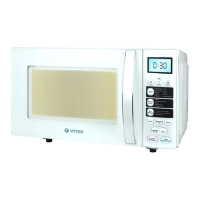
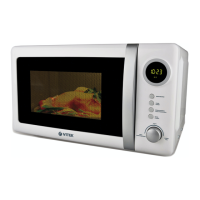
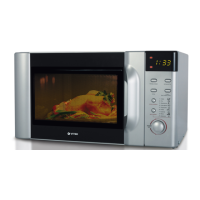
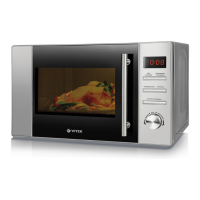
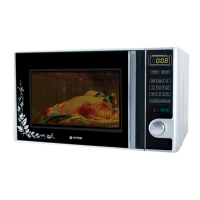
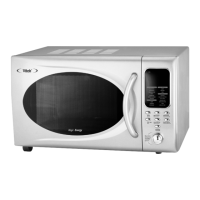
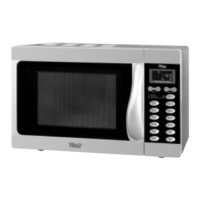
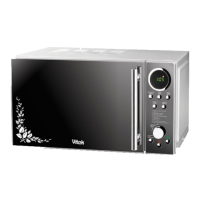
This document is a user manual for the Vitek VT-1680 Microwave Oven. It provides detailed information on the appliance's description, safety precautions, usage, maintenance, and technical specifications.
Function Description
The Vitek VT-1680 is a microwave oven designed for cooking and heating dishes. Its main components include:
- Lockout system (1): Automatically switches off power when the door is opened during operation, preventing microwave radiation leakage.
- Viewing window (2): Allows observation of the cooking process.
- Glass tray (3): A rotating platform inside the oven for even cooking.
- Glass tray support (4): Supports the glass tray.
- Roller ring (5): Facilitates the rotation of the glass tray.
- Microwaves output (6): The point from which microwave energy is emitted into the cooking chamber.
- POWER knob (7): Used to select the desired cooking power level.
- TIMER knob (8): Used to set the cooking or defrosting time.
The microwave offers various power levels for different cooking needs:
- Low (17% power): Suitable for softening ice cream and keeping food warm.
- Medium low/defrost (33% power): Ideal for defrosting products, softening chocolate or glaze, and melting butter or soft cheese.
- Medium (55% power): Used for cooking braised meat or fish.
- Medium high (77% power): Recommended for cooking rice, fish, and dishes made from chopped meat.
- High (100% power): Best for heating beverages, boiling water, cooking vegetables, and reheating cooked products.
Important Technical Specifications
- Power supply: 230 V ± 10% ~ 50 Hz
- Nominal microwave power: 700 W
- Nominal power consumption in microwave mode: 1150 W
- Operation frequency: 2450 ± 49 MHz
- Chamber capacity: 17 L
- Glass tray diameter: 245 mm
- Dimensions (not more): 450 x 360 x 260 mm
- Net weight (not more): 11.0 kg
- Operation conditions:
- Air temperature: +10°C to +35°C
- Relative air humidity: 35-80%
- Atmosphere pressure: 86-106 kPa (650 – 800 mm of mercury)
- Valuable material content: Gold (0 g), Silver (1.050505 g)
- Service life of appliance: 5 years
Usage Features
Safety Precautions:
- Never operate the oven with an open door due to microwave radiation risk.
- Do not tamper with the electrical networks of the door's protective interlocks.
- Keep the door and oven body clean from any objects, dirt, or detergent residues.
- Do not use the oven if it is damaged, especially if the door is bent, hinges or latches are broken/loose, or there are dimples. Repairs should only be performed by authorized service personnel.
- Read all instructions carefully before use.
- Ensure the voltage matches your home socket.
- Use the unit only for its intended purpose: cooking and heating dishes.
- Do not switch on the unit without food inside.
- Avoid heating liquids or products in firmly closed packaging, as they can explode.
- Be cautious when removing hot food, as strong boiling can occur after heating.
- Do not fry products in the oven.
- Never cook or heat shell eggs, as they can explode.
- Pierce thick-skinned products (potatoes, zucchini, apples) before cooking.
- Shake feeding bottles and check temperature before feeding children.
- Use potholders as cookware can become very hot.
- Ensure proper ventilation; do not obstruct ventilation openings.
- Do not store or use the unit outdoors, near water, or in damp environments.
- Do not immerse the power cord or plug in water.
- Keep the power cord away from heated or sharp surfaces and ensure it doesn't hang over table edges.
- Regularly clean the oven using soft, non-abrasive substances.
- Do not allow children to use the unit as a toy; close supervision is necessary.
- Outer surfaces, including the door, heat up during operation.
- Place the unit with its rear panel against the wall.
- The power cord has a grounded euro plug; connect it to a securely grounded socket.
Cooking Products:
- For bacon, do not place directly on the glass tray to avoid local overheating and cracks.
- Use only microwave-safe cookware on the glass tray.
- Place thicker slices of food near the edges of the cookware for even cooking.
- Set minimum cooking time and increase if necessary; do not exceed cooking time to prevent burning.
- Cover food with a glass lid to prevent splashing and ensure even cooking.
- Turn over easy-cooking products (chicken, hamburgers) once; larger meat slices at least twice.
- Stir products during cooking, moving them from top to bottom and from the center to the edges.
Choosing Cookware:
- Ideal cookware should be "transparent" to microwaves, allowing energy to pass through and heat food.
- Do not use metal cookware or plates with metal finishing, as microwaves cannot pass through metal.
- Avoid using recycled paper, as it may contain metal and cause burning.
- Round or oval plates are preferred over rectangular ones.
Testing Cookware:
- Place the tested cookware with a glass of cold water in the oven.
- Operate at maximum power for no more than 30 seconds.
- If the cookware is hot but the water is cold, it is not microwave-safe.
- Do not exceed 30 seconds for testing.
Installation:
- Remove all packaging materials.
- Do not remove the light-gray mica plate inside the chamber (6), as it protects the magnetron.
- Place the oven on a flat, stable surface that can support its weight and the weight of the food.
- Keep out of reach of children.
- Avoid high humidity, high temperature, or flammable areas.
- Ensure proper ventilation: 30 cm above, 7-8 cm behind and on the sides. Do not block ventilation openings or remove support legs.
- Do not use without the glass tray and roller ring.
- Keep the power cable undamaged and clear of hot/sharp objects.
- Avoid placing near TVs or audio appliances to prevent interference.
Setting the Glass Tray:
- Insert the rotating socket (4) into the opening at the bottom of the chamber.
- Place the roller ring (5) on the bottom of the chamber.
- Carefully place the glass tray (3) by aligning its ledges with the grooves of the support (4).
- Never place the glass tray upside down.
- Ensure the glass tray rotates freely during operation.
- Always use the glass tray and support during cooking.
- Food and cookware should only be placed on the glass tray.
- Clockwise/anticlockwise rotation is normal.
- Replace immediately if cracks or chips appear.
Operation:
- Before switching on, ensure the voltage matches the unit's specifications.
- Place food inside the chamber and close the door.
- Set cooking power using knob (7).
- Set cooking time using knob (8) clockwise.
Defrosting Products:
- Set knob (7) to "medium low/defrost."
- Set defrost time according to weight using knob (8).
- The oven starts automatically after time is set.
- You can open the door to turn products over; cooking resumes when closed.
- The unit switches off with a sound signal when time is over.
- Always set knob (8) to "0" to switch off the unit if food is removed early or the unit is not in use.
Maintenance Features
Clean and Care:
- Switch off and unplug before cleaning.
- Protect the control panel from water; wipe with a soft, damp cloth.
- Keep the chamber clean; remove food residues with a damp cloth or soft detergent if heavily soiled.
- Do not use abrasives or wire brushes for cleaning.
- Prevent detergent from entering air and steam openings.
- Avoid ammonia-based detergents.
- Clean external surfaces with a damp cloth.
- Keep the door clean to ensure proper closing; prevent crumbs from accumulating.
- Clean ventilation openings from dust and dirt.
- Regularly clean the glass tray and its support; wipe the bottom of the chamber.
- Wash the glass tray and roller ring with a neutral soapy solution.
- Do not immerse a heated glass tray in cold water to prevent splintering.
- To remove odors, place a bowl with water and lemon juice in the oven, boil for several minutes, then wipe the chamber walls thoroughly with a soft cloth.
Troubleshooting Guide:
- Static in TV/radio signals: Normal occurrence, similar to other small electrical devices.
- Dim oven light: Normal at low power levels.
- Steam on door/hot air from vents: Normal during cooking as steam is released.
- Oven not turning on: Check if the power plug is firmly connected or if there's a power outlet problem.
- Oven not heating: Ensure the door is firmly closed.
- Rotating glass tray makes strange noises: Clean the roller ring or cooking chamber floor.
If these measures do not resolve the problem, contact an authorized service center. Repairs and adjustments should only be performed by qualified personnel.

 Need help?
 General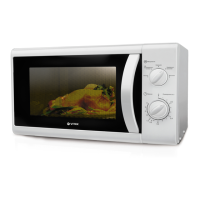

 To Next Page