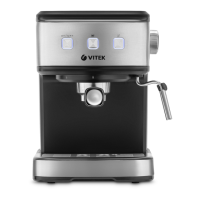
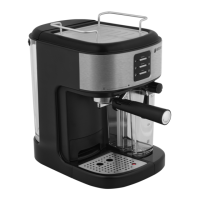
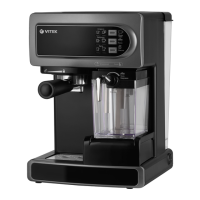
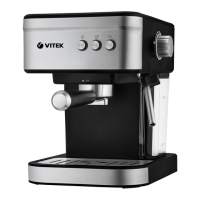
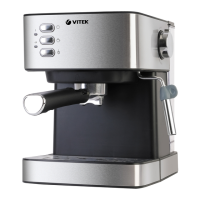
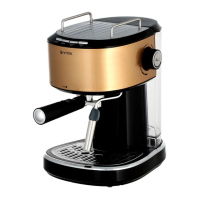
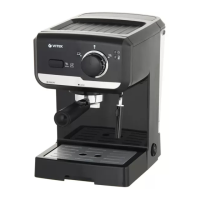
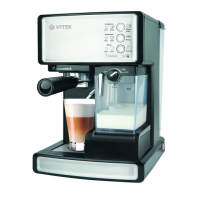
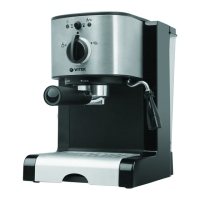
This document describes the VITEK VT-8471 Coffee Maker, designed for preparing "ESPRESSO" and "CAPPUCCINO" coffee.
Important Technical Specifications:
- Power Supply: 220-240 V ~ 50-60 Hz
- Rated Input Power: 850 W
- Water Tank Capacity: 1.5 L
- Unit Operating Life: 3 years
Usage Features:
The coffee maker features a cup warming tray (1), a removable water tank (3) with a lid (2), a steam supply control knob (4), a cappuccinator pipe (6), a drip tray (8) with a grid (9) and a pop-up indicator (10), a coffee filter (11), a filter holder (12) with a clamp (13) and handle (14), and control buttons for ON/OFF (15), water supply (16), and steam supply (17). A measuring spoon with a ground coffee tamper (18) is also included.
Before First Use:
After transportation or storage at low temperatures, allow the unit to stand at room temperature for at least three hours. Unpack the coffee maker and remove all packaging materials. Check for damages; if any, do not use the unit. Ensure the operating voltage matches your mains supply.
Preparation for Operation:
- Ensure the steam supply is closed by turning the knob (4) clockwise to "OFF".
- Wash all removable parts (3, 11, 12, 18) with warm water and dry them.
- Fill the water tank (3) with cold water up to the MAX mark and install it.
- Insert the coffee filter (11) into the filter holder (12).
- Install the filter holder (12) into the coffee maker, aligning its ledges with the boiler grooves and turning the handle (14) to the right until it bumps.
- Place a suitable cup on the drip tray grid (9).
- Plug the power cord into the mains socket.
- Switch on the coffee maker by pressing the ON/OFF button (15). The button (15) will light up, and button (16) will flash.
- Wait until the water supply button (16) illuminates constantly, indicating the coffee maker is ready.
- To fill the boiler, press button (16) for 15-20 seconds, or until water appears in the cup, then press button (16) again to stop the water supply. This step is crucial to remove any air block in the boiler during first use. Repeat this procedure several times depending on cup capacity until the boiler is clean.
- Attention! Do not remove the filter holder (12) if buttons (16) or (17) are pressed. Do not remove the filter holder immediately after preparing coffee; allow the coffee maker to cool down completely due to residual pressure. To remove, turn handle (14) to the left and pull out the filter holder.
Making Espresso:
- Ensure the steam supply is closed (knob (4) to "OFF").
- Ensure sufficient water in the tank (3).
- Insert the coffee filter (11) into the holder (12).
- Add ground coffee to the filter (11) and lightly tamp it with the back of the measuring spoon (18).
- Install the filter holder (12) into the coffee maker as described in the preparation steps.
- Place one or two cups on the drip tray grid (9).
- Plug in the coffee maker and switch it on (button 15).
- Wait for button (16) to illuminate constantly.
- Start water supply by pressing button (16). Monitor the cup filling and press button (16) again to stop.
- Switch off the coffee maker (button 15).
- Allow the coffee maker to cool, then remove the filter holder (12) by turning handle (14) to the left. Discard used coffee grounds and wash the filter (11). Use the filter clamp (13) to prevent the filter from falling out of the holder.
- Notes: Preheat cups by placing them on the cup warming tray (1) while the boiler heats. In case of urgent filter holder removal, reduce boiler pressure by switching off the coffee maker (button 15), placing a cup under the cappuccinator pipe (6) tip, and slightly opening the steam supply (knob (4) counterclockwise).
Making Cappuccino:
- Attention! Be careful of hot steam to avoid burns.
- Ensure the steam control knob (4) is in the "OFF" position.
- Prepare espresso as described above in a cup large enough for frothed milk or cream.
- Press the steam supply button (17) and wait for it to illuminate constantly.
- Place a bowl under the cappuccinator pipe (6) tip. Carefully turn the steam supply knob (4) counterclockwise for a quarter turn to remove condensed fluid from the pipe (6).
- Close the steam supply by turning the knob (4) clockwise to "OFF".
- Note: Some water or steam from the filter holder (12) or steam nozzle is normal.
- Submerge the cappuccinator pipe (6) tip into a glass of cold milk or cream. Carefully turn the steam supply knob (4) counterclockwise for a quarter turn or more. The tip should not touch the bottom of the glass to avoid hindering steam release. Frothing takes several seconds.
- Note: To prevent splashing, immerse the cappuccinator pipe (6) tip deeper than 1 cm from the milk surface.
- The outgoing steam creates whirls that froth milk. Periodically lift and lower the bowl with milk against the cappuccinator pipe (6) tip until foam forms.
- Close the steam supply (knob (4) clockwise to "OFF").
- Switch off the steam supply (button 17).
- Switch off the coffee maker (button 15).
- Note: Milk frothing is an art; practice may be needed for good results.
- Important: Use fresh, additive-free whole milk (4-6% fat) or cream (at least 10% fat).
- Immediately after frothing, clean the cappuccinator pipe (6) tip by submerging it in water, pressing button (17) to release steam, and then closing the steam supply (knob (4) clockwise to "OFF"). Switch off steam supply (button 17) and the coffee maker.
- Allow the coffee maker to cool, then remove the cappuccinator pipe (6) tip, wipe the pipe with a damp cloth, and wash the tip under running water.
- Note: Repeated coffee making is recommended after at least a 5-minute interval.
Warming Drinks:
You can warm drinks by placing the cappuccinator pipe (6) (without the tip) into the cup.
- Press the steam supply button (17) and wait for it to illuminate constantly.
- Submerge the cappuccinator pipe (6) (without the tip) into the drink and carefully turn the steam supply control knob (4) counterclockwise.
- Close the steam supply (knob (4) clockwise to "OFF").
- Switch off the steam supply (button 17).
- Switch off the coffee maker (button 15).
- Note: Some water or steam from the filter holder (12) or steam nozzle is normal.
How to Make a Good Espresso:
- Use fresh ground coffee specifically for espresso makers.
- Lightly tamp the ground coffee in the filter (11) using the back of the measuring spoon (18).
- Coffee strength depends on bean quality and grind size. If coffee pours out too slowly, the grind is too fine or tamped too strongly.
Maintenance Features:
Descaling:
For effective operation, descaling is recommended every 2-3 months, or more frequently with "hard" water.
- Ensure the steam supply is closed (knob (4) clockwise to "OFF").
- Prepare a citric acid solution: 2 teaspoons per 1 liter of water. Pour into the water tank (3) and install the tank.
- Insert the coffee filter (11) into the filter holder (12).
- Install the filter holder (12) into the coffee maker as described in the preparation steps.
- Place a suitable cup on the drip tray grid (9).
- Plug in the coffee maker.
- Switch on the coffee maker (button 15).
- Press button (16) and fill a cup with about 100 ml of water (to drain the boiler and fill with citric acid solution), then press button (16) again to stop water supply.
- Press button (16) again to supply water and fill a 100 ml cup, then press button (16) to stop and discard the water.
- Repeat step 9 after a short interval.
- Press the steam supply button (17). Place a bowl under the cappuccinator pipe (6) tip and slightly open the steam supply (knob (4) counterclockwise). Carefully turn the knob (4) to maximum steam release for about 1 minute, then close the steam supply (knob (4) clockwise to "OFF") and switch off steam supply (button 17).
- Switch off the coffee maker (button 15). Wait 10-15 minutes.
- Repeat steps 9 and 10 at least 3 times.
- Repeat the steam release channel cleaning procedure described in step 11.
- With small intervals, repeat the boiler cleaning procedure (step 9) until the citric acid solution in the tank (3) is completely used.
- Switch off the coffee maker (button 15).
- Fill the tank (3) with clean water to the MAX mark and repeat steps 9, 11 at least 3 times without a 10-15 minute break.
- Switch off the coffee maker (button 15).
- Note: Special descaling agents for coffee makers can be used, following their instructions.
Cleaning:
- Filter (11): Can be washed in a dishwasher. If clogged with coffee grounds, clean with a small brush.
- Coffee maker body (5): Wipe with a soft, damp cloth and dry. Do not use metal brushes, abrasives, or solvents. Do not immerse the body (5), power cord, or plug in water or other liquids.
- Removable parts (3, 11, 12, 18): Wash with warm water and mild detergent, rinse, and dry.
- Drip tray (8): The red pop-up indicator (10) shows when the tray is full. Remove the grid (9) and tray (8), empty the water, then reassemble. If necessary, wash the tray (8) and grid (9) with water and soft detergent, rinse, and dry.
Storage:
Unplug the coffee maker and clean it. Pack it in its original packaging and store it in a dry, cool place, out of reach of children and disabled persons.
Recycling:
Do not dispose of the unit or its batteries (if included) with regular household waste. Take them to specialized recycling centers. Waste generated during disposal is subject to mandatory collection and disposal as prescribed. For more information, contact your local municipality, waste disposal service, or the store where you purchased the product.
The manufacturer reserves the right to change design, construction, and technical specifications without prior notice, provided it does not affect the general operating principles of the device. Minor differences between the manual and the product may occur. If discrepancies are found, please report them via e-mail info@vitek.ru to receive an updated manual.

 Need help?
 General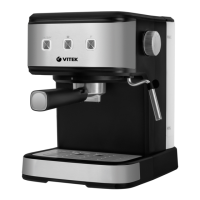

 To Next Page