
 Need help?
Do you have a question about the Vitrifrigo FG Series and is the answer not in the manual?
Details about the company that designed and manufactured the refrigerator.
Information found on the refrigerator's identification label for model and serial details.
Overview of the FG series refrigerators designed for milk storage.
Explains the refrigerant compression cycle used by the refrigerator.
Inspect the delivered refrigerator for damage and completeness upon arrival.
Guidelines for correctly placing the refrigerator for ventilation and stability.
Instructions for safely connecting the refrigerator to the power supply.
How to switch the refrigerator on/off and adjust the internal temperature settings.
Procedure for removing ice buildup to maintain efficiency and reduce energy consumption.
Steps for cleaning the interior and exterior, and basic maintenance tasks.
Specifies that advanced servicing must be performed by qualified professionals.
Guidelines for proper disposal of the refrigerator as electrical waste.
How to make warranty claims and what is covered or excluded.
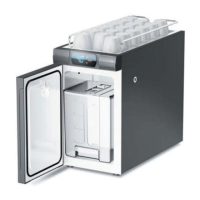
The Vitrifrigo FG series refrigerators, specifically the FG10I DGT and FG10I DGT CHILL&CW models, are designed for the controlled storage of milk and similar liquids intended for human consumption. These appliances are primarily intended to be integrated with coffee machines, ensuring that milk is kept at an optimal, pre-set temperature. The FG10I DGT CHILL&CW model offers an additional feature: a cup warmer module for maintaining cups and/or glasses at a warm temperature.
The core function of these refrigerators is to maintain a controlled internal temperature suitable for milk storage. They operate on a refrigerant vapor compression cycle, which efficiently transfers heat from the interior to the exterior. In this cycle, the refrigerant evaporates by absorbing heat from the air inside the refrigerator, specifically through the cold internal walls that are in contact with the evaporator. After absorbing heat, the refrigerant enters the compressor, where its pressure and temperature are increased. It then passes through an air-cooled condenser, where it condenses, releasing heat to the outside. Finally, the refrigerant fluid returns to the evaporator via a capillary tube, and the cycle repeats, continuously cooling the internal compartment.
The internal temperature of the refrigerator can be adjusted by the user through an electronic thermostat, allowing for precise control over the storage conditions. The FG10I DGT CHILL&CW model extends its functionality with a cup warmer module. This module, when activated, heats a shelf to a steady-state temperature, providing a warm surface for mugs and cups.
A level sensor, where fitted, enhances the functionality by monitoring the milk quantity within the container. Should the milk level drop below approximately 0.5 liters, the sensor triggers an alarm, indicated by a flashing "IA" sign on the digital thermostat and an audible signal. This feature ensures that the user is promptly alerted to low milk levels, preventing interruptions in service, especially when integrated with coffee machines. The refrigerator is designed to operate with a full milk container, and the alarm will activate if it runs without a container or with an insufficient amount of milk.
The refrigerator is designed for straightforward operation. To begin, it should be placed on a horizontal surface and leveled using its adjustable feet. Proper positioning is crucial, requiring a minimum gap of 50 mm (2 inches) between the back panel and any wall to allow for adequate warm air dissipation from the condenser. No specific space requirements are noted for the sides of the refrigerator.
Electrical connection is made via an IEC connection socket and a main power switch located on the back panel. A power cord with a Schuko plug (CEE 7/7) is supplied. Users must ensure that the electrical supply characteristics (voltage, phases, frequency, amperage) match those specified on the product label. Grounding the appliance is mandatory for safety, and the electrical system must be properly grounded and in perfect working order. Direct connection to a socket is recommended; if adaptors, multiple sockets, or extension cords are unavoidable, they must comply with current safety standards and not exceed their current capacity.
The refrigerator features holes on each side for ducting the milk pick-up pipe from the internal container. An unused hole should be sealed with the provided transparent cap. The appliance must only be used with the provided tank or other closed milk containers.
Operation is managed via a digital thermostat on the front panel. In standby mode, the display alternates between "OFF" and the current internal temperature. To switch on the refrigerator, the user presses and holds the power button for at least 3 seconds, upon which "ON" will appear on the display, followed by the internal temperature. For the FG10I DGT CHILL&CW model, activating the refrigerator also turns on the cup warmer shelf. It takes some time for the refrigerator to reach the desired internal temperature, and it is recommended to place milk inside only once this temperature has stabilized.
Temperature setting is intuitive: press the "set" button until the current set point flashes, then use the up and down arrows to adjust the value. Press "set" again to store the new temperature. To comply with HACCP guidelines for milk storage, the setpoint can only be varied within a specific range. The manufacturer emphasizes that while the refrigerator can achieve lower temperatures, it is designed for controlled storage of milk and similar liquids, not for chilling products from room temperature.
The cup warmer module on the FG10I DGT CHILL&CW model is activated or deactivated by holding the dedicated button for at least 1 second. When active, "AUX" is displayed on the thermostat. The shelf heats up, reaching its steady-state temperature in about 10 minutes, after which mugs and cups can be placed on it, with caution due to the high temperature.
To switch off the refrigerator, the user holds the power button for at least 3 seconds.
Regular cleaning and maintenance are essential for hygiene and optimal performance, especially for an appliance storing food products. Before any cleaning or maintenance, the refrigerator must be disconnected from the electrical supply.
For external cleaning, the plastic-coated steel surfaces can be washed with warm water, rinsed with cold water, and dried with a soft cloth. Abrasive products should be avoided. For internal cleaning, after removing milk containers, the interior can be wiped with warm water and, if necessary, a small amount of vinegar to remove grease. This should be followed by rinsing with clean water and drying with a soft cloth. Abrasive products, detergents, or soap should never be used inside the refrigerator.
Defrosting is necessary if ice builds up significantly on the inside walls, as excessive ice can reduce efficiency and increase electricity consumption. To defrost, switch off the appliance by holding the thermostat's power button for at least 3 seconds. Leaving the door open will speed up the process. It is crucial never to use tools or utensils to remove ice, as this can damage the evaporator. During defrosting, the milk container should be removed. After defrosting, thorough cleaning and drying of the interior are recommended before switching the refrigerator back on.
The air-cooled condenser at the back of the unit should also be kept clean. If it becomes clogged with dust, it should be cleaned using a vacuum cleaner.
For prolonged periods of disuse, it is advised to disconnect the refrigerator from the power supply, empty it completely, clean it, and leave the door slightly open to prevent mold and unpleasant odors.
Non-ordinary maintenance and service operations must only be performed by professionally qualified service personnel. Access to service areas is restricted to individuals with the necessary knowledge and practical experience, particularly regarding safety and hygiene. The refrigerator's setup should facilitate easy care and maintenance.
In case of fire, only extinguisher powder should be used. Packaging materials must be disposed of according to current regulations. If the refrigerator is to be taken out of service permanently, it must not be disposed of as household waste but taken to a certified refuse recycling center. The refrigerant inside the system must be handled by specialists, as incorrect disposal can harm the environment and incur legal penalties.
 General
| Type | Refrigerator |
|---|---|
| Series | FG Series |
| Number of Doors | 1 |
| Refrigerant | R600a |
| Installation | Built-in |



 To Next Page
