Need help?
Do you have a question about the VOI SNSC 2.3 and is the answer not in the manual?
Declaration of conformity for the SNSC 2.3 electric kickscooter with EU Radio Equipment Directive.
Information on battery disposal and recycling according to EU Directive 2006/66/EC.
Instructions on how to clean the scooter frame and store it properly.
Guidelines for charging, storing, and maintaining the battery for optimal performance.
This document serves as a comprehensive user manual for the Voi SNSC 2.3 electric kickscooter, a portable small electric vehicle designed for short-distance travel on public roads. It emphasizes safe operation, maintenance, and compliance with relevant regulations.
The Voi SNSC 2.3 is a modern and robust electric scooter, suitable for individuals aged 18 and above. It is designed for ease of use, but prior experience or knowledge is beneficial. For new users, it is crucial to be informed about safe usage practices and potential dangers. The manual explicitly states that children should not play with this product, and maintenance and cleaning should not be performed by unsupervised children, highlighting the importance of responsible adult supervision.
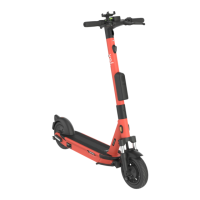
The Voi SNSC 2.3 functions as a personal mobility device, providing an efficient and environmentally friendly way to cover short distances. It is equipped with both front and rear drum brakes for reliable stopping power, an electronic brake, and an electronic throttle for acceleration. The scooter features a handlebar for steering, a headlight for visibility, and a bell for alerting pedestrians and other road users. An integrated IoT (Internet of Things) system likely enables connectivity features, such as tracking and remote management, which are common in shared scooter services. The design includes a kickstand for stable parking and reflectors for enhanced visibility, especially in low-light conditions. A phone holder is also integrated, suggesting the possibility of using a smartphone for navigation or app-based control. The battery compartment is designed for easy access, facilitating battery swaps, which is a key feature for operational efficiency, particularly in fleet management.
Operating the Voi SNSC 2.3 requires adherence to specific safety guidelines to ensure a secure riding experience. Before the first ride, it is recommended to practice in an area free from children, pedestrians, pets, vehicles, and other potential hazards. Riders must always yield to pedestrians and reduce speed to walking pace when approaching them from behind, ensuring sufficient visibility. Compliance with local laws and road traffic regulations (StVO) is mandatory when using the scooter on public roads. The manual stresses that higher speeds lead to longer braking distances and that strong braking on slippery surfaces can cause falls, urging riders to maintain a safe distance from other vehicles and traffic participants.
Wearing an approved and suitable bicycle or skateboard helmet is strongly advised to protect the head in case of a fall. Before each journey, users should inspect the scooter and its components to ensure they are in perfect condition. Any unusual noises or triggered alarms necessitate an immediate stop and contact with the manufacturer. Riders are encouraged to drive with foresight, anticipating potential hazards, obstacles, and changing road conditions. The manufacturer recommends a minimum age of 18 for users. Certain individuals should refrain from riding the scooter, including those under the influence of alcohol or drugs, those who should avoid strenuous physical activity due to illness, individuals with balance problems, those whose weight exceeds the maximum load, and pregnant women.
The scooter should not be ridden in snow, rain, or on wet, muddy, icy, or otherwise slippery roads, nor should it be driven over obstacles like sand or gravel, as these conditions can lead to loss of control and falls. Only parts and accessories approved by Voi should be used, and any modifications to the scooter are prohibited as they can negatively affect performance, increase injury risk, and void the warranty.
Battery charging is a critical aspect of usage. The scooter is fully charged when the LED light on the charger changes from red (charging) to green (charged). It is crucial not to connect the charger if the charging cables or connection are moist. The safety cover for the charging port must be replaced after charging, and the scooter should be kept out of reach of children during this process. Only the supplied charger should be used, and it should only be used for this specific scooter. Charging should occur in a dry, well-ventilated place. If any odor or very high temperature is noticed during charging, charging must be stopped immediately, and the manufacturer contacted. Battery swaps, if applicable, should only be performed as depicted in the manual, involving connecting to an app or computer to open the battery compartment, pulling off the battery plug, removing and replacing the battery, inserting the new battery plug, and securely closing the compartment cover.
Proper maintenance is essential for extending the lifespan and ensuring the safe operation of the Voi SNSC 2.3. For cleaning the scooter's frame, a soft, damp cloth is recommended. For stubborn dirt, a toothbrush and toothpaste can be used for pre-treatment, followed by cleaning with a soft, damp cloth. Scratches on plastic parts can be polished with fine sandpaper. It is important to avoid cleaning the scooter with alcoholic substances, vinegar, petrol, or other corrosive substances, as these can corrode and destroy the surface. Pressure washers should not be used for cleaning.
Before cleaning, the scooter must be switched off, the charger cable unplugged, and the rubber protector fitted to the charger connector to prevent damage to electronic components. The scooter should be stored in a cool, dry place and not left outdoors for extended periods. Prolonged exposure to sunlight and extreme temperatures (hot or cold) can accelerate wear and tear on plastic parts and reduce battery life.
Battery maintenance is crucial. The battery should not be stored or charged at temperatures outside the specified limits. Puncturing the battery is strictly prohibited. Local laws and regulations regarding battery disposal must be followed. Regular charging, ideally after each use, significantly extends battery life, and complete discharge should be avoided. Optimal battery performance is achieved at room temperature (22 degrees Celsius), with performance decreasing significantly at freezing temperatures and halving at -20 degrees Celsius. A fully charged battery in standby mode typically lasts 120-180 days, while a low-charged battery lasts 30-60 days. The battery should be charged every 20-30 days to maintain its health. Disassembling the battery is strictly forbidden due to fire and explosion hazards. The scooter should not be operated if the ambient temperature is outside the specified limits, as extreme temperatures can affect performance and potentially lead to injury or damage.
 General
| Category | Electric Scooter |
|---|---|
| Motor Power | 350W |
| Max Speed | 25 km/h |
| Weight | 18 kg |
| Max Load | 100 kg |
| Charging Time | 4-5 hours |
| Battery Capacity | 36V 10.4Ah |
| Tire Size | 10 inch |
| Brakes | Rear disc brake |

 To Next Page