CONTROLS
AND EQUIPMENT
Roof
rack
When
loads are to be carried on the roof, the
following should be noted:
• As the rain channels are moulded into the
roof for streamlining reasons, the normal
type of roof rack cannot be
used.
To avoid
risks
we advise
that
only the cross bars pro-
vided by the factory are
used.
• These cross bars are the basis for a com-
plete roof load carrying system. For safety
reasons
when carrying luggage, bicycles,
surf boards, skis and boats, the appropriate
special
adapters are required.
Ail
the components of this system are avail-
able
from Volkswagen dealers.
• Any
damage
which
may occur to
the
vehicle
as a
result
of using
other
roof
load
carrying
systems or by in-
correct
fitting
will
not be covered by
the
Warranty.
Warning
• Please
refer
to the accompany-
ing assembly
instructions
when
using the
roof
load
carrier
sys-
tem.
• Check all securing
points
and
screws
after
having
driven
a
short
distance,
tighten
if necess-
ary and
then
check
again
after
appropriate
periods.
Roof
load
The permissible
roof
load
(including
the
carrier
system)
and the
maxi-
mum permissible
weight
of the ve-
hicle
must
not be
exceeded
- see
Booklet
3.3.
• Distribute the load evenly. When using
carrier systems of a low load threshold, it is
not possible to carry loads corresponding to
the maximum permissible roof load. The
roof
load
carrier
can
only
carry
loads
up to the
limit
defined
in the assem-
bly instructions.
Warning
It should be
noted
that
when
transporting
heavy
items
on the
vehicle
roof,
the
handling
will
change due to the
displacement
of the
centre
of
gravity
or as a re-
sult
of the increased surface
space exposed to the
wind.
Driv-
ing
style
and speed
must
be al-
tered
to
suit.
• Ensure
that
the opened tailgate does not
knock against the roof load.
• Ensure
that
there is enough space be-
tween the sliding roof in the driver's com-
partment and the roof load. The roof load
could
otherwise hinder the sliding roof
when opening.
SEATS
AND
STOWAGE
CONTROLS
AND
TOUII'MI
Nl
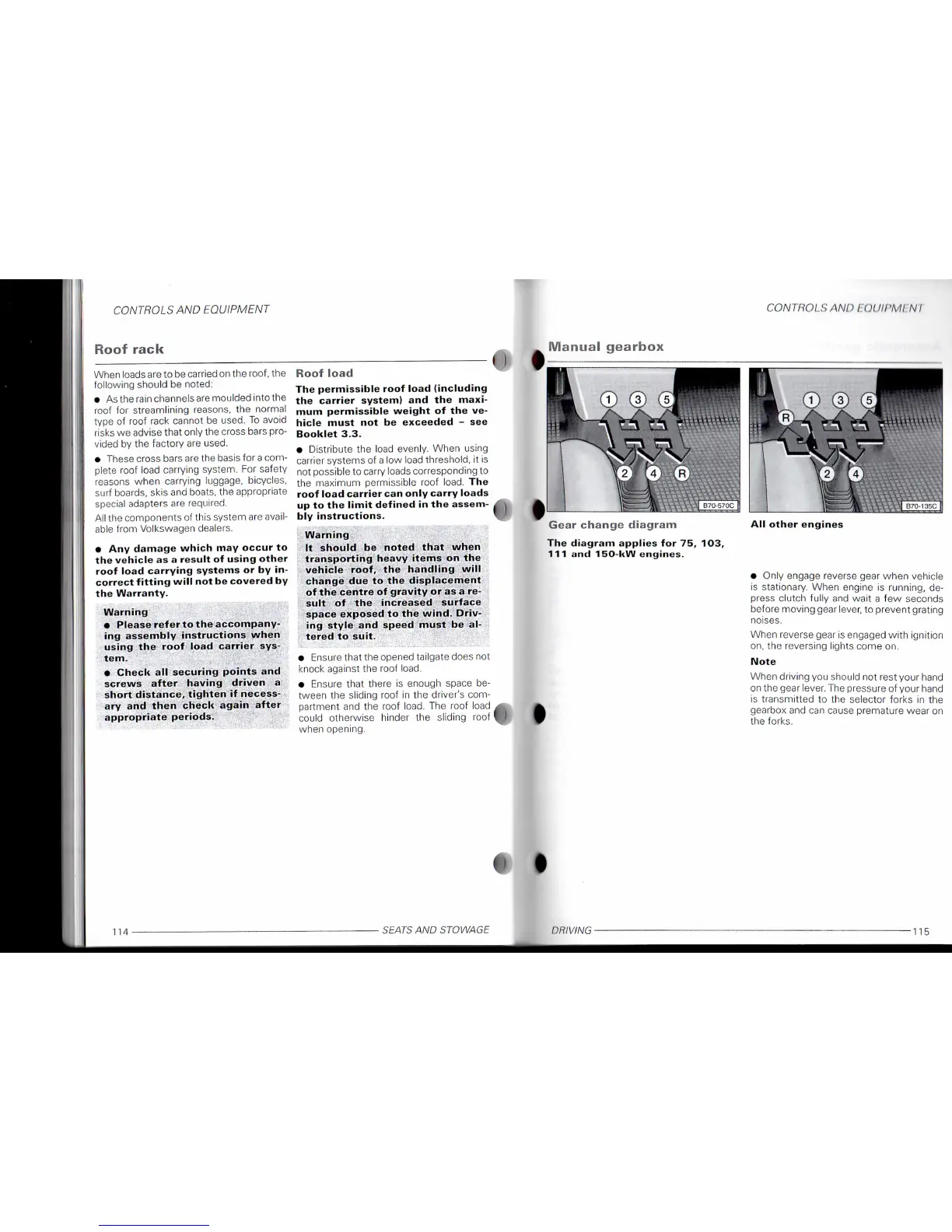
Manual
gearbox
Gear
change
diagram
The
diagram
applies
for 75, 103,
111 and
150-kW
engines.
All
other
engines
• Only engage reverse gear when vehicle
is
stationary. When engine is running, de-
press
clutch fully and wait a few seconds
before moving gear lever, to prevent grating
noises.
When
reverse gear is engaged
with
ignition
on,
the reversing lights come on.
Note
When
driving you should not rest your hand
on the gear lever. The pressure of your hand
is
transmitted to the selector forks in the
gearbox and can cause premature wear on
the forks.
DRIVING
115


 To Next Page
 Loading...