Service and maintenance
Electrical system 123
Checking state of charging
The state of charge of the batteries is checked with a hydrometer.
When there is risk of frost, it is particularly important that the
batteries do not become discharged, as the electrolyte in a flat
battery may freeze and thus destroy the battery.
Operating with faulty batteries is not allowed.
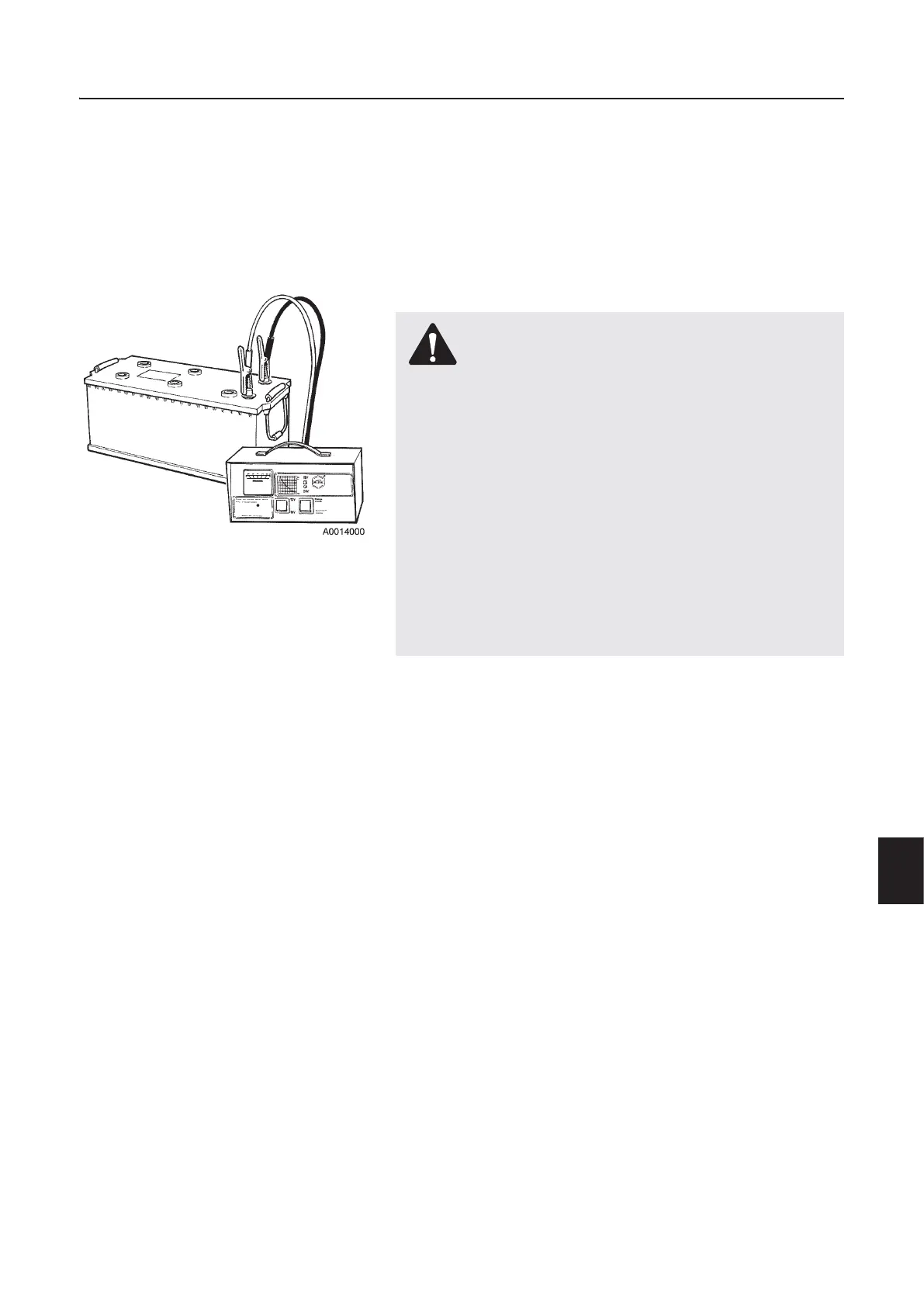
Batteries, charging
1 Disconnect the cables from the battery pole studs.
2 Remove the cell caps.
3 Top up with distilled water when required.
4 Connect the charging lead clips with plus to the positive pole
and minus to the negative pole.
5 Make sure that the battery charger is set to the correct voltage.
6 Switch on the charger.
WARNING!
During rapid charging of batteries, always remove the cell
caps. When a battery is being charged, an explosive
mixture of oxygen and hydrogen gas is formed. A short
circuit, an open flame or a spark in the neighbourhood of
the battery can cause a powerful explosion.
Always switch off the charging current before the
charging lead clips are disconnected.
Ventilate well, particularly if the battery is being charged
in a confined space.
The battery electrolyte contains corrosive sulphuric acid.
Electrolyte spilled on bare skin must be removed
immediately. Wash with soap and plenty of water. Should
you get splashes of electrolyte in your eyes or on any
other sensitive part of your body, rinse immediately in
plenty of water and contact a doctor immediately.



 To Next Page