Service and maintenance
Central lubrication 165
Lubricant recommendation
The system requires that the lubricant is clean and can be pumped
at the ambient temperature. Therefore, use lubricants of
recommended NLGI grease class. Lower grease grade may result
in reduced lubrication performance and increased wear.
Q Do not mix different types of lubricant. Change all lubricant, not
only in the reservoir.
Q No graphite or Teflon additives are permitted in the lubricant.
Q Use of molybdenum disulphide (MoS
2
) is only allowed if:
– the lubricant is of very high quality and does not contain
more than 5% MoS
2
.
– the lubrication system is checked at regular intervals for
reliable function.
– the main lines are flushed at least once a year.
NOTE! Special tools are needed to troubleshoot, adjust, and
repair the control unit. Therefore, contact qualified service
personnel when needed.
System test
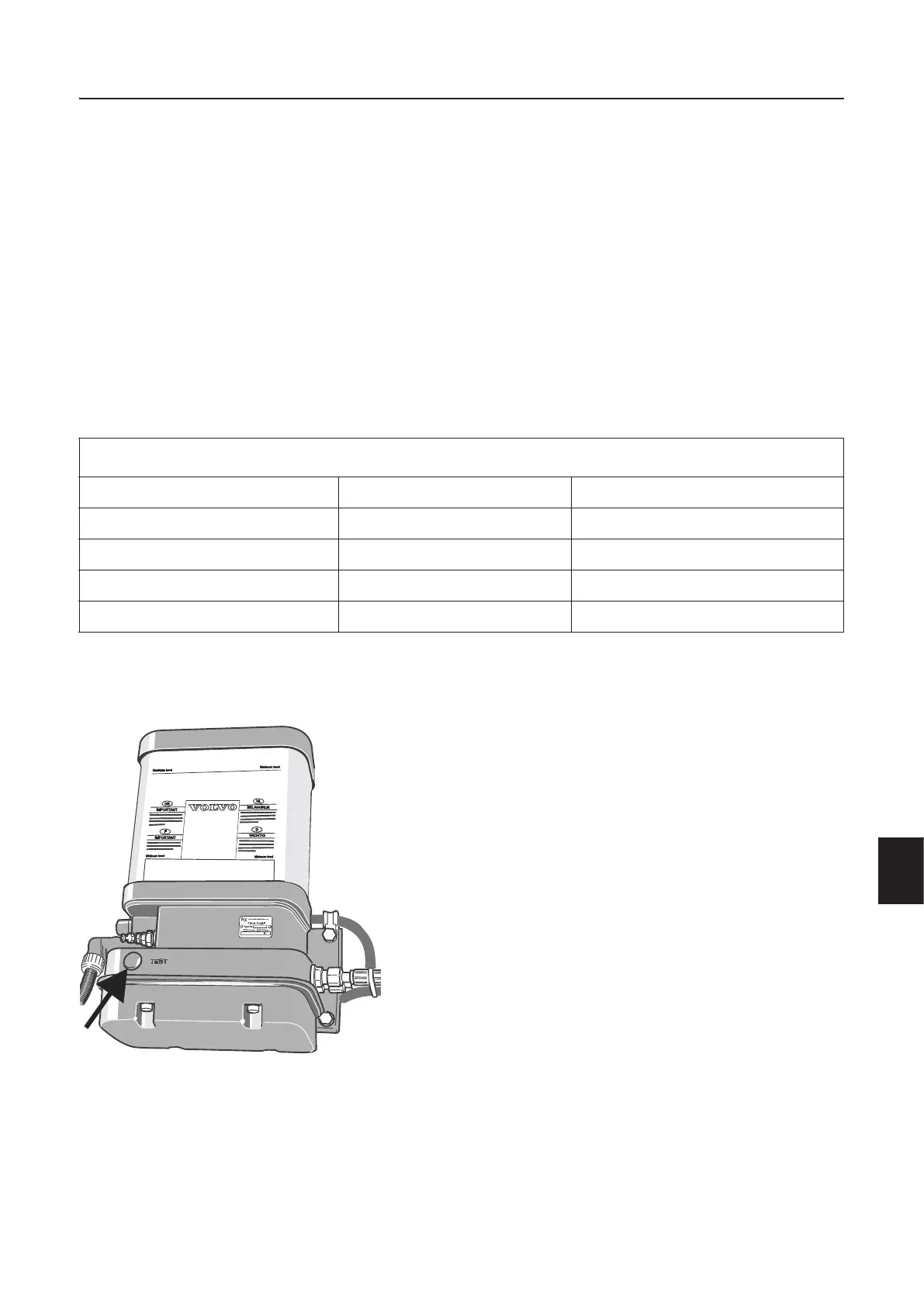
A system test can be performed to check the lubrication system's
function or to get extra lubrication, e.g., after washing.The test
button used to start a system test is located on the front of the
pump.
A test cycle can only be run when the pump is between two normal
lubrication cycles (not when lubrication cycle is in progress).
Single lubrication test cycle
The pump only runs one lubrication cycle via one main line. Can
be used after washing to get extra lubrication.
1 Turn the ignition key to position 1 (operating position).
2 Press in the test button for 2–6 seconds.
3 The lubrication cycle starts.
4 The test cycle finishes automatically.
If the lubrication test cycle has been used to get extra
lubrication after washing, the test button should be pressed
in one more time to lubricate the other main line.
Lubricant recommendation
Lowest temperature Highest temperature Lubricant type, NLGI
Above -25 °C (-13 °F) +80°C (176 °F) 2
Below -25 °C (-13 °F) 0 °C (32 °F) 0 / 1
Below -25 °C (-13 °F) +80 °C (176 °F) Synthetic 2
Below -25 °C (-13 °F) 0 °C (32 °F) Synthetic 0 / 1
1041514
Test button



 To Next Page