EasyManua.ls Logo

VTech Zoo Jamz Guitar - User Manual

VTech Zoo Jamz Guitar
2 pages
Print Icon
To Next Page IconTo Next Page
Loading...
Toy Adaptation Program Zoo Jamz Guitar Instruction Sheet
1. Carefully remove the toy from its box. We want the toy to look brand new when were all finished, so the
packaging should be kept in nice condition. The guitar is attached to a piece of cardboard that comes out of
the outer box. Three tabs on the back hold the toy in place and can be removed by turning the tabs 90 degrees.
2. Turn the toy on and play with it! See what each
of the buttons do and how their different
functions might be beneficial for a childs
learning and play. There are eight colorful
buttons on the neck of the giraffe. Choose one
of these buttons to adapt.
3. Remove the back cover of the toy.
There are 15 screws holding the
back in place, circled on the image
to the left. Remove these screws
and set them aside, making sure
not to lose any of them during the
adapting process.
4. Once the toy is opened, you can see the
circuit board in the neck is bolted in place.
Remove the 3 screws shown in the photo
to the right and set them aside in a safe
location.
Question and Answer IconNeed help?

Do you have a question about the VTech Zoo Jamz Guitar and is the answer not in the manual?

Summary

Zoo Jamz Guitar Toy Adaptation: Preparation and Disassembly

Unboxing and Initial Toy Removal

Carefully remove the toy from its box, keeping the packaging in good condition. Detach toy from cardboard.

Functionality Test and Button Selection

Turn the toy on to understand its functions. Choose one of the eight colorful buttons on the neck to adapt.

Accessing Internal Components

Remove the back cover by unscrewing 15 screws, then remove 3 screws holding the circuit board in the neck.

Zoo Jamz Guitar Toy Adaptation: Circuit Modification and Reassembly

Circuit Board and Button Mapping

Identify silicon buttons on the circuit board corresponding to toy buttons. Gently pull silicon cover to reveal mesh circuit.

Wiring Adaptation to Mesh Circuit

Strip a wire and solder it to one half of the mesh circuit board, ensuring no contact with other metal strips.

Securing Connections and Switch Testing

Secure the wire connection, test the adapted switch, and gently replace the silicon button over the mesh circuit.

Final Reassembly and Testing

File a notch for flush wire seating, screw the circuit board and back cover into place, then test the adapted toy.

Repackaging the Adapted Toy

Carefully repackage the working toy into its original box, securing it with the original tabs and taping edges.

Overview

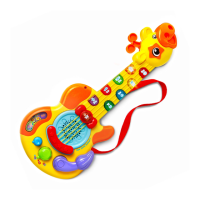
The VTech Zoo Jamz Guitar is an interactive musical toy designed for children aged 12 months to 4 years, aiming to teach music and encourage creative play. It functions as a 3-in-1 toy, allowing children to sing along, create their own music, and act as a rock star. The toy features a giraffe-shaped neck with eight colorful buttons, each with different functions that contribute to a child's learning and play.

Function Description:

The primary function of the Zoo Jamz Guitar is to provide an engaging musical experience for young children. It allows them to explore different sounds and melodies through its various buttons and modes. The toy is designed to be adaptable for children with diverse needs, with detailed instructions provided for modifying one of the eight colorful buttons to work with an external switch. This adaptation process involves accessing the internal circuit board and soldering a jack and wires to a chosen button's circuit, enabling alternative input methods.

Important Technical Specifications:

  • Age Range: 12 months to 4 years.
  • Input Method: Features eight colorful buttons on the giraffe's neck for direct interaction.
  • Adaptation Capability: Designed for modification to integrate an external switch, enhancing accessibility. This involves soldering wires to the internal mesh circuit board.
  • Power Source: Not explicitly stated, but implies internal electronics requiring power (likely batteries, given it's a portable toy).
  • Construction: Composed of a plastic casing, internal circuit board, silicon buttons, and a mesh circuit underneath the silicon cover.
  • Dimensions: The toy's dimensions are not specified but are consistent with a child-sized guitar.
  • Included Accessories: Comes with a strap for playing.

Usage Features:

  • Interactive Play: Children can press the colorful buttons to activate different sounds, melodies, and potentially songs.
  • 3-in-1 Play Modes: Offers versatility, allowing children to sing along to pre-programmed tunes, create their own musical sequences, or engage in imaginative role-play as a "rock star."
  • Portability: The inclusion of a strap suggests it's designed to be worn and played, promoting active engagement.
  • Developmental Benefits: The different functions of the buttons are intended to be beneficial for a child's learning and play, likely aiding in the development of motor skills, auditory processing, and creativity.
  • Adaptability for Special Needs: The detailed adaptation instructions are a key feature, allowing the toy to be customized for children who may require an external switch for interaction. This significantly broadens its usability and inclusivity. The adaptation process ensures that the original button also remains functional, offering multiple ways to interact with the toy.
  • Careful Disassembly: The instructions emphasize careful removal from packaging and meticulous handling during disassembly to maintain the toy's "brand new" condition. This includes turning tabs to remove the toy from its cardboard backing and carefully unscrewing 15 screws to remove the back cover.
  • Component Handling: Users are instructed to set aside removed screws in a safe location to prevent loss. The silicon button covers are gently pulled off to reveal the mesh circuit underneath.
  • Soldering and Wiring: For adaptation, precise soldering is required to connect a jack and wires to the mesh circuit board. Instructions highlight the importance of avoiding contact with other metal strips and using "helping hands" for stability.
  • Testing: Multiple testing stages are integrated into the adaptation process:
    • Initial testing of the toy's functions before adaptation.
    • Testing the soldered connection for security and functionality.
    • Testing the adapted button with the external switch and the original button after reassembly.
  • Reassembly: Instructions detail screwing the circuit board back into place, ensuring silicon buttons face down, and then reattaching the back cover with all 15 screws.
  • Modification for Wire Clearance: A crucial step involves filing a notch next to the adapted button so the wire sits flush with the plastic edge, allowing the toy to close completely without damaging the wire.
  • Repackaging: After successful adaptation and testing, the toy can be carefully repackaged using the original cardboard tabs and box, ready for return or use. This suggests a focus on maintaining the toy's aesthetic and structural integrity even after internal modifications.
  • Troubleshooting: In case the adapted switch does not work, users are advised to "check with a TAP team member," indicating a support system for the adaptation process.

The VTech Zoo Jamz Guitar, through its design and explicit adaptation instructions, stands out as a versatile and inclusive musical toy, offering both standard play features and the potential for enhanced accessibility for children with diverse needs.
VTech Zoo Jamz Guitar Specifications

General IconGeneral
BrandVTech
ModelZoo Jamz Guitar
CategoryToy
LanguageEnglish

Related product manuals