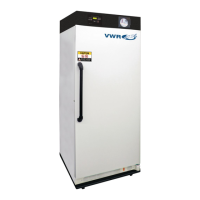
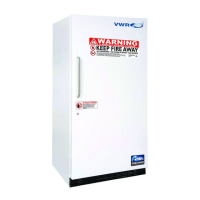
This document serves as an Owner's Guide for Horizon Scientific's Basic Series Free-Standing Undercounter Refrigerators and Freezers, specifically models SCUCFS-0404 and SCUCFS-0420. It provides comprehensive instructions on operation, care, and maintenance to ensure optimal and efficient performance of the appliance.
Function Description
The Horizon Scientific Basic Series Free-Standing Undercounter Refrigerators and Freezers are designed for indoor use, intended to store products at controlled temperatures. These units are factory-preset to maintain desired air and product temperatures, requiring no further adjustment under normal circumstances. They are designed to operate in air-conditioned spaces with ambient temperatures between 65°F and 85°F. The refrigeration system works by condensing moisture already present in the chamber, rather than generating it. The units are equipped with a motor compressor that cycles to maintain the internal temperature.
Usage Features
Receiving and Installation:
Upon receiving the unit, it is crucial to inspect for shipping damage. There are two types of damage: visible and concealed. Visible damage, such as loss, damage, or shortage, must be noted on the delivery receipt and acknowledged by the carrier's agent at the time of delivery. A signed copy should be obtained, and a written request for inspection sent to the carrier. Concealed damage, discovered after unpacking, requires immediate cessation of unpacking, retention of all packing materials, and prompt contact with the carrier to report the claim and request an inspection within 15 days of receipt. Failure to follow these instructions may result in the carrier refusing to honor a claim, and merchandise should never be returned to the manufacturer without prior authorization.
For installation, the unit should be uncrated and moved as close as possible to its final location and power outlet. A minimum of 4 inches of air flow space is required at the back and 3 inches on the sides and top; no material should be stored on top of the unit. The unit can be leveled using the screw-type adjustable leveling legs on the front corners, turning counterclockwise to raise and clockwise to lower. A slight tilt from front to back after leveling is acceptable and recommended.
Power Source and Startup:
The appliance requires a dedicated supply circuit conforming to all National and Local Electrical Codes, with voltage, cycle, phase, and amp requirements as specified on the cabinet Serial-Data plate. Voltage should not vary more than 5% from the serial plate ratings. A separate circuit is recommended to prevent overloading. The circuit should be protected with a 20 AMP delay-type fuse or circuit breaker. An extension cord or adapter plug should not be used, and the 3-prong plug must be inserted into a 3-prong grounded outlet to prevent severe or lethal shock. Never plug more than one unit into a single electrical outlet.
After proper leveling, the unit can be plugged in. It is essential to allow the cabinet to operate for a minimum of eight hours, or until it has started cycling normally, before placing any product inside. This ensures the unit is properly installed and functioning. During initial startup or after defrosting, especially in hot weather, the motor compressor may start and stop several times, which is normal functioning of the motor overload protector.
Loading and Operation:
When loading the unit, expect a temporary temperature rise as warmer products are introduced. If loading a large quantity, do so in stages, allowing several hours between stages for temperature stabilization. To ensure proper air circulation and even cooling, leave 2-3 inches of free space along the back and sides of the unit. Avoid overloading; the maximum suggested load is about 75% of the chamber capacity, distributed evenly from top to bottom and side to side. Minimizing door open time is crucial to prevent cold air loss and warm, moist air entry, which can lead to condensation and frost build-up.
The temperature controls are factory-preset and typically do not require adjustment. However, if adjustment is deemed necessary, it is strongly recommended to contact the manufacturer's Technical Support Department to ensure it is performed correctly.
Maintenance Features
Cleaning:
Regular cleaning is essential for efficient operation.
- Interior and Door Liners: Clean with a solution of 2 tablespoons of baking soda in 1 quart of warm water. Ensure the sponge or cloth is well-wrung before cleaning around controls, light bulbs, or any electrical parts.
- Door Gaskets: Wipe gaskets and their seating surfaces with a clean, soft cloth using soap and water.
- Shelves: Clean with soap and water. Removable shelves should not be washed in a dishwasher.
- Exterior and Handles: Use soap and water or a non-abrasive glass cleaner. Use a soft cloth for smooth handles; avoid dry cloths. Do not use commercial household cleaners, ammonia, or alcohol on handles.
Defrosting (Manual-Defrost Freezers):
Manual-defrost freezers should be defrosted when ¼ to ½ inch of frost has accumulated. Frost tends to accumulate faster on the upper part of the freezer due to warm, moist air entering when the door is opened.
- Between defrost evolutions: Minimize frost build-up by using a plastic scraper to remove soft frost with a pulling motion. Never use metal instruments, damp cloths, or wet hands, as they can stick to cold surfaces.
- Full defrost: Disconnect the freezer from the power source by unplugging it to avoid electrical hazards. Do not adjust the thermostat. Remove all products and leave the door open.
- Softening frost: If the frost is glazed and hard, fill deep pans with hot water and place them inside on the freezer bottom. Close the freezer door for about 15 minutes to soften the frost. Repeat as necessary until all frost is removed.
- After defrosting: Replace any drain plugs (if applicable). Remove all towels, tools, or pans from the interior. Clean the interior and exterior of the unit as described above. Plug the unit back in and restore it to service according to the operation instructions.
Moisture During Summer Season:
Increased moisture, condensation, or high humidity issues are common during summer. These typically self-resolve as the weather cools. Keeping the unit in an air-conditioned, low-humidity space will mitigate many of these problems.
- Check the freezer's location to ensure it's not facing a doorway or under an air conditioning vent.
- Monitor door sealing and frequency of door openings.
- Ensure there is a water trap (U-shaped loop) in the drain tube near the compressor. This trap holds a small amount of water, preventing air from entering the chamber through the tube.
Before contacting technical service for any issues, have the unit's model and serial number (found on the interior left upper wall) and a detailed problem description ready.



 To Next Page
 General