Technical Data
Max. delivery rate: 20 -350 g/min Container capacity: 800 ml
Max. viscosity: (runout time) 280 sec. Double insulation:
Max. pressure spikes: 180 bar Pump: Replaceable
Power source: 230 V, 50 hz Pump cylinder: Hard metal
Power consumption: 110 W Piston: Hard metal
Round spray nozzle: 0.8 mm Sound pressure
level:
86 dB(A)
Weight: 1.5 kg Sound pressure
output:
99 dB(A)
Oscillation level: 10.5 m/s²
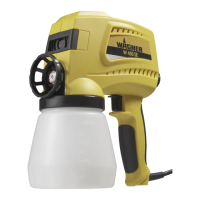
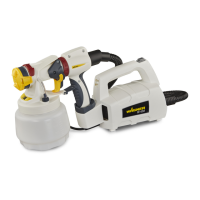
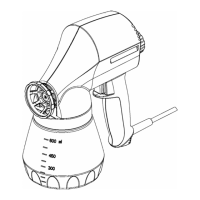
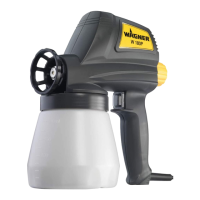
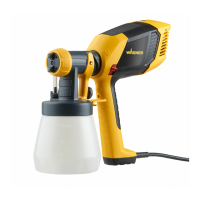
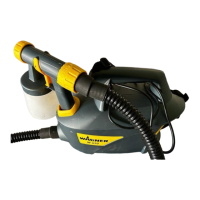
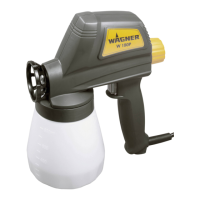
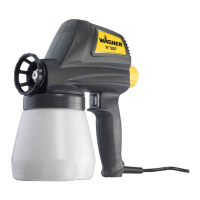
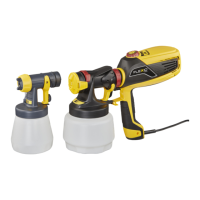
Description (Illus. 1)
1 Paint container 800 ml 6 Fine-adjustment knob 11 Suction tube
2 Locking nut 7 ON/OFF switch 12 Nozzle spanner
3 Nozzle 0,8 mm 8 Grip 13 Oil bottle
4 Housing 9 Pump housing 14 Viscosity measuring cup
5 4-step electronic system 10 Cleaning brush
Materials to be used:
Paints and varnishes containing solvents, acrylic enamel paints, water-soluble varnishes,
glazes, polishes, wood preservatives, disinfectants, plant protectives, saturants, as
well as oils and other watery liquids.
Dispersion and latex paints, bituminous paints. In the case of dispersion paints that contain
ne quartz or similar materials: Observe the specications in the handling table.
The following spray substances are not suitable for use:
Materials containing strong abrasives, glazes with coarse particles, strippers and caustic
solutions, silicate paints. Use of these spray materials can lead to increased wear or
corrosion damage in the pump area, which are not covered by the WAGNER-Guarantee.
Functional Description of the Spray Gun
The spray gun sucks in spray materials. The airless atomisation results when the spray material
is pumped at high pressure through the swirl system and the nozzle bore.
Preparing the Spray Material
The paints usually need to be diluted for use with the spray gun. You will nd guidelines
for sprayable dilutions in the following viscosity table (viscosity = consistency
of the paint). You can achieve the correct dilution by using the viscosity test cup.


 To Next Page
 Loading...