

EasyManua.ls Logo

wantai DQ860MA - User Manual

wantai DQ860MA
9 pages
Print Icon
To Next Page IconTo Next Page
Loading...
Changzhou Wantai Electrical Appliance Co., Ltd
Introduction:
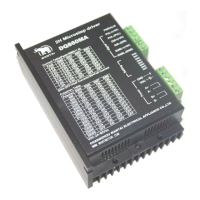
DQ860MA is a type of two-phase hybrid stepping motor driver, The drive voltage of which is
from 24VDC to 80VDC. It is designed for use with 2-phase hybrid stepper motor of all kinds with
57mm to 110mm outside diameter and less than 7.8A phase current. This circuit that it adopts is
similar to the circuit of servo control which enables the motor running smoothly almost without
noise and vibration. Holding torque when DQ860MA runs under high speed, is also significantly
higher than the other two-phase driver, what’s more, the positioning accuracy is also higher. It is
widely used in middle and big size numerical control devices such as curving machine, CNC
machine, and computer embroider machine, packing machines and so on.
Features:
l High performance, low price
l Average current control, 2-phase sinusoidal output current drive
l Supply voltage from 24VDC to 80VDC
l Opto-isolated signal I/O
l Overvoltage, under voltage, over-current, phase short circuit protection
l 14 channels subdivision and automatic idle-current reduction
l 8 channels output phase current setting
l Offline command input terminal
l Motor torque is related to speed, but not related to step/revolution
l High start speed
l High holding torque under high speed
Electrical specification:
Input voltage
24-80VDC
Input current
6A
Output current
2.8A7.8A
Consumption
Consumption80W Internal
Insurance10A
Question and Answer IconNeed help?

Do you have a question about the wantai DQ860MA and is the answer not in the manual?

Summary

DQ860 MA Product Overview

Introduction to DQ860 MA

Overview of DQ860MA as a two-phase hybrid stepping motor driver, its voltage range, and typical applications.

Key Features of DQ860 MA

Lists high performance, low price, sinusoidal output, opto-isolated signals, and protection features.

DQ860 MA Electrical Specifications

Details input voltage, input current, output current range, and power consumption ratings.

Pin Configuration and Wiring

Connector Pins Assignment and Description

Explains the function of PUL+, PUL-, DIR+, DIR-, ENBL+, ENBL- pins for control signals.

Input Port Wiring Diagrams

Illustrates typical input port circuits for PC open collector and PNP output connections.

Function Selection via DIP Switches

Micro Step Resolution Setting

Details how DIP switches SW5-SW8 are used to set the micro-step resolution for the driver.

Standstill Current Setting

Explains the use of SW4 to adjust standstill current relative to selected dynamic current.

Output Current Setting

Describes how DIP switches SW1-SW3 set the peak and RMS output current for the motor.

Semi-flow Functionality

Defines the semi-flow function which reduces output current after 200ms of no pulse input.

Mechanical and Environmental Specifications

Motor and Power Connections

Outlines motor phase connections (A+, A-, B+, B-) and power supply terminals (DC+, DC-).

Mechanical Installation Guidelines

Provides recommendations for mounting space, environmental conditions, and physical dimensions.

Troubleshooting and System Wiring

Status Indicators and Troubleshooting

Explains LED indications (PWR, ALM) and common troubleshooting scenarios with their measures.

Typical System Wiring Diagram

Presents a comprehensive wiring diagram for the controller, power supply, and stepper motor.

Appendix and Warranty Information

Warranty Terms and Limitations

Covers the limited warranty period, exclusions, service obtaining process, and limitations.

Overview

The DQ860MA is a two-phase hybrid stepping motor driver manufactured by Changzhou Wantai Electrical Appliance Co., Ltd. It is designed to operate with 2-phase hybrid stepper motors that have an outside diameter ranging from 57mm to 110mm and a phase current of less than 7.8A. The drive voltage for this device ranges from 24VDC to 80VDC.

Function Description:

The DQ860MA utilizes a servo control circuit, which allows for smooth motor operation with minimal noise and vibration. This design also contributes to significantly higher holding torque at high speeds and improved positioning accuracy compared to other two-phase drivers. It is widely applied in various middle and large-sized numerical control devices, including curving machines, CNC machines, computer embroidery machines, and packing machines.

Important Technical Specifications:

  • Input Voltage: 24-80VDC
  • Input Current: ≤ 6A
  • Output Current: 2.8A ~ 7.8A
  • Consumption: 80W (Internal Insurance: 10A)
  • Working Temperature: -10℃ ~ 45℃
  • Stocking Temperature: -40℃ ~ 70℃
  • Humidity: Not condensation, no water droplets
  • Gas Environment: Prohibition of combustible gases and conductive dust
  • Weight: 600g
  • Mechanical Dimensions: 130mm (length) x 48mm (width) x 23.5mm (height) for the main body; 139mm (length) x 97mm (width) for the mounting plate.

Usage Features:

  • High Performance, Low Price: Offers a cost-effective solution with robust performance.
  • Current Control: Features average current control and 2-phase sinusoidal output current drive.
  • Opto-isolated Signal I/O: Ensures electrical isolation for control signals.
  • Protection Mechanisms: Includes overvoltage, undervoltage, over-current, and phase short circuit protection.
  • Micro-step Resolution: Supports 14 channels of subdivision, configurable via DIP switches (SW5, SW6, SW7, SW8). The available resolutions are 400, 800, 1600, 3200, 6400, 12800, 25600, 51200, 1000, 2000, 5000, 10000, 25000, and 50000 pulses per revolution.
  • Output Phase Current Setting: Provides 8 channels for setting the output phase current, configurable via DIP switches (SW1, SW2, SW3). Peak current options range from 2.80A to 7.80A, with corresponding RMS values from 2.00A to 5.60A. Users should select a setting closest to their motor's required current.
  • Automatic Idle-Current Reduction: Automatically reduces current when idle to prevent motor heat.
  • Offline Command Input Terminal: Allows for external control to take the driver offline.
  • Motor Torque Characteristics: Motor torque is related to speed but not to step/revolution.
  • Start Speed: Capable of high start speeds.
  • Holding Torque: Maintains high holding torque at high speeds.
  • Semi-flow Function: If no step pulse is received for 200ms, the driver automatically reduces the output current to 40% of the rated output current to prevent motor overheating.
  • Control Signal Compatibility: PC's control signals can be active in high or low electrical levels. For high electrical level activation, all control negative signals connect to GND. For low electrical level activation, all control positive signals connect to a public port. Input port circuits are provided for both Yang connection (PC open collector output) and Yin connection (PC PNP output). Resistors (R) are required in the control signal part, with specific values depending on VCC (e.g., R=0 for VCC=5V, R=1K for VCC=12V, R=2K for VCC=24V).

Pins Assignments and Description:

  • PUL+, PUL-: Pulse signal input pins. PUL+ is the positive end, PUL- is the negative end.
  • DIR+, DIR-: Direction signal input pins. DIR+ is the positive end, DIR- is the negative end.
  • ENBL+, ENBL-: Enable signal input pins. ENBL+ is the positive end, used for enabling/disabling the driver (high level enables, low level disables). ENBL- is the negative end, usually left unconnected (enabled by default).
  • Motor Wiring:
    • 1: A+
    • 2: A-
    • 3: B+
    • 4: B-
  • Power Supply Pins:
    • 5, 6: DC+ (24-80VDC)
    • DC- (The peak input current cannot exceed 6A)

Maintenance Features:

  • Installation Environment: To ensure proper cooling, a minimum of 20mm space should be maintained around the device, and it should not be placed next to other heating devices. It is crucial to avoid dust, oil mist, corrosive gases, high humidity, and high vibration.
  • Status Indicators:
    • PWR (Green): Indicates normal operation.
    • ALM (Red): Indicates a failure, such as motor phase short-circuit, overvoltage, or undervoltage protection.
  • Troubleshooting Guide:
    • LED off turn:
      • Reason: Wrong connection for power or low voltages for power.
      • Measure: Check wiring of power or enlarge voltage of power.
    • Motor doesn't run, without holding torque:
      • Reason: Wrong connection of stepper motor or RESET signal is effective when offline.
      • Measure: Correct its wiring or make RESET ineffective.
    • Motor doesn't run, but maintains holding torque:
      • Reason: Without input pulse signal.
      • Measure: Adjust PMW & signal level.
    • Motor runs wrong direction:
      • Reason: Wrong wires' connection or wrong input direction signal.
      • Measure: Change connection for any of 2 wires or change direction setting.
    • Motor's holding torque is too small:
      • Reason: Too small relative to current setting.
      • Measure: Correct rated current setting.
    • Acceleration is too fast:
      • Measure: Reduce the acceleration.
    • Motor stalls:
      • Measure: Rule out mechanical failure.
    • Driver does not match with the motor:
      • Measure: Change a suitable driver.

Warranty:

WANTAI MOTOR provides a twelve-month limited warranty against defects in materials and workmanship from the date of shipment. The company will repair or replace defective products at its option. The warranty excludes damage due to improper handling, inadequate wiring, unauthorized modification, misuse, or operation beyond electrical or environmental specifications. To obtain warranty service, an RMA number must be obtained from customer service via sales@wantmotor.com. Shipping charges for returns are prepaid by the customer, while WANTAI MOTOR covers return shipping. The implied warranties of merchantability and fitness for a particular purpose are disclaimed, with any implied warranty limited to the 12-month duration of the written warranty.
wantai DQ860MA Specifications

General IconGeneral
Brandwantai
ModelDQ860MA
CategoryDC Drives
LanguageEnglish