The MTOL+ Turbidimeter, available in models 28052 (Infrared) and 28053 (White Light), is a process turbidimeter designed for on-line measurement of water turbidity. It operates on the principle of nephelometry, measuring light reflected at a 90° angle to the incident light beam. The white light version (Model #28053) complies with US EPA 180.1 design criteria for turbidity measurement, while the infrared version (Model #28052) meets ISO 7027 and DIN 27027 standards. Both models feature long-life lamps and are equipped with ultrasonic cleaning.
Function Description:
The MTOL+ continuously monitors turbidity levels in process water. It provides real-time readings on a multi-line liquid crystal backlit display. The instrument offers three operating modes: AUTO (normal operation), CAL (calibration), and CONFIG (configuration). In AUTO mode, it performs routine measurements. CAL mode is used for calibration, during which all reading outputs and alarms are held. CONFIG mode allows users to customize instrument settings, download logged files, and update software. The device includes isolated 4-20mA, Modbus, and two programmable alarms, with an optional factory-installed flow alarm. A pressure regulator on the incoming line reduces pressures up to 7 bar (101.5 PSI) down to 1.03 bar (15 PSI).
Important Technical Specifications:
- Measurement Range: 0-100 NTU (factory configured), with optional ranges of 0-10 NTU and 0-1000 NTU available via USB thumb drive.
- Accuracy:
- ±2% of reading or ±0.02 NTU (whichever is greater) below 40 NTU for 0-100 and 0-1000 ranges.
- ±5% of reading above 40 NTU for 0-100 and 0-1000 ranges.
- ±2% of reading or ±0.02 NTU for 0-10 NTU range.
- Resolution: 0.0001 NTU (below 10 NTU).
- Response Time: Adjustable.
- Display: Multi-Line Liquid Crystal Backlit Display.
- Alarms: Two programmable, 120-240VAC 2A Form C Relays.
- Analog Output: Powered 4-20 mA, 1000 Ω drive.
- Communications Port: Bi-directional RS-485, Modbus RTU.
- Data Storage: 16 Gigabytes, downloadable via USB flash drive.
- Software: Upgradeable via USB flash drive.
- Maximum Water Pressure: Integral pressure regulator rated 7 bar (101.5 PSI).
- Flow Rate: 100 ml/min. - 1.5 liter/min. (.026-.40 Gal/min).
- Operating Temperature: 1°C - 50°C (34°F – 122°F).
- Wetted Materials: Nylon, Borosilicate Glass, Silicone, Polypropylene, Stainless Steel, Viton, Acetyl.
- Sample Temperature: 1°C - 50°C (34°F – 122°F).
- Power Supply: 100-240 VAC, 47 – 63 Hz, 80VA (Optional 24VDC factory installed option available for models 28052-24V and 28053-24V, operating from 18-36VDC).
- Insulation Rating: Double Insulated, Pollution Degree 2, Overvoltage Category II.
- Environmental Conditions: Not recommended for outdoor use, altitude up to 2000 meters, up to 95% RH (non-condensing).
- Enclosure: ABS.
- Regulatory Compliance and Certifications: White Light Version compliant to U.S. EPA 180.1, Infrared Version compliant to ISO 7027 and DIN 27027, CE Approved, LC listed to UL 61010-1 3rd Edition: 2012, LC: Certified to CSA 22.2 No.61010-1-12: 2012.
- Instrument Weight: 1.8 kg (4.0 lbs.).
- Shipping Weight: 2.8 kg (6.2 lbs.).
- Limited Warranty: 2 Years from date of invoice.
Usage Features:
- Display and Touchpad: The display shows turbidity levels, user guidance, and error messages. A five-button touchpad allows navigation through menus and selection of settings.
- Vapor Purge System: Equipped with a continuous vapor purge system that uses system heat and a fan to circulate heated dry air around the optical well and flow-through cuvette, preventing condensation. The instrument monitors the desiccant pouch condition and displays "DESC" when replacement is needed.
- Installation: Requires mounting in a suitable location, plumbing to the sample water source, and hard-wiring to electrical power. Installation must be performed by qualified technicians following all local, state, federal, and construction codes. The instrument should be isolated from vibration and temperature extremes.
- Configuration: Users can customize settings such as 4-20mA output levels, error level, RS-485 Baud Rate, Modbus Address, Alarm functions (HI, LO, OFF, Error) with adjustable set points and delay times, Offset Reading Adjustment (±1 NTU), Access Code for security, Signal Averaging (1-60 seconds), Display Resolution (up to four digits below 10 NTU), LCD Brightness (10 levels), Display Units (NTU or FNU), Ultrasonic Cleaning (On/Off), Instrument ID (up to 4 digits), and Logging Interval (1-60 minutes).
- Calibration: The instrument is factory calibrated for the 0-100 NTU range. Re-calibration is recommended quarterly using primary standards (ProCal Calibration Standards are available). Alternate ranges (0-10 NTU, 0-1000 NTU) require recalibration if selected.
- Data Retrieval: Data can be downloaded via USB flash drive. The instrument supports Modbus communication for integration with other systems.
- Starting the System: After initial installation, power on the instrument and allow it to warm up for 45 minutes to 1 hour. Initial settings for Date and Time must be configured.
Maintenance Features:
- Desiccant Pouch Replacement: The desiccant pouch needs periodic replacement when the display shows "DESC." Replacement involves unscrewing four thumbscrews, removing the electronics half, and inserting a new desiccant pouch. The enclosure seal should be inspected and maintained for proper desiccant life.
- Ultrasonic Cleaning: The instrument features patented ultrasonic cleaning to continuously clean the flow-through cuvette, extending the time between manual cleanings. It requires a special cuvette. The system can detect incorrect cuvette installation or transducer issues, displaying "CLN" as an error.
- Cuvette Cleaning: Measurement cuvettes should be checked and cleaned every three months during primary calibration. Cleaning involves washing the interior and exterior with detergent and rinsing with distilled or de-ionized water. Any condensate on the cuvette should be wiped dry before reinstallation to preserve desiccant life.
- Source Lamp Replacement: While lamps are designed for long life, replacement may be necessary. HF scientific service department should be contacted for assistance, as lamps are not covered under warranty.
- Troubleshooting: The manual provides a diagnostic table for common symptoms, causes (e.g., 4-20 mA loop open, desiccant pouch bad, lamp failed, flow option error, major system fault, ultrasonic cuvette not found, update not possible, bubbles, condensate, dirty cuvette, out of calibration, sample over-range), and corresponding cures.
- Technical Assistance: HF scientific offers technical and customer assistance via phone and email for any questions or service needs.

 Need help?
 General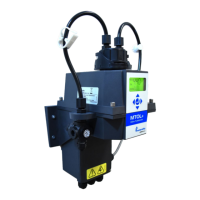

 To Next Page