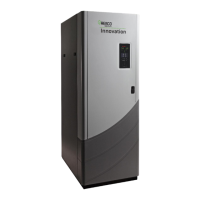
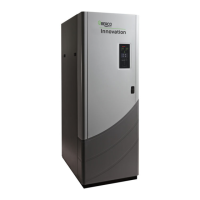
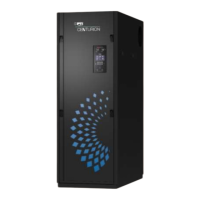
The Lync AEGIS is a heat pump water heater designed for efficient domestic hot water production. It comes in two main versions: Aegis A (air source) for indoor or outdoor installation and Aegis W (water source) for indoor installation. The Aegis A absorbs and moves heat from the surrounding air, while the Aegis W absorbs and moves heat from a connected water source, both producing hot water at temperatures as low as 14°F. The unit utilizes natural refrigerant-grade CO2 (R744), which has a Global Warming Potential (GWP) of 1, making it an environmentally friendly choice.
Function Description
The Lync AEGIS system is designed to heat domestic hot water, with the Aegis A model capable of operating year-round. The unit integrates with hot water storage tanks, which must be equipped with two NTC 10k temperature sensors: BT2 (hot side probe) located at the top of the last storage tank, and BT1 (cold side probe) placed at the bottom of the first storage tank. An optional BT3 sensor, located on the outlet of an external heat exchanger, modulates the inverter circulation pump between the heat exchanger and storage tanks.
The unit turns on when the BT1 probe reaches the "Set point unit ON" value (ST03 minus differential ST04) and continues heating until BT1 reaches the "Set point unit OFF" value (ST03). A "comfort" function can be enabled using the BT2 probe, allowing the unit to operate even if BT1 is above its "OFF" set point, provided BT2 is below a "Set point comfort ON" value. This helps prevent excessive heat dissipation or water spillage from the tanks. Operation with only the BT1 probe is allowed, but using BT2 requires BT1 to be present. The unit will only turn off when both BT1 and BT2 temperatures exceed their respective set points.
The system also features a cool recovery option (available only for the Air source unit), allowing heat to be drawn from a water stream for cooling a water loop. This enhances heat pump performance and can benefit central chilled water systems.
Domestic hot water pump management is integrated into the software, allowing for adjustable start, minimum, and maximum speeds for both the main unit pump and the domestic hot water pump. An offset can be applied to the unit set point (ST1) to regulate the domestic hot water pump based on the BT3 probe, accounting for temperature losses in the plate exchanger.
The unit incorporates a High Inlet Temperature (HIT) Function for inlet water temperatures above 30°C (>86°F), managing superheating via a 3-way bypass valve. This function limits the superheat value based on compressor oil and discharge temperatures to optimize cycle efficiency and prevent excessively high compressor temperatures.
An anti-Legionella function is included to prevent the proliferation of Legionella bacteria. This function involves heating the water to specific temperatures for a set duration. The unit can be configured to activate this function automatically or manually. The defrost function takes priority over the anti-Legionella function.
Important Technical Specifications
- Refrigerant: Natural refrigerant-grade CO2 (R744)
- GWP Value: 1
- Water Quality: Requires water within specified ranges (refer to Section 4.3 for details).
- Strainer: A cleanable strainer (60 mesh / 0.25mm or smaller) is required at the water inlet to prevent foreign matter.
- Electrical Supply: 460 V ± 5% (line voltage 277V +/- 3%). Voltage variations must not exceed ±5%, and phase unbalance must be less than 2%.
- Safety Valve Setting (High Pressure Side): 1740 PSI [120 bar]
- Safety Valve Setting (Low Pressure Side): 1160 PSI [80 bar]
- High Pressure Switch Setting: 1566 PSI [108 bar] (Differential: 1160 PSI [80 bar])
- Low Pressure Switch Setting: 290 PSI [20 bar] (Differential: 580 PSI [40 bar])
- Anti-freeze Alarm Setting: 39°F (4°C) (Differential: 11°F (6°C))
- Condensate Disposal (Aegis A): Equipped with two condensate drain pipes per air coil (2 for Aegis A 250, 4 for Aegis A 350-500).
Usage Features
- Installation: Aegis A models are suitable for indoor or outdoor installation, requiring a minimum of 9 ft (3 m) overhead clearance. Aegis W models are for indoor installation. A solid, flat, and horizontal support base (6-8 inches / 15-20 cm high, at least 12 inches / 30 cm wider and longer than the machine) is required.
- Temperature Control: The unit's controller regulates the outlet water temperature, with the parameter "ST01 Set Hot Water" being user-adjustable.
- Fan Speed Control: Equipped with a fan speed control device to allow operation at elevated ambient air temperatures and reduce sound emissions during cooler periods.
- Crankcase Heater: Ensures optimal oil temperature on startup. The compressor is equipped with a crankcase heater and oil temperature sensor. The heater is powered automatically when the master switch is closed, at least 12 hours before initial startup in cold weather.
- Potential Free Contacts: Available for alarm relay, compressor status, and enabling the domestic hot water pump.
- Start-up: Must be performed by authorized and qualified personnel. Requires verification of electrical connections, voltage, refrigerant pressure, and hydraulic system bleeding.
- Emergency Stop: Turning off the main switch powers off the entire machine.
Maintenance Features
- Periodic Inspections: Regular checks are required for proper operation.
- Monthly: Check functioning of all control and safety appliances, cleanliness of power panel and control components, verify no oil leaks from compressor, and check for water/glycol mixture leaks.
- Seasonal: Drain the unit if it is to remain out of service for a long period, especially in freezing conditions.
- Monthly: Verify filling of the water circuit, check metal filters in hydraulic pipes, clean finned battery and metal filters.
- Monthly: Perform defrosting test.
- 4 Months: Verify the state, fastening, and balance of the fans.
- 1 Month: Ensure the unit is regularly emitted by the machine.
- Monthly: Clean the outlets of the condensate drip tray.
- Safety Precautions: Before any service, disconnect power, wait at least 5 minutes, use a multimeter to check for voltage, ensure motor has stopped, and check that the dissipator is not hot.
- Transportation Braces: Must be removed after positioning the unit.
- Disposal: At the end of its lifespan, the unit must be removed and replaced. Lubricating oil and unit components (copper, aluminum) must be recovered and sent to collection centers for proper disposal and recycling.
- Refrigerant Handling: Carbon dioxide (R744) is a pressurized gas that can cause asphyxiation in high concentrations. Proper handling procedures, including adequate ventilation and personal protective equipment, are essential. Do not discharge into the atmosphere. Contact supplier for guidance on disposal.

 Need help?
 General

 To Next Page