
 Need help?
Do you have a question about the Waveshare RS232 TO RS485 and is the answer not in the manual?
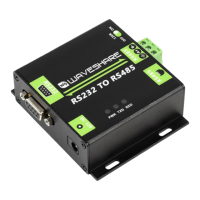
This bidirectional converter features electromagnet isolation and TVS protection for unstable environments.
Details about the RS232 vs RS485 converter, including its compatibility, isolation, and protection features.
Highlights include stable transmission, unibody magnetic isolation, and a switchable 120R terminal resistor.
Defines product type, baud rate, interface details for RS232 and RS485, and environmental operating conditions.
Describes the RS485 RJ45 Connector, RS485 Screw Terminal, and DC-005 Power Input.
Details the pin assignments for RS232 DB9 Female and RS485 RJ45 interfaces.
Explains the function of PWR (Power), TXD (Transmit), and RXD (Receive) indicators.
Provides the physical dimensions of the converter in millimeters.
Outlines preparation, required devices, and hardware connection steps for testing the converter.
This document outlines the features and usage of the RS232 TO RS485 asynchronous bidirectional converter, a robust device designed to facilitate communication between RS232 and RS485 systems. The converter's primary function is to transform RS232 signals into balanced difference RS485 signals, enabling reliable data exchange across different serial communication standards. It is engineered with several key features to ensure stable, secure, and efficient operation in various industrial and commercial environments.
One of the standout features of this converter is its electromagnetic isolation. This critical design element ensures that the RS232 and RS485 sides of the device are electrically separated, preventing ground loops and protecting connected equipment from voltage spikes and noise. This isolation is achieved through integrated unibody power supply isolation, which provides a stable isolated voltage without requiring an external power supply for the isolated terminal. This simplifies installation and reduces the overall complexity of the system. Furthermore, onboard unibody magnetic isolation contributes to signal isolation, enhancing reliability and providing strong anti-interference capabilities, all while maintaining low power consumption. This triple layer of isolation—electromagnetic, power supply, and signal—makes the converter highly resilient to electrical disturbances, ensuring data integrity even in harsh industrial settings.
The converter supports a stable transmitting rate, accommodating baud rates from 300 to 115200bps. This wide range of supported speeds makes it versatile for various applications, from legacy systems requiring slower communication to modern setups demanding higher data throughput. The device also incorporates internal TVS (Transient Voltage Suppressor) bidirectional transient suppression diodes and a detonator. These components are crucial for protecting the device and connected equipment from unstable working conditions, such as electrostatic discharge (ESD) and lightning strikes. The interface protection is rated at 600W for lightning protection, along with over-current and 15KV ESD protection, further safeguarding the system against electrical damage.
For ease of use and flexibility in network configuration, the converter includes an onboard 120R terminal resistor. This resistor is switchable, allowing users to enable or disable it as needed. Terminal resistors are essential in RS485 networks to prevent signal reflections, which can cause data corruption, especially over long cable runs or at high baud rates. The manual recommends enabling the terminal resistor for the start and end devices in a multi-point network, optimizing signal quality and network stability. This switchable feature provides convenience for system integrators, allowing them to adapt the converter to different network topologies without external components.
Powering the device is straightforward, thanks to its DC-005 power interface, which supports a wide range of DC voltages from 6V to 36V. This broad input voltage compatibility makes the converter suitable for various power sources and applications, reducing the need for specific power adapters. The device comes with a power adapter, simplifying the initial setup.
User feedback and operational status are provided through three LED indicators: PWR, TXD, and RXD. The PWR indicator turns red when the power supply is connected, confirming that the device is receiving power. The TXD (Transmit Data) indicator turns green when data is being transmitted from the RS232 port, offering visual confirmation of outgoing data. The RXD (Receive Data) indicator turns blue when data is received by the RS232 port, indicating incoming data. These indicators are invaluable for troubleshooting and monitoring the communication status, allowing users to quickly identify if data is flowing correctly in both directions.
The physical design of the converter emphasizes durability and practicality. It features an aluminum alloy enclosure with a sandblasting and anodic oxidation finish. This robust construction makes the device solid and durable, capable of withstanding the rigors of industrial environments. The enclosure not only protects the internal components but also contributes to heat dissipation, ensuring stable performance over extended periods.
The RS232 interface is provided via a DB9 male connector, a standard in serial communication, ensuring compatibility with a wide range of existing RS232 devices. The transmitting range for RS232 is approximately 15 meters, suitable for point-to-point connections. For the RS485 interface, the converter offers both a DIP connector and an RJ45 port, providing flexibility in cabling options. The DIP connector allows for direct wire termination, while the RJ45 port is convenient for structured cabling systems. The RS485 interface supports hardware auto-controlling for direction, simplifying software development by eliminating the need for explicit control signals for data direction. The transmitting range for RS485 is significantly longer, extending up to approximately 1200 meters. This makes it ideal for long-distance communication in industrial automation, building management systems, and other distributed applications. The RS485 interface supports point-to-multipoint communication, allowing up to 32 points to be connected. For networks with more than 16 points, the use of a relay is recommended to maintain signal integrity and performance.
In terms of maintenance, the device is designed for reliability and minimal intervention. The robust construction and comprehensive protection features reduce the likelihood of hardware failures. The LED indicators provide immediate visual feedback on operational status, aiding in quick diagnosis of communication issues. The switchable 120R terminal resistor allows for easy adaptation to network changes without requiring physical modification or external components. The wide operating temperature range of -15°C to 70°C and humidity range of 5%RH to 95%RH ensure that the converter can perform reliably in diverse environmental conditions. The device's design, with its focus on isolation, protection, and robust construction, aims to minimize the need for frequent maintenance, offering a dependable solution for serial communication conversion.
The user manual also provides clear instructions for hardware testing, including preparation and connection diagrams. For testing, a Windows PC is required, along with the RS232 TO RS485 converter and a USB TO RS485 converter. If the PC lacks an RS232 port, a USB to RS232 cable (male port) can be purchased separately. The testing procedure involves connecting the RS232 port of the converter to the PC (either directly or via a USB to RS232 cable) and the RS485 port of the converter to the RS485 port of the USB TO RS485 converter. The USB port of the USB TO RS485 converter is then connected to the PC for a loopback test. This setup allows users to verify bidirectional communication using serial port debugging software like SSCOM, ensuring that the device is functioning correctly before deployment in a larger system. The SSCOM software allows users to select the correct serial ports, set the baud rate, and send/receive data to confirm normal operation. This systematic approach to testing helps users confirm the device's functionality and troubleshoot any initial setup issues.
 General
| Interface | RS232, RS485 |
|---|---|
| RS232 Connector | DB9 Female |
| RS485 Connector | Terminal Block |
| Function | RS232 to RS485 conversion |
| Power | 5V |
| Baud Rate | 300bps to 115200bps |
| Operating Temperature | -40°C to 85°C |
| Communication Distance | Up to 1200m |
| Isolation Voltage | 2500V |

 To Next Page