EasyManua.ls Logo

Wayne WSB1275 - User Manual

Wayne WSB1275
4 pages
Print Icon
To Next Page IconTo Next Page
Loading...
600002W-001 C 10/18
Maintenance Free Battery
Please read and save these instructions. Read carefully before attempting to assemble, install,
operate or maintain the product described. Protect yourself and others by observing all safety
information. Failure to comply with instructions could result in personal injury and/or property
damage! Retain instructions for future reference.
Installation Manual WSB1275
REMINDER: Keep your dated proof of purchase for warranty purposes! Attach it to this manual or file it for safekeeping.
SUMP PUMP DESCRIPTION
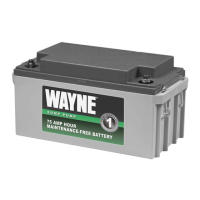
The WSB1275 is a maintenance-free, seal lead acid, rechargeable
battery. The construction and sealing technique prevents electrolyte
leakage from the termianls or case under normal usage.
Sealed lead-acid batteries are rechargeable batteries that
recombine suppresses gases, thus eliminating the need to add
water. Since they are sealed, the batteries will not leak and can
be installed in certain applications where “wet” battery can not be
installed.
UNPACKING
Inspect this unit before it is used. Occasionally, products
are damaged during shipment. If the pump or components
are damaged, return the unit to the place of purchase for
replacement, or call Customer Support (800-237-0987).
SAFETY GUIDELINES
This manual contains information that is very important to know
and understand. This information is provided for SAFETY and
to PREVENT EQUIPMENT PROBLEMS. To help recognize
this information, observe all safety information labeled danger,
warning, caution and notice.
This product can expose you to chemicals , including
DEHP, which is known to the State of California to cause cancer, birth defects
and reproductive harm. For more information, go to www.P65Warnings.ca.gov.
Do no load lead-acid batteries (hereinafter described
as “the battery”) in airtight equipment. Use of the battery in airtight equipment
may cause explosion of the equipment or injury.
Charge the battery using a specified
charger or under the chargin condition specified in this manual.
Charging the battery under any other conditions may cause the
battery to overheat, emit hydrogen gas, ignite, or burst.
Avoid direct contact of the battery with metallic
containers; acid-and-heat-resistant insulators should be employed. Leakage of
the battery in the absence of insulators may cause problems such as release of
fumes and ignition.
Do not place the battery near a device that
may cause sparks (such as a switch or a fuse). The battery may
generate flammable gas when charged, so remember to keep the
battery away from fire or an open flame to prevent any sparks
from igniting or causing explosions.
690003-001 B 11/19© 2019, WAYNE/Scott Fetzer Company
www.waynepumps.com
WSB1275
12 Volt-75 Amp Hour
Avoid placing the battery near a heat-generating part
(such as a transformer). Using the battery near a heat source may cause the
battery to overheat, ignite, or burst.
In applications which use more than one battery,
first make sure of correct mutual connections between batteries, and then
connect the battery with the charger or the load. Make sure to firmly connect
the (+) pole of the batteries to the (+) terminal of the charger or load, and
the (-) pole to the (-) terminal in the same way. If the poles/terminals of the
batteries, the charger and the load are connected improperly, explosion,
ignition or damage to the batteries and/or equipment may occur, causing
injurt to personnel in some cases.
Be extemely careful not to drop the battery onto feet
to avoid the possibility of serious injury.
The operating temperature range for the battery
is specified below. Use the battery at temperatures beyond this range may
cause battery damage.
Normal operating temerature of the battery is 77°F (25°C).
When charged: -40°F to 140°F (-40°C to 60°C)
Do not allow the battery to be immersed in or wetted
with water/sea-water; as it may corrode the battery, ignite or create an
electric shock hazard.
Do not place or store the battery in an automobile
in hot weather, under direct sunlight, in front of a stove, or near fire. Use or
storage of the battery in these places may cause fire or bursting.
Use of the battery in a dusty environment is not
recommended, as it may cause the battery to short. The battery should be
periodically checked when used in such an environment.

Question and Answer IconNeed help?

Do you have a question about the Wayne WSB1275 and is the answer not in the manual?

Summary

Product Description and Unpacking

Safety Guidelines

Installation Procedures

Preparation and Operation

Method of Use

Emergency Measures and Storage

Maintenance and Disposal

Limited Warranty Information

Summary

Product Description and Unpacking

Safety Guidelines

Installation Procedures

Preparation and Operation

Method of Use

Emergency Measures and Storage

Maintenance and Disposal

Limited Warranty Information

Overview

The WAYNE WSB1275 is a maintenance-free, sealed lead-acid, rechargeable battery designed for use in sump pump applications. Its construction and sealing technique prevent electrolyte leakage from the terminals or case under normal usage. As a sealed lead-acid battery, it utilizes a recombination process to suppress gases, eliminating the need for water addition. This design also prevents leaks, making it suitable for installations where "wet" batteries cannot be used.

Technical Specifications:

  • Voltage: 12 Volt
  • Amp Hour: 75 Amp Hour
  • Normal Operating Temperature: 77°F (25°C)
  • Charging Temperature Range: -40°F to 140°F (-40°C to 60°C)

Function Description:

The WSB1275 serves as a reliable power source, particularly for sump pumps, ensuring continuous operation even during power outages. Its maintenance-free design simplifies ownership by removing the need for regular water checks. The battery is intended for cycle operation, meaning it can be repeatedly charged and discharged as the main power source. For optimal performance and longevity in cycle applications, it should be charged using a charger that controls either the charge period or charge quantity, and charging should continue until completion. In trickle or float charge applications (stand-by power), the total voltage should be measured with a high-accuracy voltmeter (Class 0.5 or better) to ensure proper charge levels, as insufficient or overcharge can impact capacity and service life.

Usage Features:

  • Safety First: Users are strongly cautioned against placing the battery in airtight equipment, near heat-generating parts (like transformers), or near devices that may cause sparks (switches, fuses), as these conditions can lead to overheating, gas emission, ignition, or explosion.
  • Proper Charging: Always use a specified charger and adhere to the charging conditions outlined in the manual. Overcharging can cause overheating, hydrogen gas emission, ignition, or bursting.
  • Connection Protocol: When using multiple batteries or connecting to a charger/load, ensure correct mutual connections and firmly connect the positive (+) pole to the positive (+) terminal and the negative (-) pole to the negative (-) terminal. Improper connections can lead to explosion, ignition, or damage.
  • Environmental Considerations: Avoid immersing the battery in water or seawater, as this can cause corrosion, ignition, or electric shock. Do not store the battery in hot weather, direct sunlight, near a stove, or fire, as these conditions can lead to fire or bursting. A dusty environment is not recommended, as dust can cause short circuits; periodic checks are advised in such conditions.
  • Handling Precautions: Exercise extreme caution to avoid dropping the battery, as it is heavy and can cause serious injury. When loading into equipment, mount it in the lowest section for easy checking, maintenance, and replacement. Do not charge the battery in an inverted position, as this may cause leakage from the safety valve. Avoid carrying the battery by its terminals or lead wires, and do not apply strong shocks or jolts during transport.
  • Insulation: Insulate metallic tools (screwdrivers, wrenches) with vinyl tape to prevent short circuits, burns, damage, or explosions. Apply insulation covers to terminals, joint parts, bolts, and nuts to prevent electric shocks.
  • Firm Fastening: Securely fasten batteries to equipment to mitigate the effects of vibration and physical shock.
  • Initial Use: Newly purchased batteries may have lost some capacity due to self-discharge during shipment and storage. It is recommended to recharge them before initial use to restore full capacity. If newly purchased batteries exhibit irregularities (rusting, overheating), do not use them, as continued use could lead to fire or bursting.
  • Discharge Management: Avoid over-discharge. Charge the battery immediately after discharge. Equipment should be designed with a low voltage cut-off circuit to completely stop discharge current, including weak currents, to prevent accelerated deterioration from sulphation.
  • Professional Installation: Installation by skilled personnel (specialists) is recommended to avoid dangerous errors.

Maintenance Features:

  • Cleaning: Clean the battery with a slightly damp cloth, ensuring no excess water. Do not use dry cloth or a duster, as static electricity can lead to ignition or bursting. Avoid organic solvents (paint thinner, gasoline, kerosene, benzene, liquid detergents) as they can cause the battery case to crack and leak.
  • Regular Checks: Periodically check the battery for any signs of irregularities, such as cracks, deformation, or leakage. Replace damaged batteries immediately. Clean dirty or dusty batteries.
  • Storage: When storing, remove the battery from equipment, disconnect it from the charger/load, and keep it in a cool, low-humidity place, away from direct sunlight or high temperatures. Charge the battery fully before storage. During storage, charge it at least once every six months (or more frequently in higher ambient temperatures). Storing a discharged battery for a long period can lead to irreversible capacity loss. Use the battery as soon as possible after storage, as its capacity gradually deteriorates.
  • Replacement: Replace the battery within the time period specified in the instruction manual or equipment guidelines. This typically means replacement when capacity has decreased to 50% of the initial capacity at 77°F (25°C) or below. In trickle or float applications, the replacement period shortens by half for every 10°C rise in temperature above 77°F (25°C). Higher discharge currents (above 0.25 CA) also shorten run time and battery life.
  • Disposal: The WSB1275 is fully recyclable and should be accepted at locations that accept common automotive starter batteries, such as county/municipal recycling drop-off centers, scrap metal dealers, and retailers selling automotive replacement lead-acid starter batteries.

Wayne WSB1275 Specifications

General IconGeneral
BrandWayne
ModelWSB1275
CategoryCamera Accessories
LanguageEnglish