Need help?
Do you have a question about the Welch Allyn GS 900 and is the answer not in the manual?
Lists and shows all components provided with the mobile stand assembly kit.
Identifies necessary tools that are not supplied with the product for assembly.
Place wheels with brakes through ring cable and insert completely into the base.
Insert two wheels without brakes completely into the base.
Insert two screws into the pole for initial attachment to the base.
Insert tripod tube correctly into the base, ensuring it cannot rotate.
Assemble the winged screw with the spring washer and tighten to secure the pole.
Remove and discard the grey protective cover from the pole assembly.
Unscrew, remove cover, pull cord, and insert the spring arm.
Place the disk and then the retaining ring over the spring arm.
Secure the retaining ring into the pin groove using pliers.
Identifies the luminaire head as a distinct component for assembly.
Connect the luminaire head to the spring arm assembly.
Place the securing segment completely into its designated slot.
Tighten screws and adjust the plastic sleeve for secure pole connection.
Connect the electrical cord to the unit, tuck wires, replace cover, and tighten screw.
Connect the power cord to the unit and then plug it into a wall outlet.
Final step to power on the assembled GS 900 luminaire.
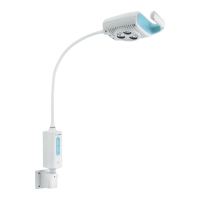
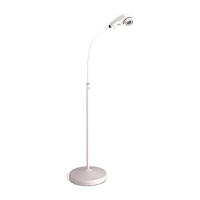
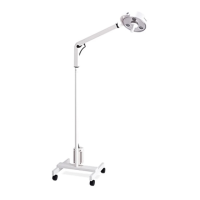
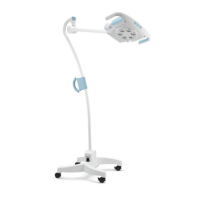
The Welch Allyn GS 900 is a medical examination light designed for use on a mobile stand, providing illumination for various medical procedures. The assembly instructions detail the process of setting up the device, from unpacking to final operation.
The GS 900 serves as a general examination light, offering bright and focused illumination. Its primary function is to provide optimal visibility for healthcare professionals during patient examinations and minor procedures. The light head, or luminaire, is equipped with multiple LED light sources, ensuring a broad and even light field. The mobile stand allows for easy positioning and maneuverability within a clinical setting, adapting to different examination needs and room layouts. The design incorporates features for adjusting the light's position and angle, ensuring the light can be directed precisely where needed.
While specific technical specifications like light intensity (lux), color temperature (Kelvin), or power consumption are not explicitly detailed in the provided pages, the visual evidence suggests it uses LED technology, which is known for its efficiency, long lifespan, and consistent light output. The device is designed to be powered via a standard electrical outlet, as indicated by the power cord and wall plug connection. The mobile stand features four wheels, two of which are equipped with brakes, providing stability and controlled movement. The overall construction appears to be robust, utilizing materials suitable for a medical environment, likely including durable plastics and metal components for the stand and arm. The light head itself features a ventilated design, suggesting heat dissipation mechanisms for prolonged use.
The GS 900 is designed for ease of use and flexibility.
The provided manual pages primarily focus on assembly, but some aspects hint at maintenance considerations:
In summary, the Welch Allyn GS 900 is a mobile examination light characterized by its robust design, ease of assembly, and flexible positioning capabilities, making it a practical illumination solution for various medical settings.
 General
| Brand | Welch Allyn |
|---|---|
| Model | GS 900 |
| Category | Lighting Equipment |
| Language | English |

 To Next Page