
 Need help?
Do you have a question about the Wenger Tourmaster Storage Cart and is the answer not in the manual?
The Wenger Tourmaster Storage Cart is a specialized piece of equipment designed for the efficient and safe storage and transport of Wenger Tourmaster risers and fourth steps. This manual provides comprehensive instructions for its operation, ensuring users can maximize its utility while adhering to crucial safety guidelines.
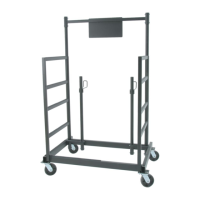
The primary function of the Tourmaster Storage Cart is to consolidate and organize multiple risers and fourth steps, making them easy to move, store, and access. It is engineered to hold up to four back rails, four risers, and four fourth steps, providing a compact solution for managing staging components. The cart's design incorporates swing arms and support frames that securely cradle the risers and steps, preventing damage during transit and storage. Its wheeled base allows for smooth movement across various surfaces, enhancing portability within a venue or for loading onto a transport vehicle.
The Tourmaster Storage Cart is designed for ease of use, though it emphasizes the need for two people for most loading and moving operations to ensure safety and prevent injury.
The process begins with loading up to four back rails. Each back rail is lifted with its positioning wheels pointing upward and the legs positioned next to the cart, ensuring the horizontal rail faces away from the cart. The back rail is then placed onto the back rail supports, with each back rail leg facing toward the back rail support posts. For subsequent back rails, the positioning wheels should still point upward, but the legs should face away from the cart. The back rails are placed so that their horizontal rails touch, or their legs nest together, optimizing space and stability. The manual illustrates how the back rail legs are positioned outside the back rail support post.
Loading risers onto the cart involves a sequence of opening swing arms and carefully placing the risers. The swing arms are opened by pushing upward on the underside of the horizontal bar, close to the swing arm post. It is crucial to start with the highest arm and swing it away from the cart. The manual highlights the importance of lifting the swing arm to free the keeper on the end, allowing it to swing. Once the swing arms are open, two people are required to place the first riser onto the cart, ensuring its positioning wheels hang over the right end of the cart support frame. A critical note specifies that the 13-inch swing arm must be on the right side of the cart; if not, it indicates incorrect assembly requiring customer service assistance. After placing the first riser, the two lower swing arms are closed, requiring them to be lifted high enough to clear the riser. This process is repeated for subsequent risers, alternating the positioning wheels on the left and right ends of the cart. The manual explicitly warns about a dangerous pinch point that develops when the swing arm keeper is inserted into the holding socket, emphasizing the need for caution to prevent serious injury. For transport by vehicle, it is essential to fasten each riser to both swing arms (or the cart frame for the lowest riser) using rubber or polyurethane tie-down cords or light-duty cinch straps.
The final stage involves loading the fourth steps onto the cart. The first fourth step is placed onto the top set of swing arms with the carpet side down and the positioning wheels facing outward, away from the swing arm post. Subsequent fourth steps are loaded alternately with the carpet side up and carpet side down, always with the positioning wheels facing outward. This alternating placement helps to optimize space and secure the steps. Once all fourth steps are loaded, cinch straps are used to fasten them securely around the stacked steps.
The manual places a strong emphasis on safety. It defines "CAUTION" as indicating a risk of injury or damage, and "WARNING" as indicating a risk of serious injury or death. Key precautions include:
These precautions are reiterated throughout the loading instructions with prominent "CAUTION" and "WARNING" labels.
While the manual primarily focuses on operation, the inclusion of a "Replacement Parts List" suggests that the Tourmaster Storage Cart is designed for long-term use with the possibility of component replacement. This list details various parts, including hex head cap screws, hex head lock nuts, cross bars, swing arm posts, swing arms (13-inch and 10-inch), the storage cart frame, casters, back rail support posts, and safety straps. The availability of these parts indicates that individual components can be replaced if they become worn or damaged, extending the lifespan of the cart. This modularity in design simplifies maintenance, allowing for targeted repairs rather than requiring a full cart replacement. The absence of complex electronic or hydraulic systems implies that routine maintenance would likely involve visual inspections for wear and tear, ensuring all fasteners are tight, and lubricating moving parts like casters and swing arm pivots if necessary, although specific lubrication instructions are not detailed in this excerpt. The robust construction, as implied by the parts list, suggests a durable design intended to withstand the rigors of frequent use in various environments.
 General
| Product Name | Wenger Tourmaster Storage Cart |
|---|---|
| Category | Outdoor Cart |
| Type | Storage Cart |
| Handle Type | Telescoping Handle |
| Application | Outdoor Storage and Transport |
| Storage Compartments | Multiple Interior and Exterior Pockets and Compartments |
| Color | Black |
| Foldable | Yes |

 To Next Page
