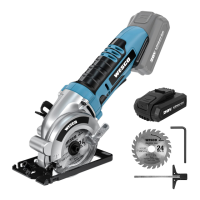
The WESCO WS3454U (PSC120MU1) is a mini circular saw designed for ripping and cross-cutting wood and other materials in straight lines. It comes with a 2-year warranty.
Component List:
The saw includes a hex key, soft grip handle, on/off switch, lock-off trigger, fixed upper guard, lower guard lever, lower blade guard, base plate, parallel guide, parallel guide clamping bolt, bevel angle adjustment lock knob, dust extraction outlet, vacuum adapter (optional), inner flange, saw blade, outer flange, blade bolt, spindle lock button, depth adjustment knob, depth scale, and bevel angle scale.
Technical Specifications:
- Model: WS3454U (PSC120MU1)
- Voltage: 120V~60Hz
- Rated current: 6.0A
- No load speed: 4700/min (n₀) / 5200/min (n)
- Blade size: 4-1/2"
- Cutting capacity:
- Cutting depth at 90°: 1-11/16"
- Cutting depth at 45°: 1-1/8"
- Protection class: II
- Machine weight: 6.09lbs
Accessories:
The standard delivery includes a parallel guide, hex key, diamond blade, 24T TCT blade, and 40T TCT blade. It is recommended to purchase additional accessories from the same store where the tool was bought.
Function Description and Usage Features:
Changing the Saw Blade:
- Safety First: Always unplug the saw before changing the blade and wear protective gloves.
- Blade Compatibility: Use only saw blades that match the specifications in the operating instructions. Grinding discs are not to be used as cutting tools.
- Direction: Ensure the cutting direction of the teeth (arrow on saw blade) aligns with the direction of rotation arrow above the blade guard.
- Removal:
- Press and hold the spindle lock button (only when the blade is at a standstill).
- Push the lower guard lever counterclockwise to the left side to retract the lower blade guard.
- Loosen the blade bolt clockwise with the hex key. Remove the blade bolt, outer flange, and saw blade.
- Mounting:
- Clean the saw blade and all clamping parts.
- Depress and hold the spindle lock button.
- Push the lower guard lever counterclockwise to the left side to retract the lower blade guard.
- Place the blade onto the inner flange, then insert the outer flange over the spindle.
- Tighten the blade securing bolt counter-clockwise by 1/4 turn more than finger-tight using the hex key.
- Verify secure fastening by holding the spindle lock button and attempting to manually rotate the blade; it should not spin if installed correctly.
- Cutting Results: For optimal results, use a blade suited to the material and desired cut quality.
Sawdust Removal:
- The saw has a dust extraction outlet that can be connected to a vacuum adapter (not supplied) and a vacuum cleaner (sold separately). This helps keep the work area clean, improves visibility, reduces airborne dust, and protects the guard's working elements.
Adjusting the Cutting Depth:
- Determine Depth: Calculate the desired depth by adding 3mm to the material thickness.
- Loosen Knob: Turn the depth adjustment knob counter-clockwise.
- Adjust Height: Manually lift or lower the machine handle to align the depth indicator (a) with the depth scale.
- Tighten Knob: Turn the depth adjustment knob clockwise to secure.
Adjusting the Bevel Angle:
- Loosen Knob: Turn the bevel angle adjustment lock knob counter-clockwise.
- Tilt Base Plate: Tilt the base plate until the triangle symbol (b) aligns with the desired bevel angle on the bevel angle scale.
- Tighten Knob: Turn the bevel angle adjustment lock knob clockwise to secure.
Parallel Guide:
- The parallel guide allows for exact cuts along a workpiece edge and for cutting strips of the same dimension.
- Loosen: Use the hex key to rotate the parallel guide clamping bolt counter-clockwise.
- Position: Slide the parallel guide left or right to the desired position.
- Tighten: Rotate the parallel guide clamping bolt clockwise to tighten and ensure it is locked in place.
Operation:
Safety On/Off Switch:
- The switch is locked off to prevent accidental starting.
- To switch on, push the lock-off trigger backwards, then depress the on/off switch.
- To switch off, release the on/off switch.
Pocket and Plunge Cutting:
- Control: Always maintain proper control of the saw to ensure safety and prevent injury.
- Trial Cut: Make a trial cut on scrap material to determine blade thickness and offset the blade from the cut mark for accuracy.
- Movement: Do not remove the saw and blade from the workpiece while the blade is moving, as this can damage the cut (kerf), cause kickback, and lead to injury.
Working Hints for Your Circular Saw:
- Blade Selection: Use a blade appropriate for the material and its thickness. More teeth generally result in a better quality cut.
- Workpiece Security: Ensure the workpiece is firmly held or clamped to prevent movement.
- Support: Support large panels close to the cut line to prevent material movement, which can affect cut quality.
- Cutting Direction: The blade cuts on the upward stroke, which may chip the uppermost surface. If possible, ensure the uppermost surface is a non-visible surface after cutting.
Maintenance Features:
- Before Maintenance: Always remove the plug from the socket before any adjustment, servicing, or maintenance.
- Lubrication: The power tool requires no additional lubrication or maintenance.
- User Serviceable Parts: There are no user serviceable parts in this power tool.
- Cleaning: Do not use water or chemical cleaners. Wipe the tool clean with a dry cloth.
- Storage: Store the power tool in a dry place.
- Ventilation: Keep motor ventilation slots clean and all working controls free of dust. Occasional sparks through the ventilation slots are normal and will not damage the tool.
- Cord Damage: If the supply cord is damaged, it must be replaced by the manufacturer, its service agent, or similarly qualified persons to avoid a hazard.
- Read Instructions: Read all safety warnings, instructions, illustrations, and specifications provided with the power tool to prevent electric shock, fire, and serious injury.
- Work Area Safety: Keep the work area clean, well-lit, and free from children and bystanders. Do not operate in explosive atmospheres.
- Electrical Safety: Power tool plugs must match the outlet. Avoid body contact with earthed surfaces. Do not expose to rain or wet conditions. Do not abuse the cord. Use an outdoor-suitable extension cord when operating outdoors. Use a residual current device (RCD) protected supply in damp locations.
- Personal Safety: Stay alert, use common sense, and do not operate while tired or under the influence. Use personal protective equipment, including eye protection, dust mask, non-skid safety shoes, hard hat, or hearing protection. Prevent unintentional starting. Remove adjusting keys/wrenches before turning on. Do not overreach. Dress properly, keeping hair and clothing away from moving parts. Connect dust extraction facilities if provided. Do not let familiarity lead to complacency.
- Power Tool Use and Care: Do not force the power tool. Do not use if the switch doesn't turn it on/off. Disconnect power before making adjustments or changing accessories. Store idle tools out of reach of children. Maintain tools and accessories. Keep cutting tools sharp and clean. Use the tool, accessories, and bits according to instructions. Keep handles dry, clean, and free of oil/grease.
- Service: Have the tool serviced by a qualified repair person using identical replacement parts.
Safety Warnings for All Saws - Cutting Procedures:
- DANGER: Keep hands away from the cutting area and blade.
- Do not reach underneath the workpiece.
- Adjust cutting depth to the workpiece thickness (less than a full tooth visible below).
- Never hold the workpiece in your hands or across your leg; secure it to a stable platform.
- Hold the power tool by insulated gripping surfaces when cutting near hidden wiring.
- When ripping, use a rip fence or straight edge guide.
- Use blades with correct size and shape of arbour holes.
- Never use damaged or incorrect blade washers or bolts.
Kickback is a sudden reaction to a pinched, jammed, or misaligned saw blade, causing the saw to lift up and out of the workpiece toward the operator. It can also occur if the blade becomes twisted or misaligned, causing teeth to dig into the wood and jump back. Kickback is preventable by taking proper precautions:
- Maintain a firm grip with both hands and position your body to either side of the blade, not in line with it.
- If the blade binds or you interrupt a cut, release the trigger and hold the saw motionless until the blade stops. Do not remove the saw while the blade is moving.
- When restarting, center the saw blade in the kerf so teeth are not engaged.
- Support large panels on both sides to minimize blade pinching and kickback.
- Do not use dull or damaged blades.
- Ensure blade depth and bevel adjusting locking levers are tight.
- Use extra caution when sawing into existing walls or blind areas, as protruding blades can cut objects causing kickback.
Safety Instructions for Circular Saw with Inner Pendulum Guard - Lower Guard Function:
- Check the lower guard for proper closing before each use. Do not operate if it doesn't move freely or close instantly. Never clamp or tie it open.
- Check the lower guard spring operation. Service if not operating properly.
- The lower guard may be retracted manually only for special cuts (plunge cuts, compound cuts). Release the guard as soon as the blade enters the material.
- Always ensure the lower guard covers the blade before placing the saw down. Be aware of the blade stop time.
Additional Safety Rules for Your Circular Saw:
- Only use saw blades recommended in the specification.
- Do not use abrasive wheels.
- Use only blade diameter(s) in accordance with markings.
- Identify the correct saw blade for the material.
- Use only saw blades marked with a speed equal to or higher than the tool's speed.
Additional Safety Warning for Tile Cutting - Cutting-Off Machine Safety Warnings:
- The guard must be securely attached and positioned for maximum safety, exposing the least amount of wheel to the operator. Position yourself and bystanders away from the plane of the rotating wheel.
- Use only bonded reinforced or diamond cut-off wheels.
- The rated speed of the accessory must be at least equal to the maximum speed marked on the power tool.
- Wheels must be used only for recommended applications (e.g., no grinding with the side of a cut-off wheel).
- Always use undamaged wheel flanges of correct diameter.
- Do not use worn-down reinforced wheels from larger power tools.
- The outside diameter and thickness of your accessory must be within the capacity rating.
- The arbour size of wheels and flanges must properly fit the spindle.
- Do not use damaged wheels. Inspect wheels for chips/cracks before each use. If dropped, inspect for damage or install an undamaged wheel. Run the tool at maximum no-load speed for one minute after installation; damaged wheels will break apart.
- Wear personal protective equipment: face shield, safety goggles/glasses, dust mask, hearing protectors, gloves, and shop apron.
- Keep bystanders a safe distance away.
- Hold the power tool by insulated gripping surfaces when cutting near hidden wiring or its own cord.
- Position the cord clear of the spinning accessory.
- Never lay the power tool down until the accessory has come to a complete stop.
- Do not run the power tool while carrying it.
- Regularly clean the power tool's air vents.
- Do not operate near flammable materials.
- Do not use accessories that require liquid coolants.
Further Safety Instructions for Abrasive Cutting-Off Operations - Kickback and Related Warnings:
Kickback is a sudden reaction to a pinched or snagged rotating wheel.
- Maintain a firm grip and use the auxiliary handle (if provided).
- Never place your hand near the rotating accessory.
- Do not position your body in line with the rotating wheel.
- Use special care when working corners, sharp edges, etc.
- Do not attach a saw chain, woodcarving blade, segmented diamond wheel with a peripheral gap greater than 10 mm, or toothed saw blade.
- Do not "jam" the wheel or apply excessive pressure.
- If the wheel binds or you interrupt a cut, switch off the power tool and hold it motionless until the wheel stops. Do not remove the wheel while it is in motion.
- Do not restart the cutting operation in the workpiece. Let the wheel reach full speed and carefully re-enter the cut.
- Support panels or oversized workpieces to minimize kickback.
- Use extra caution when making a "pocket cut" into existing walls or blind areas.
Additional Safety Rules:

 Need help?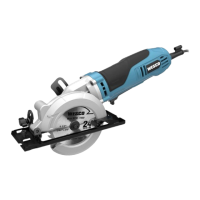

 To Next Page
 General