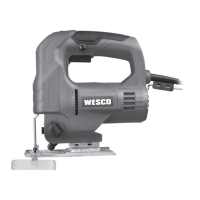
The WESCO WS3772 / WS3772U is an 850W electric jig saw designed for various cutting applications in wood, plastic, metal, and building materials. It is a versatile power tool suitable for both straight and curved cuts, with the ability to achieve bevel angles up to 45°.
Function Description:
The jig saw operates by moving a saw blade (11) rapidly up and down to cut through materials. It features a lock-on button (1) for continuous operation, an on/off switch (2) for power control, and a variable speed control (14) to adjust the cutting speed according to the material and desired cut. The pendulum action control (9) allows for varying the blade's cutting angle for improved efficiency, especially in softer materials.
For precise cuts, the tool includes a parallel guide (12) that can be adjusted to achieve specific cutting distances. The base plate (7) can be tilted to create bevel cuts, with angle adjustments up to 45°. A roller guide (10) ensures the saw blade remains in the correct groove during operation, contributing to smoother cuts.
The jig saw is equipped with a tool-free blade holder (15) for quick and easy blade changes. Safety features include a finger protection wire (16) to prevent accidental contact with the moving blade and a shaving shield (17) to protect the user from flying debris. For improved visibility of the cutting line, an on/off switch for the work light (13) activates an LED light (18). Additionally, a dust blower switch (6) directs air to clear sawdust from the cutting area, and a vacuum adapter (5) allows for connection to a dust extraction system for a cleaner work environment.
Important Technical Specifications:
- Model: WS3772 / WS3772U
- Power Input: 850W
- Voltage:
- WS3772: 220V~60Hz
- WS3772U: 127V~60Hz
- No-load Speed: 0-3000/min
- Stroke Length: 20mm
- Bevel Capacity: ±45°
- Cutting Capacity (max.):
- Wood: 100mm
- Steel: 12mm
- Plastic: 15mm
- Protection Class: / II (Double Insulation)
- Machine Weight: 2.24kg
Accessories (included):
- Parallel guide: 1
- Hex key: 1
- Vacuum adapter: 1
- Metal cutting blade: 1
- Wood cutting blade: 2
Usage Features:
- ON/OFF Switch (1): Depress to start, release to stop.
- Switch Lock-On Button (2): For continuous operation, depress the on/off switch, then the lock-on button. Release the on/off switch first, then the lock-on button.
- Variable Speed Control (14): Adjust the rotary selector to increase or decrease speed based on material, thickness, and blade type. Avoid prolonged use at very low speeds to prevent motor damage.
- Hand Grip Areas (3): Always maintain a firm grip on these areas during operation.
- Blade Installation (Fig. D, E, F): Ensure the power cord is disconnected. Use gloves and eye protection. Rotate the ring of the tool-free blade holder (15) to the "open" position, insert the blade fully with teeth facing forward, and release the holder. Verify the blade is secured and seated in the roller guide (10).
- Blade Removal: Hold the blade, rotate the blade holder ring anti-clockwise, and pull the blade out. Be cautious as the blade may be ejected by a spring.
- Parallel Guide Assembly (Fig. G1, G2): Slide the parallel guide arm through the guide fixations and tighten the locking knob (a) to the desired cutting distance. The guide can be mounted in two positions.
- Roller Guide (10): Ensure the blade runs smoothly in the roller guide. If not, the pendulum function may not work correctly, and the blade will not be supported.
- Pendulum Action Control (9) (Fig. H): Adjust the lever to vary the forward cutting angle of the blade for improved cutting efficiency. This can be adjusted during no-load operation. Avoid excessive force when using pendulum action. The blade cuts only on the upward stroke.
- Position 0: Fine materials, tight curves.
- Position I: Hard materials (e.g., steel & chipboard).
- Position II: Thick materials (e.g., wood & plastic).
- Position III: Fast cuts (e.g., softwood), cutting in the direction of the wood grain.
- Base Plate (7): Always rest the base plate firmly on the workpiece to reduce vibration, blade jumping, or breakage.
- Base Plate Angle Adjustment (Fig. I1, I2): Remove the shaving shield (17). Loosen the two fixing screws on the bottom of the saw with the hex key (4). Pull the base plate backward to disengage it from the locking system. Adjust to the desired angle (0°, 15°, 30°, or 45°) using the engraved scale. Push the base plate forward until it locks, then tighten the screws. Store the hex key in its holder on the back of the saw.
- Finger Protection Wire (16): Located in front of the blade holder to prevent accidental contact with the moving blade.
- Dust Blower (6): Move the dust blower switch to the back (towards the vacuum adapter) to activate, clearing sawdust from the cutting area. Move it to the front (towards the pendulum action control) to switch off. If using a vacuum cleaner, disconnect it when using the dust blower.
- Work Light (13) (Fig. J): The LED light's brightness is linked to motor speed. Avoid looking directly into the strong light.
- Working Hints:
- Overheating: If the jig saw becomes too hot, especially at low speeds, set the speed to maximum and run for 2-3 minutes without load to cool the motor.
- General Cutting: Always use a blade suited to the material and thickness. Secure the workpiece firmly. Start cutting at low speed, then increase. The blade cuts on the upward stroke, which may chip the uppermost surface; ensure this surface is non-visible in the final product.
- Cutting Laminates: Use a fine-tooth blade. To reduce chipping, clamp waste wood on both sides of the workpiece and cut through it.
- Circle Cutting: Do not use pendulum action when cutting tight circles or angles.
- Plunge Sawing (Fig. K, L): Only for soft materials (wood, aerated concrete, gypsum plasterboards). Use short saw blades. Place the front edge of the base plate on the workpiece, switch on, press firmly, and slowly plunge the blade. Once the base plate is fully on the workpiece, continue sawing along the line.
- Metal Cutting: Use a finer tooth blade for ferrous metals and a coarse tooth blade for non-ferrous metals. For thin sheet metals, clamp wood on both sides to reduce vibration and tearing. Do not force the blade; excessive force can reduce blade life or damage the motor. Add lubricant along the cutting line to reduce heat.
Maintenance Features:
- General Maintenance: Disconnect the plug from the socket before any adjustment, servicing, or maintenance.
- Lubrication: The power tool requires no additional lubrication. There are no user-serviceable parts.
- Cleaning: Never use water or chemical cleaners. Wipe clean with a dry cloth. Store the tool in a dry place. Keep motor ventilation slots clean and free of dust. Sparks from ventilation slots are normal and do not damage the tool.
- Cord Damage: If the supply cord is damaged, it must be replaced by the manufacturer, its service agent, or similarly qualified persons to avoid hazards.
- Service: Have your power tool serviced by a qualified repair person using only identical replacement parts to ensure safety. Seek authorized service centers.

 Need help?
 General

 To Next Page