The WHALETEQ AECG100 is a multifunction testing unit designed for ECG (Electrocardiogram), PPG (Photoplethysmography), PWTT (Pulse Wave Transit Time), and SpO2 (Peripheral Oxyhemoglobin Saturation) parameter adjustment control. It is particularly useful for improving wearable devices that measure blood pressure and calculate the degree of arteriosclerosis, significantly increasing measurement accuracy.
Function Description:
The AECG100 features a main ECG module that functions as a single-lead ECG tester, capable of producing signals compliant with IEC standards for medical equipment. Users can pair this module with either a single-channel or dual-channel PPG module. The single-channel PPG module incorporates a green LED to simulate PPG heart rate signals, while the dual-channel PPG module uses red and infrared LEDs to simulate various SpO2 blood oxygen levels.
When both the ECG and PPG modules operate concurrently, the system allows for the determination of Pulse Wave Transit Time (PWTT). This is achieved by adjusting the time difference (PTTp or PTTf) between the peak of the ECG signal and the peak or valley of the PPG wave.
The device supports various test modes:
- ECG Test Mode: Conducts single-lead ECG testing, supporting all ECG-related standards for sensitivity, frequency response, input impedance, and more, compliant with international standards of YY-0885 and IEC 60601-2-47.
- PPG Mode: Allows users to select different testing waveforms and adjust parameters to simulate human skin reflection signals and noise. It can record or program signal sets for playback, aiding in algorithm development.
- PWTT Mode: Sends ECG and PPG signals simultaneously to measure the time difference between the two signals, which is crucial for blood pressure measurement algorithms and arteriosclerosis assessment.
- Auto Test SpO2 Mode: Applicable with the PPG-2TF-660 module, this mode detects the DUT's parameters like Trigger Level and DC values of R/IR, and records them. It can also detect dynamic light intensity, allowing the PPG-2TF-660 to send corresponding signals with matching intensity.
- SpO2 Mode: Enables individual adjustment of AC/DC ratios of R and IR LEDs to simulate different light absorption degrees, allowing the DUT to determine SpO2 values based on AECG100's optical signals.
- Auto Sequence Mode: Users can program a playlist of different waveforms with specified playtimes and sequences. This playlist can be saved for repeated playback.
Important Technical Specifications:
ECG Test Mode:
- Main Output Voltage: Resolution of 2.5µV (DAC resolution), accuracy of ±1% for amplitudes of 0.5mVpp or higher.
- Frequency/Pulse repetition rate: Accuracy of ±1%.
- Pulse duration/Timing: Accuracy of ±1ms.
- Pacing pulse amplitude: Range of -1000mV to +1000mV, accuracy of ±1% for ±2mV pulse, and ±10% for >2mV or <-2mV pulse.
- Pacing pulse width: Range of 0.1ms to 2ms, resolution of 0.1ms, accuracy of ±5µs.
- Pacing pulse characteristics: Rise/fall time of 5µs, overshoot <1%, settling time <1%.
- Sample rate: 50 ~ 40K (Normal/Standalone), 10K (Raw data mode), accuracy depends on system clock.
- DC offset: Range of -300mV to +300mV (fixed, noise-free, sourced from internal super capacitor) with ±1% accuracy. Additional range of -500mV to +500mV.
- RCA output amplitude: ECG electrode output x1000, max 10V, accuracy ±1% for amplitudes of 0.5Vpp or higher.
PPG Test Mode (PPG-1R-525 module):
- BPM: Range of 10~300 BPM, resolution 1 BPM, accuracy ±1 BPM.
- LED AC Level reference output (RCA): Range of 0.075~3 V (Full range), resolution (1/3000) full range, accuracy ±1%.
- Lumen: Range of 50 ~ 925 Lux (5mm from diffusion film), resolution (1/3000) full range, accuracy ±6%.
- Light wavelength: Range of 525nm, accuracy ±10nm.
- S/N Ratio: >51dB (with USB isolator).
- PD response time: Rising 1µs Typical, Falling 1µs Typical (varies with light intensity).
Reflective PPG Module + SpO2 Test Mode (PPG-2R-880/PPG-2R-940):
- BPM: Range of 10~300 BPM, resolution 1 BPM, accuracy ±1 BPM.
- LED AC Level reference output (RCA): Range of 0.075~3V (Full range), resolution (1/3000) full range, accuracy ±1%.
- PI (AC level/DC level): Range of 0.025%~30% (AC/DC, varies with AC or DC level), accuracy NA.
- Light wavelength: Red: 660nm, Infrared: 940nm/880nm. Accuracy Red:±10nm, Infrared: ±10nm.
- RED light Absolute Irradiance (100%): Intensity 3.55 mW/m^2*nm, accuracy ±15%.
- Infrared light Absolute Irradiance (100%): Intensity 6.65 mW/m^2*nm, accuracy ±15%.
- S/N Ratio: >51 DB (with USB isolator).
- PD response time: Rising 1µs Typical, Falling 1µs Typical (varies with light intensity).
Transmission PPG Module + SpO2 Test Mode (PPG-2TF-660):
- BPM: Range of 10~300 BPM, resolution 1 BPM, accuracy ±1 BPM.
- LED DC Level: Range of 100~3000 mV, resolution 1.1 mV, accuracy ±3%.
- LED AC Level: Range of 0.75~30 mV, resolution 11 µV, accuracy ±5%.
- PI (AC level/DC level): Range of 0.5% ~ 15%, accuracy X.
- LED scan rate: 1K (Normal mode), 10K (Raw data mode), accuracy ±5µs.
- PD sample rate: 250K (single channel), accuracy ±5µs.
- PD response time: Rising 1µs Typical, Falling 1µs Typical.
- SpO2(%): Range of 1~100%, resolution 1%. Accuracy: 91% to 100%: ±1% + specified accuracy of the DUT; 81% to 90%: ±2% + specified accuracy of the DUT; 71% to 80%: ±3% + specified accuracy of the DUT; Below 70%: with unspecified accuracy.
- MCX LED voltage: Amplitude AC Level x 100, accuracy ±5%.
PWTT Test Mode:
- Time Difference (PTTp, PTTf): Range of 0 ~ 999ms (decreasing with increased BPM), resolution 1ms, accuracy ±1ms.
General Specifications:
- Operating Temp.: 10℃ ~ 40℃.
- Storage Temp.: 0℃ ~ 50℃.
- Humidity: 0 – 80% RH, non-condensing.
- Housing: Plastic.
- Weight: Main Console Unit: 241g. Reflective Module: 165g. Transmission Module: 122g.
- Dimensions (L x W x H): Main Console Unit: 150mm x 98mm x 33mm. Reflective Module: 70mm x 98mm x 60mm. Transmission Module: 132mm x 85mm x 14mm.
Usage Features:
- PC Software Control: The AECG100 Test System connects to a Windows PC (Windows 7 or later, with Microsoft .NET 4.0 or higher) via USB. Administrator access is required for software and driver installation.
- Standalone Operation: Up to 3 quick test modes can be stored in the AECG100 for rapid testing without PC software. A USB hub can be used for power.
- Electrode Connections: Dedicated ports for LA/L, RA/R, RL2/N2, and RL1/N1 electrodes to connect to the DUT's matching electrodes for ECG signal output.
- PPG Fixture Mounting Base: Provided for users to develop custom fixtures to fasten DUTs onto PPG modules.
- Monitor Ports: LED and PD monitor ports are available on PPG modules to connect to an oscilloscope for measuring output voltage of AC signals and monitoring optical signals from the DUT's LEDs.
- Waveform Player: Allows playback of raw data files (*.txt format) for ECG, PPG Green, PPG Red, and PPG Infrared channels. Users can adjust output settings and loop playback.
- Database Player: Includes 30 records of PPG waveforms and 10 records of PPG and ECG waveforms from clinical trials, including disease waveforms like AF, APC, VPC, and first-degree AV block.
- Respiration Simulation: Simulates impedance changes of human skin during breathing using the impedance pneumography method, with adjustable respiration rate, basic level, variations, ratio, and apnea selection (duration and cycle).
- Frequency Scan: Tests the frequency response of ECG DUTs using sine waves, with adjustable amplitude, start/stop frequency, and duration.
- Auto Heart Rate: Generates different test combinations of BPM, QRS Amplitude, QRS Duration, and Interval using the ECG waveform.
- SpO2 Table and R Curve: Users can create and utilize SpO2 tables and R curves for verification and calibration, either by filling in values or using a calibration curve function to generate equations.
- Inverted/Sync Pulse/Ambient Light: Options to invert PPG waveforms, synchronize AECG100 LED behavior with DUT LED, and simulate 14 types of indoor/outdoor ambient light signals.
- Software Development Kit (SDK): WhaleTeq provides an SDK for AECG100, supporting C/C++ header, C# interface, third-party tools, and script language integration for custom program binding and upgrades.
- Optional Software Add-on Packs: Includes AECG Assistant-E47 for IEC60601-2-47:2012 performance tests, AECG Assistant-YY0885 for YY0885-2013 performance tests, and WTDB-AECG for clinical database waveforms.
Maintenance Features:
- Troubleshooting: Provides steps for resolving issues such as accidental separation of the PPG module, persistent red LED on the power indicator (system crash), or no LED display (power supply issue).
- Self-calibration: Users can perform self-calibration to quickly confirm signal quality before testing. This involves setting specific parameters for square wave output and measuring DC mV with a multimeter.
- Professional Calibration Service: WhaleTeq offers original calibration services using specially designed physiological simulators to ensure accuracy. Annual calibration is recommended.
- Device Repair: If components are damaged and cannot be adjusted, the device should be sent back for maintenance.
- Firmware Updates: Users are advised not to disconnect the USB cable or close the software during firmware upgrades.

 Need help?
 General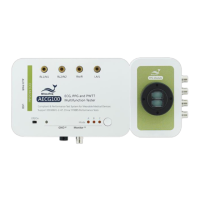

 To Next Page