
 Need help?
Do you have a question about the Whip Mix 8500 Series and is the answer not in the manual?
Instructions for attaching/removing the incisal guide pin and aligning frames.
Steps to engage and disengage the spring latch for upper and lower member separation.
Guidance on setting intercondylar distance using the engraved settings L, M, S.
Adjusting the angle of the fossa relative to the occlusal plane using a clamp knob.
Setting the path of the orbiting condyle on the medial wall of the fossa.
Steps to mount the maxillary cast using the facebow and articulator.
Procedure for mounting the mandibular cast after the maxillary cast is in place.
Facebow for convenient, quick, and accurate securing of axis location.
Adjustable support for bitefork and maxillary cast during facebow mounting.
Incisal pin with chisel and spherical ends for vertical adjustments.
Jig to replace mandibular cast for remounting finished dentures.
Support for mounting lower cast without glue, paper clips or accelerants.
Guide table adjustable for anterior/posterior position and incline.
Apply lubricant or silicone spray to moving surfaces for smooth operation.
Remove stone and keep articulator clean to prevent surface corrosion.
Apply silicone spray to prevent plaster or stone from sticking to surfaces.
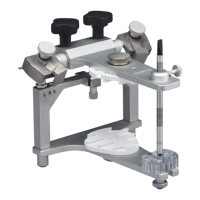
The Whip Mix 8500 Series Articulator System is a mechanical device designed to accurately reproduce the natural relationship and movements of a patient's dentition. This semi-adjustable articulator is an arcon-type instrument, meaning the condyle is located on the lower member and the guidance on the upper member, making it ideal for the study of occlusion and temporomandibular joint movements. The system aims to simplify and speed up the process of obtaining and transferring necessary registrations, enabling more precise corrective and restorative dentistry without the need for expensive or time-consuming techniques.
The primary function of the 8500 Series Articulator is to facilitate the mounting of dental casts in a way that mimics the patient's actual jaw movements. This allows dental professionals to analyze occlusal relationships, plan treatments, and fabricate restorations outside of the patient's mouth with a high degree of accuracy. The articulator's design allows for adjustments that simulate various aspects of mandibular movement, including protrusive and lateral excursions, as well as intercondylar distance.
The 8500 Series Articulator offers several key features that enhance its usability and precision:
Protrusive Condylar Inclination: This feature allows for the adjustment of the angle of the fossa in relation to the occlusal plane. The protrusive condylar path inclination can be adjusted from 0 to 70 degrees, calibrated in 5-degree increments. This adjustment is made by loosening a large black clamp knob on the side of the upper member.
Progressive Side Shift: This adjustment controls the path the orbiting condyle follows on the medial wall of the fossa as it orbits around the rotating condyle. The progressive side shift can be set from 0 to 40 degrees, calibrated in 5-degree increments. To set this, the side shift guide locking knob is loosened, and the guide is moved until it touches the side of the condyle element.
Adjustable Intercondylar Distance: The articulator provides three adjustable intercondylar distance settings: Small (S - 96mm), Medium (M - 110mm), and Large (L - 124mm). The lower frame of the articulator has the letters L, M, and S engraved on its top corners to indicate these settings. Each of the two condylar elements should slide to the corresponding setting based on the patient's intercondylar width, as recorded on the facebow. Spacers are used on the shafts of the condylar guides to achieve the correct width for the upper frame. Two spacers are used for Large, one for Medium, and no spacers for Small. When using spacers, they should be placed with the beveled sections closest to the condylar guides, and the horizontal line on each spacer must align with that on the back of the condylar guide. A rubber band can be placed around the condyle elements to hold them tightly together during initial setup, and then the screws in the back of the slot are tightened to secure the condylar element.
Spring Latch Assembly: This mechanism holds the articulator in a centric position when locked, ensuring stability during mounting procedures. When released, it allows for easy separation of the upper and lower members. To engage the latch, pull down on the spring and slide it into the latch bracket. To remove the upper member, slide the spring latch out of the bracket.
Non-Skid Rubber Feet: These feet are integrated into the design to stabilize the articulator when it is open, preventing unwanted movement during use.
Articulator Manipulations: The incisal guide pin can be attached or removed by loosening or tightening its screw. For parallel alignment of the upper and lower frames, the top of the pin boss should be aligned with the dark line that encircles the pin.
Mounting Casts: The system supports direct mounting of the maxillary cast using a facebow record. The incisal guide pin should be raised or removed to allow the upper member to rest on the horizontal crossbar of the facebow. Condylar guides are typically set to 30 degrees for facebow attachment. The maxillary cast is then positioned into the bite registration, optionally supported by a facebow fork support. For mounting the mandibular cast, the spring latch is engaged, and both progressive side shift guides are set to "0." The articulator is inverted to ensure condylar elements seat in their most retruded position, and the mandibular cast is positioned on the CR or MI bite registration.
The 8500 Series Articulator System can be enhanced with several accessories:
Whip Mix® Direct Mounting Facebow Model 8645: This facebow offers a convenient, quick, and accurate method for securing an axis location without the need for complex equipment.
Maxillary Fork Support: An adjustable "T" shaped support that stabilizes the bitefork and maxillary cast during facebow record mounting on the articulator. Versions are available for both magnetic and screw-type mounting.
Dual-End Incisal Pin: Features a chisel end for use with an adjustable incisal guide table and a spherical end for use with a flat anterior guide table. Both ends are calibrated for vertical adjustments.
8575 Remounting Jig: Temporarily replaces the mandibular cast, eliminating the need for a second facebow recording and transfer when remounting finished dentures. It is a screw-type accessory.
FlexiMount™ Universal Mounting Support: Provides dynamic stability when mounting the lower cast without the need for glue, paper clips, or accelerants.
Adjustable Guide Table: Can be moved anteriorly or posteriorly to minimize adjustments for the "x" dimension. Its incline is adjustable and lockable from 0 to 40 degrees protrusive, and adjustable lateral wings establish incisal freedom from 0 to 45 degrees.
The Whip Mix articulator is constructed for durability and long service life with proper care. Both the upper and lower members are made of cast aluminum, which is anodized to prevent corrosion and staining. The condyle elements and condylar guidance assemblies are made of stainless steel.
Lubrication: Applying a thin film of lubricant or silicone spray to the surfaces where the condylar elements move will ensure smooth action of these parts.
Cleaning: It is crucial to remove any excess stone or plaster and keep the articulator clean. Failure to do so may lead to corrosion of the articulator surfaces. Applying silicone spray to the articulator frame can prevent plaster or stone from sticking.
Warranty: The articulator system comes with a one-year warranty covering defects in material and/or workmanship. Failure to follow the provided care and maintenance instructions will void this warranty. Whip Mix Corporation reserves the right to improve, modify, or discontinue products, or change specifications and prices without notice.
 General
| Model | 8500 Series |
|---|---|
| Manufacturer | Whip Mix |
| Voltage | 110-120V |
| Material Compatibility | Investment Materials |
| Power Requirements | 120V/60Hz or 240V/60Hz |

 To Next Page