
 Need help?
Do you have a question about the Whirlpool ACP102PS0 and is the answer not in the manual?
Component responsible for heat dissipation in the air conditioner.
Device that controls the flow of refrigerant.
The primary component that circulates refrigerant.
Includes fan motor, base, fan blade, and spring for airflow.
Component responsible for absorbing heat and cooling air.
Includes the main PC board, LCD cover, and overlay.
Components related to powering motors, including compressor capacitor.
Temperature sensing component.
Includes the main power cord and securing clips.
Includes remote control unit and the front panel assembly.
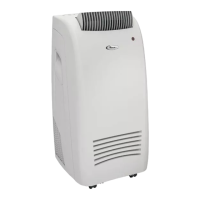
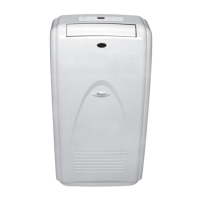
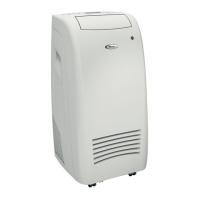
This document outlines the parts and components of a Whirlpool Portable Air Conditioner, specifically model ACP102PS0, providing a comprehensive guide for understanding its construction, operation, and maintenance. The air conditioner is designed to offer a portable solution for cooling indoor spaces, featuring a self-contained system that includes refrigeration, airflow, and control mechanisms.
The primary function of this portable air conditioner is to cool the ambient air in a room. It achieves this through a refrigeration cycle that involves a compressor, condenser, evaporator, and a tube restrictor. Air is drawn into the unit, passed over the cold evaporator coil, where heat and humidity are removed, and then discharged back into the room as cooler, drier air. The heat absorbed from the room air is transferred to the refrigerant, which then releases this heat to the outside environment via the condenser.
The unit incorporates various components to manage airflow effectively. Fan motors drive blowers to circulate air through the system, ensuring efficient heat exchange. Louver assemblies direct the cooled air into the room, allowing users to control the airflow direction for optimal comfort. The air conditioner also includes a drain pan system to collect condensed moisture, which is a byproduct of the dehumidification process. This moisture is typically either evaporated and expelled with the exhaust air or collected in a reservoir that requires periodic draining.
Control mechanisms are integral to the air conditioner's operation, allowing users to adjust settings such as temperature, fan speed, and operating modes. These controls are managed by PC-boards, which process user inputs and regulate the various components to maintain desired conditions. Thermistors are used to sense the ambient temperature, providing feedback to the control system to ensure accurate temperature regulation.
The portable nature of this air conditioner is a key usage feature, allowing it to be easily moved between rooms or locations as needed. This flexibility makes it suitable for cooling specific areas without the need for permanent installation. The unit is designed for user-friendly operation, with a control panel that typically includes an LCD display for clear visibility of settings and an overlay for intuitive button functions. A remote control is also provided, enhancing convenience by allowing users to adjust settings from a distance.
The airflow system is designed to provide effective cooling distribution. Louver assemblies can be adjusted to direct the cool air, ensuring that the desired area receives adequate cooling. The unit likely offers multiple fan speeds, allowing users to choose between quiet operation and maximum cooling power.
For exhaust, the air conditioner typically uses an exhaust tube that connects to a window slider kit. This setup allows the hot air expelled from the condenser to be vented outside, preventing it from re-entering the cooled space. The window slider kit is designed for easy installation and removal, accommodating various window types.
The unit's design includes rollers on the base, further facilitating its portability. These rollers allow the air conditioner to be effortlessly moved across different floor surfaces, making it simple to position the unit wherever cooling is most needed.
Regular maintenance is crucial for the efficient and long-term operation of the portable air conditioner. The design incorporates several features to simplify maintenance tasks. Filters are included in the airflow path to capture dust and other airborne particles, preventing them from accumulating on the internal components and ensuring cleaner air output. These filters are typically removable and washable, making routine cleaning straightforward. The literature parts, such as the "Guide, Use & Care," provide detailed instructions on how to access and clean these filters.
The drain pan system, which collects condensed water, is designed for easy access to facilitate draining. Depending on the model, the unit may have a continuous drain option, allowing water to be continuously discharged through a drain hose, or a reservoir that needs to be manually emptied periodically. The "Plug, Drain Hose" and "Clamp, Drain Hose" components indicate that the unit supports external drainage, which can reduce the frequency of manual emptying.
The internal components, such as the compressor, condenser, and evaporator, are housed within a cabinet structure that is designed for both protection and accessibility. While most internal repairs would require professional service, the modular design of some components, such as the PC-boards and fan motors, can simplify troubleshooting and replacement if necessary. The "Wiring Diagram" provided in the literature parts is an essential resource for technicians performing diagnostics and repairs.
The unit's construction, with various supports and brackets, ensures the stability and proper alignment of its internal components. Grommets are used to protect wiring and tubing from wear and vibration, contributing to the overall durability of the appliance. The refrigerant charge, specified at 21.6 oz., is a critical aspect of the refrigeration system and should only be handled by qualified personnel during servicing.
Overall, the Whirlpool Portable Air Conditioner ACP102PS0 is designed to be a convenient and effective cooling solution, with features that prioritize ease of use, portability, and straightforward maintenance for the end-user.
 General
| Type | Portable |
|---|---|
| Cooling Capacity | 10000 BTU |
| Energy Efficiency Ratio (EER) | 9.5 |
| Noise Level | 52 dB |
| Power Supply | 115V / 60Hz |
| Refrigerant | R410A |
| Room Size | Up to 400 sq ft |


 To Next Page